Heat & Fire
Cracking Coconut Cream (Taek Man)
Simmering coconut cream until its oil separates to fry curry paste in fragrant fat.
Taek man heats thick coconut cream until the emulsion breaks and the coconut oil separates out, creating a glistening fat for frying curry paste. The paste sizzles and blooms in the rendered oil, deepening color and aroma before the rest of the coconut milk is added. This foundational Thai step gives curries their rich, fragrant base.
Taek man (แตกมัน), literally 'cracking the oil,' is the Thai technique of simmering coconut cream until its water evaporates and the pure coconut fat separates out on its own — leaving a pool of clear, fragrant oil around toasted milk solids. It is the opening move of nearly every coconut-based Thai curry, and it is what turns a watery emulsion of paste and coconut milk into a real gaeng. Until the cream breaks, curry paste is just suspended in milk water; once the fat splits, the paste fries in its own fat-soluble medium, and the aromatic compounds in chilies, lemongrass, galangal, and shallots finally have a medium they can dissolve into. The result is the nutty, rounded, almost caramelized flavor base that defines a properly made Thai curry.
The technique is conceptually close to an Indian bhuna or the early stages of a French roux — a deliberate, patient rendering of a stable fat-and-flavor foundation — except the fat here is coconut oil, liberated on the spot from the cream itself rather than added from a jar. David Thompson treats cracking the coconut cream as the non-negotiable first step of almost every gaeng in Thai Food, and Andy Ricker calls it the difference between a curry that tastes of coconut milk and one that tastes of curry. Done well, taek man is gentle and quiet: the foam subsides, the bubbling stills, and clear oil pools around pale-golden coconut solids that smell toasted rather than raw. Done badly — at high heat, in the wrong pan, with the wrong cream — it scorches and turns acrid before it ever cracks.
- Difficulty
- Medium
Types & varieties
Cook the cream alone over medium-low heat until the oil separates, then add curry paste directly into the rendered fat and fry until fragrant.
A portion of curry paste is added early with the cream so it fries as the oil emerges — common in some home and regional recipes, though it gives less control over the break.
Coconut milk is simmered first to reduce, then fresh coconut cream is added and cracked for a richer second-stage oil. Used in some gaeng som and southern Thai curries.
Southern Thai cooks, who use more coconut cream, often push the taek man further until the solids are deep amber for a nuttier, almost caramel note.
How to do it
- 1
Select and measure the cream
Use full-fat coconut cream, not coconut milk or 'lite' coconut. One standard 400–500 ml can is enough for most home curries serving four. If using fresh-pressed coconut cream, strain it first through muslin to remove large solids that scorch easily.
- 2
Heat gently in a heavy pan
Pour the cream into a cold wok or heavy saucepan. Set over medium-low heat and leave uncovered. Let it come up slowly so the water in the cream evaporates evenly rather than boiling violently.
- 3
Skim the first foam (optional)
As the cream warms it will foam up. Skim and discard this pale foam for a cleaner-tasting oil, or push it aside and let it reabsorb for stronger coconut flavor.
- 4
Watch for the break
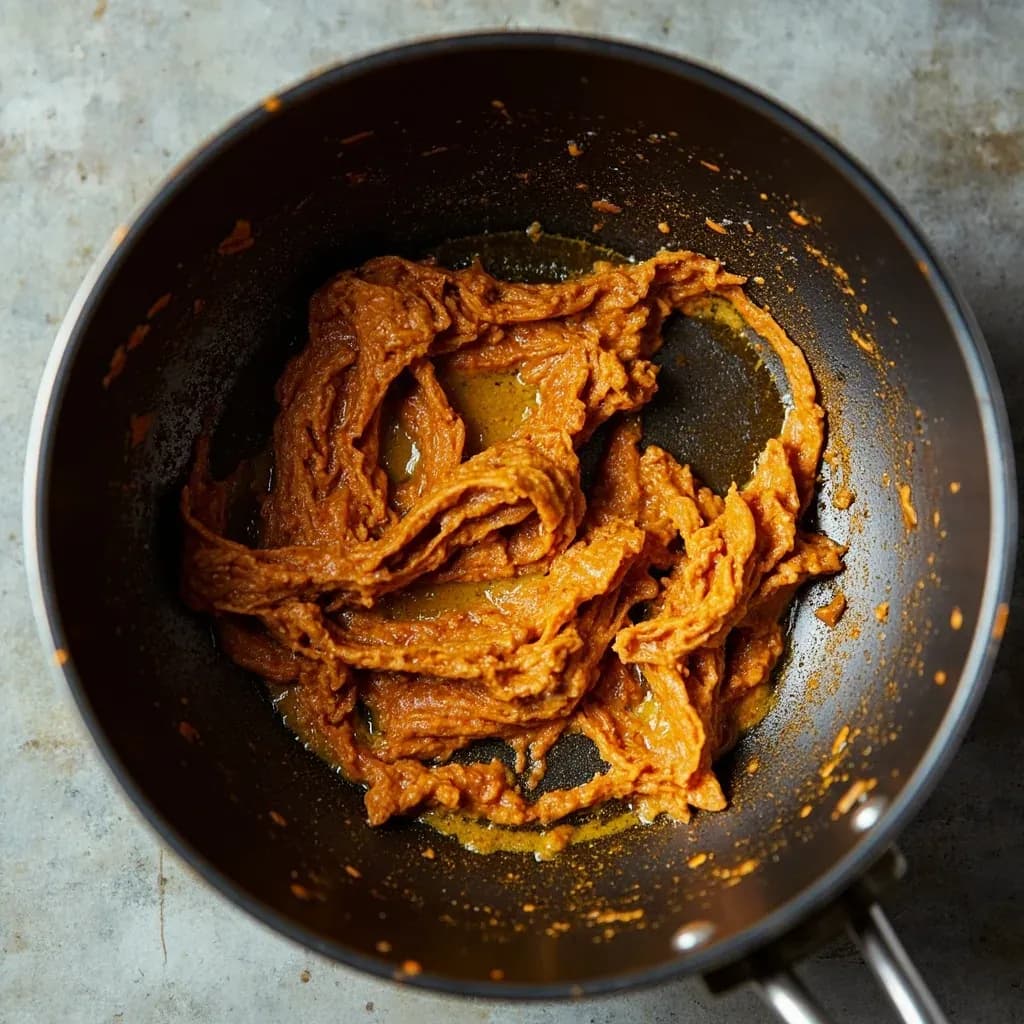
After several minutes the bubbling will quiet, the foam will collapse, and clear oil will begin to pool around the thickened cream solids. The aroma shifts from raw coconut to nutty and toasted. This is man taek — the fat has cracked.
- 5
Let the solids toast lightly
Continue cooking 30–60 seconds longer so the residual milk solids turn a pale golden-brown. Do not let them go dark brown or they will taste bitter.
- 6
Add curry paste to the rendered oil
Add all of the prepared curry paste at once. Fry, stirring constantly, in the clear coconut oil until the paste darkens, splits again into its own oil, and smells deeply fragrant — typically 2–3 minutes.
- 7
Continue with the curry
From here proceed with the rest of your recipe: thin with coconut milk, add meat or vegetables, season with fish sauce and palm sugar, and finish with herbs or chili.
Why the cream must break
Coconut cream is an emulsion of coconut oil, water, and suspended solids. Heat drives off the water and destabilizes that emulsion, allowing the oil to coalesce into a clear pool. The curry paste's fat-soluble flavor compounds — capsaicin, the citrals in lemongrass, the volatile oils in galangal and makrut lime — only become fully available to the palate once they are dissolved in fat. Frying paste in watery coconut milk steams it; frying it in rendered coconut oil toasts it. The break is the moment a curry actually begins to taste like itself.
- Coconut cream is roughly 60–70% water; the rest is fat and solids.
- Once the water evaporates, the oil separates and the solids settle and toast.
- Curry paste fried in this oil develops a deeper, rounder flavor than paste added to milk.
Equipment and cream choices
A carbon-steel wok or cast-iron saucier holds heat most evenly and develops the slight fond that encourages a clean break; nonstick pans are too gentle and the cream often refuses to split cleanly. As for cream, full-fat canned or fresh-pressed is essential — common Thai brands like Aroy-D and Chaokoh work well, and fresh-pressed coconut cream is the traditional choice. 'Lite' coconut milk will not crack; it will simply scorch.
- Best pan: carbon-steel wok, cast-iron saucier, or heavy clad saucepan.
- Avoid: thin stainless steel (hot spots) and nonstick (insufficient fond).
- Best cream: Aroy-D, Chaokoh, Thai Kitchen, or fresh-pressed at minimum 60% fat.
Common mistakes
Most failed taek man comes from rushing the heat or choosing the wrong cream. A hard boil drives off water so fast that the milk solids scorch before the oil has a chance to separate, leaving a thin, bitter, grayish film rather than a clear pool of golden oil. Over-stirring has the opposite failure mode: it keeps the emulsion intact and the cream stays a homogeneous white sludge. Adding curry paste too early — before the break — guarantees a greasy, raw-tasting curry because the paste steams in milk water instead of frying in fat.
- Heat too high: scorched solids, acrid oil, no clean break.
- Heat too low or too much stirring: emulsion holds, oil never separates.
- Wrong cream: 'lite' or coconut milk yields almost no oil and burns quickly.
- Adding paste too early: curry tastes of coconut milk, not of curry.
Common uses
Tips & pitfalls
- Use only full-fat coconut cream — 'lite' cream or coconut milk is mostly water and will scorch before yielding usable oil.
- Keep the heat at medium-low. High heat scorches the milk solids and turns the oil acrid before the cream has a chance to break.
- Stir gently and infrequently at first so the emulsion can break naturally; over-stirring keeps the cream stable and delays separation.
- Skim and discard the first foamy layer if you want a cleaner oil, or stir it back in for stronger coconut flavor.
- Wait for clear, still oil around toasted solids before adding curry paste — adding paste to a cream that has not fully cracked yields a greasy, raw-tasting curry.
- Add the curry paste all at once and fry in the rendered oil until the paste darkens, splits again into its own oil, and smells deeply fragrant — about 2–3 minutes.
- If the cream threatens to scorch before breaking, splash in 1–2 tablespoons of water to keep the solids moving; the break will still come.
- Don't walk away once the oil separates — temperature can spike and burn the residue in seconds.
Good to know
- Thai name
- แตกมัน (taek man) — 'taek' to split, 'man' fat or oil
- Origin
- Thailand; foundational to central and southern Thai curry cookery
- Cuisine
- Thai
- Category
- Fat-building flavor base technique (curry paste frying method)
- Primary use
- Extracting pure coconut oil from coconut cream to fry curry paste in its own rendered fat
- Typical heat
- Medium-low; a patient simmer, never a hard boil
- Time
- Roughly 8–15 minutes per 400–500 ml of cream, depending on water content
- Yield
- The separated oil is typically about 1/4 to 1/3 of the original cream volume
- Equipment
- Wok (kratha) or heavy-bottomed saucepan; flat-edged wooden spatula or chakkran
- Skill level
- Intermediate — requires patient heat control and visual judgment
- Key sensory cue
- Foam collapses, bubbling quiets, clear oil pools around toasted coconut solids, and a warm nutty aroma replaces the raw coconut smell
- Best cream type
- Full-fat canned or fresh-pressed coconut cream, minimum ~60% fat
- Related Thai technique
- Khua (คั่ว) — dry-frying paste without coconut, same principle of building flavor in fat
Also called
taek man · breaking coconut cream
Dishes that rely on it
Related

Sear
Blast the surface hot for a deep-browned, savory crust

Sauté
Cook quickly in a little fat over lively heat, tossing as you go

Stir-Fry
Toss bite-sized pieces over roaring heat for fast, smoky cooking

Pan-Fry
Crisp food in a shallow layer of hot fat, turning once or twice

Deep-Fry
Submerge in hot oil for an all-over crackling crust

Roast
Cook uncovered in dry oven heat for browned edges and tender centers

Bake
Cook with steady, surrounding oven heat — the soul of bread and pastry

Broil
Hit food from directly above with fierce overhead heat