Prep & Assembly
Cutting Fat into Flour
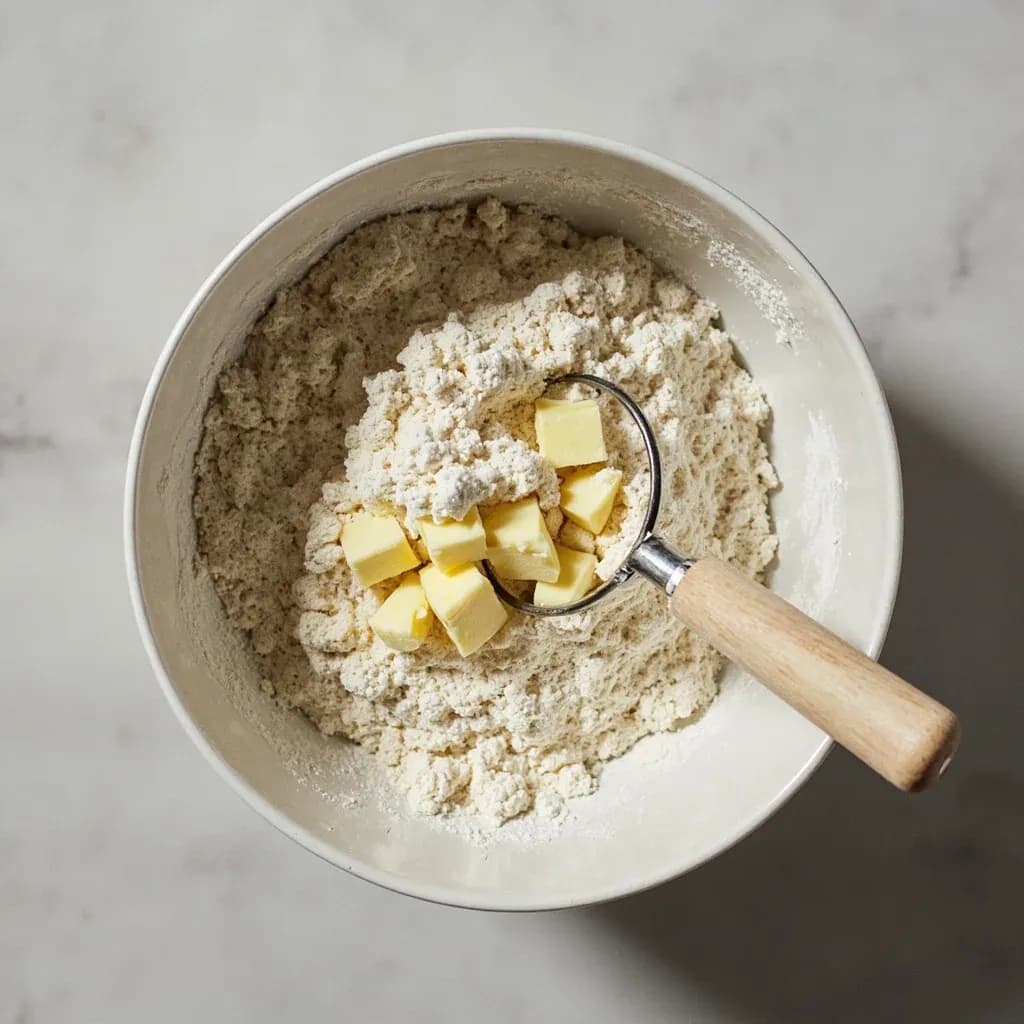
Working cold butter or shortening into flour into pea-size pieces for flaky pastry.
Cutting in fat distributes cold butter or shortening through flour as small, coated pieces using a pastry blender, fork, or fingertips rather than fully blending it. The pockets of fat melt in the oven and create steam, producing the flaky layers in pie crust, biscuits, and scones. Keeping everything cold is essential so the fat stays solid until it hits the heat.
Cutting fat into flour is the foundational move behind nearly every flaky or tender pastry — pie crust, biscuits, scones, rough puff, shortcakes, galettes, and crumb toppings all begin with this one step. The principle is simple: coat each particle of flour with solid fat so that, when liquid is added and the dough bakes, the fat melts and leaves behind pockets of steam and tender, interrupted gluten strands. The result is the contrast bakers chase between crisp, separated layers and a melt-in-the-mouth crumb.
The technique depends on keeping the fat cold and distinct from the flour. If the fat smears into the flour, you get a homogeneous, sandy dough — that's "rubbing in," and it's the right choice for shortbread or pâte sablée, where tenderness matters more than flakes. If the fat stays in visible pea- to lima-bean-sized pieces, the dough bakes into laminated, shatteringly flaky layers because steam from the melting fat puffs them apart. Knowing which endpoint you want is half of baking well; the rest is keeping your hands off the fat long enough to get there.
Butter is the default for flavor; lard and shortening contribute higher melting points and easier handling but little taste, which is why many traditional American pie crusts blend the two — usually half butter, half lard — for flakiness without losing flavor. The ratio matters too: a tender, short crust can run as low as one part fat to three parts flour by weight, while a flaky pie dough climbs closer to one part fat to two parts flour.
- Difficulty
- Easy
Types & varieties
U-shaped wire or curved blades; the traditional hand tool and the easiest for even results with minimal heat transfer.
Crossing two table knives in a scissoring motion; slow but produces very little gluten development and barely warms the fat.
Pulse in 1-second bursts with frozen butter; the fastest method but also the easiest to overwork or warm the fat past the flaky stage.
Useful for large batches; run on the lowest speed with a chilled bowl and stop the moment pea-sized pieces appear.
Box-grate rock-hard butter straight into the flour; keeps fat exceptionally cold and evenly distributed, ideal for food processors too.
Classic biscuit and scone technique; the most tactile control but warms the fat fastest — keep contact brief and use fingertips, never palms.
How to do it
- 1
Chill everything
Cube the cold fat into ½-inch (1–1.5 cm) pieces and return them to the fridge, or to the freezer for 10–15 minutes if your kitchen is warm. Chill the mixing bowl too if you're working in summer.
- 2
Combine the dry ingredients
Measure flour, salt, sugar (if using), and any leavener or spice into the bowl. Whisk briefly so the salt and leavener distribute evenly before the fat goes in.
- 3
Add the fat
Scatter the cold fat cubes over the flour so each piece is surrounded by flour rather than touching its neighbors — this prevents the pieces from smearing together into one greasy lump.
- 4
Cut in the fat
Press and twist a pastry blender through the mixture, working from the bottom up, until the fat breaks into smaller pieces; lift and repeat for 1–3 minutes. With two knives, cut in a scissoring crosswise motion. In a food processor, pulse in 1-second bursts, 6–10 times total.
- 5
Check the size
The finished mixture should look like coarse cornmeal with scattered pea- to lima-bean-size fat lumps, each coated in flour. Shortbread-style doughs should go finer, to sand-sized pieces with no lumps at all.
- 6
Rest (optional)
For very flaky pastry, chill the cut-in mixture for 10–15 minutes before adding liquid. This re-firms the fat and lets the flour absorb a little moisture for a more tender, less shaggy dough.
- 7
Add liquid
Drizzle in ice water, buttermilk, cream, or beaten egg and toss with a fork just until the dough starts to clump. Stop the moment it holds together when pressed — kneading or squeezing at this stage melts the fat you've worked so hard to keep cold.
Cutting in vs. rubbing in
These two terms are often used interchangeably, but they describe different endpoints and different pastries. Cutting in stops while the fat is still in visible lumps the size of small peas — that's what gives pie crust and biscuits their flaky lift. Rubbing in goes further, pinching the fat into the flour until the mixture looks like damp sand or fine meal with no lumps remaining; that's what you want for shortbread, pâte sablée, and pâte sucrée, where tenderness is the goal and visible flakes aren't.
The same tool can produce either result — it just comes down to how long you work and how warm your hands get. If your recipe calls for cutting in, stop the moment you see the first pea-sized lumps and resist the urge to "even things out." If it calls for rubbing in, keep going until everything is uniform, or the finished dough will bake with surprising pockets of grease instead of a tender, even crumb.
Choosing your fat
Each fat behaves differently in the bowl and in the oven, and the right choice depends on what you're after.
- Cold butter: the gold standard for flavor; melts around 90°F and browns during baking for rich, nutty notes. Cube and chill until firm before cutting in.
- Lard, especially leaf lard: rendered from pork kidney fat, with a firmer, more plastic texture and a higher melting point than butter. Gives the flakiest pie crusts imaginable and almost no competing flavor.
- Vegetable shortening: high melting point, neutral taste, very forgiving to handle. Produces tender crusts but lacks butter's flavor and browning.
- Coconut oil (solid, refined): a vegan option that, like butter, must be kept well-chilled; it softens faster than butter at room temperature, so work quickly or chill between steps.
- Butter-and-lard blend: the traditional American compromise — equal parts give butter's flavor with lard's flakiness and workability in a warm kitchen.
Common uses
Tips & pitfalls
- Chill the fat, bowl, and even the flour in hot weather; warmth is the single biggest enemy of flaky layers.
- Cube the fat into uniform ½-inch pieces so it cuts in at the same rate — uneven pieces lead to a mix of paste and chunks.
- Stop the moment the fat reaches pea-sized; further mixing smears it into the flour and you'll get a short, tender dough instead of a flaky one.
- Return the cut-in mixture to the fridge for 10 minutes before adding liquid — this buys insurance against a warm kitchen.
- For food-processor work, freeze the butter for 15 minutes and pulse in 1-second bursts; the blade heats the fat fast and you'll cross into 'overworked' in seconds.
- Flour-coated pieces should look like small peas in dusty coats, not yellow streaks — streaks mean the fat is melting and the flake potential is gone.
- Add ice water only after cutting in is finished; water both warms the fat and encourages gluten, undoing your careful work.
- If using your hands, use fingertips only — palms transfer heat quickly and will start melting the fat within seconds.
Good to know
- Technique family
- Pastry and dough mixing
- Primary goal
- Coat flour particles with solid fat while leaving distinct pea-sized pieces that create flaky layers in the oven
- Temperature window
- Fat should stay between 35–50°F (2–10°C) throughout the process
- Starting fat size
- ½-inch (1–1.5 cm) cubes, well-chilled
- End-point appearance
- Coarse meal scattered with pea- to lima-bean-size fat lumps, each coated in flour
- Typical fat-to-flour ratio
- 1:3 to 1:2 by weight (25–50% fat); finer for tender, coarser for flaky
- Time
- 3–5 minutes by hand; 10–20 seconds in a food processor
- Difficulty
- Beginner to intermediate; easy to overwork
Also called
Cutting In · Rubbing In · Sablage
Dishes that rely on it
Related

Whisk
Beat ingredients smooth and aerated with a looping wire motion

Sift
Pass dry ingredients through mesh to aerate and remove lumps

Strain
Pour through mesh to separate solids from liquid for a smooth result

Filter
Pass liquid through fine material to clarify out the smallest particles

Rice
Press cooked potatoes through small holes for fluffy, lump-free texture

Mash
Crush soft cooked food into a rustic, creamy purée

Grind
Crush food into a coarse to fine texture, from spices to meat

Grate
Shred food into fine bits against a sharp-toothed surface