Prep & Assembly
Deconstruction
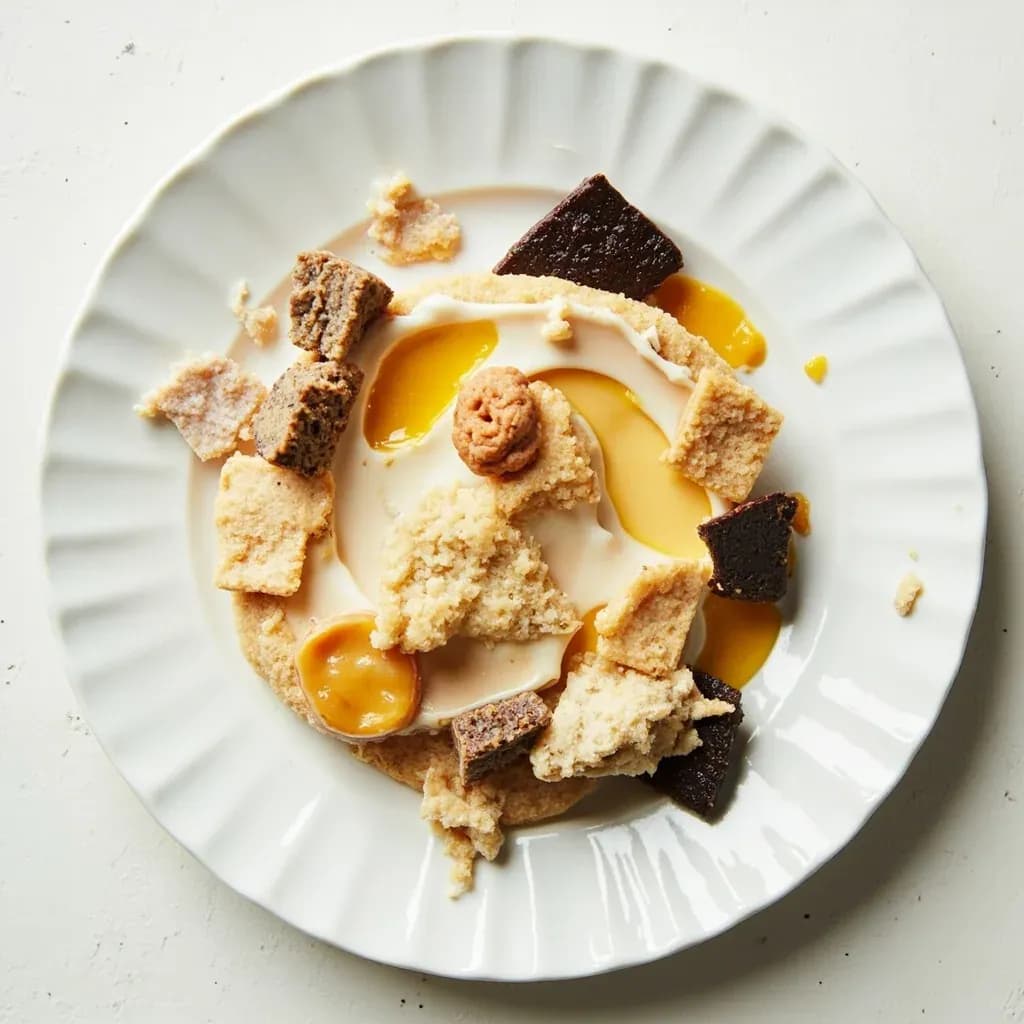
Plating a classic dish as its separated components to highlight each element.
Deconstruction is a modern plating approach that breaks a familiar dish into its individual components and arranges them separately so each flavor and texture reads on its own. Made famous by avant-garde restaurants, it reimagines something like a cheesecake or a salad as discrete elements the diner combines on the fork. The technique demands that every part stand up to scrutiny since nothing is hidden in a blend.
Deconstruction is the disciplined practice of taking a recognizable, established dish, separating its components, and reassembling them on the plate — or on the palate — so each element can be tasted, weighed, and reconsidered on its own terms. The original is not discarded; it becomes the reference point. A deconstructed Caesar, for example, might present romaine powder, anchovy gel, parmesan foam, and crouton crisp arranged around a quail egg yolk, but the diner should still taste the salad. The technique demands that the chef understand a dish well enough to take it apart and rebuild it with intent, which is precisely why it functions as a teaching tool as much as a plating style.
In practice, deconstruction behaves like a thought experiment made edible. The cook maps the architecture of the source dish — its flavors, textures, temperatures, and the order in which it hits the palate — then asks which of those roles can be expressed differently without losing the original's character. The result is rarely a prettier version of the same thing; it is a new construction that quotes the original closely enough to be legible. Because the diner often has to eat through separated elements rather than a unified bite, deconstruction also shifts how a course is sequenced: the server's introduction, the wine pairing, and the arrangement on the plate all become part of the composition.
Deconstruction is frequently conflated with molecular gastronomy, but the two are not the same. Molecular gastronomy is a toolkit — spherification, gelling, foaming, dehydration, distillation — that can be applied to any dish. Deconstruction is a philosophy of composition that can be executed with classical technique alone: a beef Bourguignon presented as sliced braised short rib, glazed pearl onions, a red wine reduction ring, and a potato pavé is deconstructed without a single piece of modernist equipment. Serious practitioners insist on flavor parity with the source; a deconstruction that no longer tastes like the original is not a deconstruction but a new dish with extra steps.
- Difficulty
- Hard
Types & varieties
Components of a classic dish are separated and repositioned on the plate without fundamentally changing the ingredients — the eye reads the original, the fork eats something new.
Each element is rendered in a different physical form (powder, foam, gel, crisp, granita) so the original's textures are replaced with a contrasting set.
Components are sequenced so the diner experiences the dish in a new order, often guided by the server; the bite is built on the palate rather than the plate.
The dish is reimagined around its history, geography, or the diner's memory of it; the original may be referenced obliquely rather than rebuilt.
Modernist techniques (spherification, emulsification, gelling, dehydration, distillation) are used to re-create the original's flavors in unfamiliar forms — the variant most often associated with the term.
How to do it
- 1
Choose a recognizable target dish
Pick a classic with a clear inventory of components the diner can name (Caesar, tiramisu, cheeseburger, beef Bourguignon, caprese, pavlova). Recognizability is what gives the exercise meaning.
- 2
Map the original's architecture
List every element — proteins, sauces, aromatics, garnishes, seasoning — and note each one's textural role, temperature, and the order in which the dish hits the palate.
- 3
Decide the angle of deconstruction
Choose one dominant approach (visual, textural, temporal, conceptual, or molecular) so the plate has a clear idea. Combining several approaches without a hierarchy produces noise.
- 4
Reimagine each component
For every element, assign a new form that preserves its flavor role: sauce → gel or powder, cream → foam, fresh herb → crisp, pickle → compressed cube, breadcrumb → soil. Match the form to the function.
- 5
Build and taste in stages
Prepare each component, season and taste it in isolation, then assemble a full test plate. Adjust acid, salt, and sweetness before final plating — separated elements rebalance differently than a composed dish.
- 6
Plate with intention
Use ring molds, tweezers, squeeze bottles, and deliberate negative space. Decide whether the diner is meant to combine the elements on the fork or eat them in sequence, and plate accordingly.
- 7
Validate against the source
Taste the deconstructed version alongside the original (or against a precise memory of it). The original's essential character should still be identifiable.
- 8
Lock the recipe and document
Record ratios, temperatures, plating photos, and the eating sequence so the dish is reproducible across services and team members.
Deconstruction vs. molecular gastronomy
The two terms became linked in food writing during the 2000s, and the link has caused confusion ever since. Molecular gastronomy refers to a body of techniques — most codified by Hervé This and Nicholas Kurti — that examine the physical and chemical processes of cooking and apply scientific methods (spherification, hydrocolloid gelling, vacuum compression, low-temperature immersion, dehydration) to manipulate texture, temperature, and form. Deconstruction is a compositional approach: it asks what happens when a recognizable dish is dismantled and rebuilt with intent. The two overlap heavily because avant-garde restaurants like elBulli, The Fat Duck, Alinea, and Mugaritz practiced both simultaneously, but they remain conceptually distinct. A plate of roasted carrots, carrot-top pesto, dehydrated carrot coins, and a carrot juice gel is a molecular deconstruction. A plate of sliced short rib, glazed onions, red wine reduction piped in a ring, and potato pavé is a classical deconstruction with no modernist equipment at all. Choosing the right tool for the right problem — rather than reaching for sodium alginate because it is on the pass — is what separates a thoughtful deconstruction from a technique-driven one.
Why deconstruction earns its criticism
No serious technique has been dismissed as 'gastroporn' more readily. The criticism is not unfair when applied to the worst examples: plates of foams and powders that taste of nothing recognizable, served on slate or glass with tweezers, where the chef has reached for equipment before deciding what the dish is supposed to say. The defense is equally straightforward — strong deconstructions taste unmistakably like their source, and they teach the diner something about the original that the original did not make obvious. Heston Blumenthal's meat fruit (a chicken liver mousse shaped and jellied to look like a mandarin, reconstructed from a historical recipe in which a whole chicken was molded into the form of fruit) reads as playful until you taste the savory, layered interior; the form is new, the flavor is not. The bar, then, is parity with the source plus a reason to dismantle it in the first place. If neither is met, the dish would be better served as the original.
Common uses
Tips & pitfalls
- Map the original first: list every flavor, texture, temperature, and structural role before changing anything — deconstruction without a clear blueprint reads as random.
- Protect the flavor DNA of the source dish; the strongest examples taste unmistakably like what they reference.
- Replace what was lost with intention: when you remove the binding sauce, reintroduce contrast (hot/cold, crisp/soft, acid/fat) so the bite still feels complete.
- Limit components — every dot, smear, or sphere on the plate should have a defined role, otherwise the dish collapses into garnish.
- Taste each element solo, then taste the assembled bite; the whole should match or exceed the original.
- Pick modernist techniques because they solve a problem (texture, temperature, intensity), not because the equipment is in the kitchen.
- Plate on neutral, simple dishware so the components read clearly; busy china fights with separated elements.
- Brief the diner — deconstructed dishes often need a sentence of context for the references to land.
Good to know
- Origin
- Late 20th century, associated with Spanish avant-garde cuisine, particularly elBulli (Roses, Catalonia) under Ferran Adrià in the 1990s–2000s
- Key practitioners
- Ferran Adrià, Albert Adrià, Pierre Gagnaire, Heston Blumenthal, Grant Achatz, Wylie Dufresne, Andoni Luis Aduriz
- Related movements
- Molecular gastronomy, modernist cuisine, postmodern gastronomy, technocuisine
- Setting
- Fine-dining restaurants, multi-course tasting menus, avant-garde and experimental kitchens
- Skill level
- Advanced — requires fluency in classical technique, modernist methods, and plating design
- Common equipment
- Tweezers, squeeze bottles, ring molds, immersion circulator, ISI whip, spherification kits, fine mesh strainers, precision scales, pipettes
- Time investment
- Highly variable; component prep commonly runs from several hours to multiple days
- Typical application
- Tasting menu courses where a single composed bite replaces a traditional plated dish
Also called
Deconstructed Plating
Related

Whisk
Beat ingredients smooth and aerated with a looping wire motion

Sift
Pass dry ingredients through mesh to aerate and remove lumps

Strain
Pour through mesh to separate solids from liquid for a smooth result

Filter
Pass liquid through fine material to clarify out the smallest particles

Rice
Press cooked potatoes through small holes for fluffy, lump-free texture

Mash
Crush soft cooked food into a rustic, creamy purée

Grind
Crush food into a coarse to fine texture, from spices to meat

Grate
Shred food into fine bits against a sharp-toothed surface