Transform & Preserve
Disgorging (Méthode Traditionnelle)
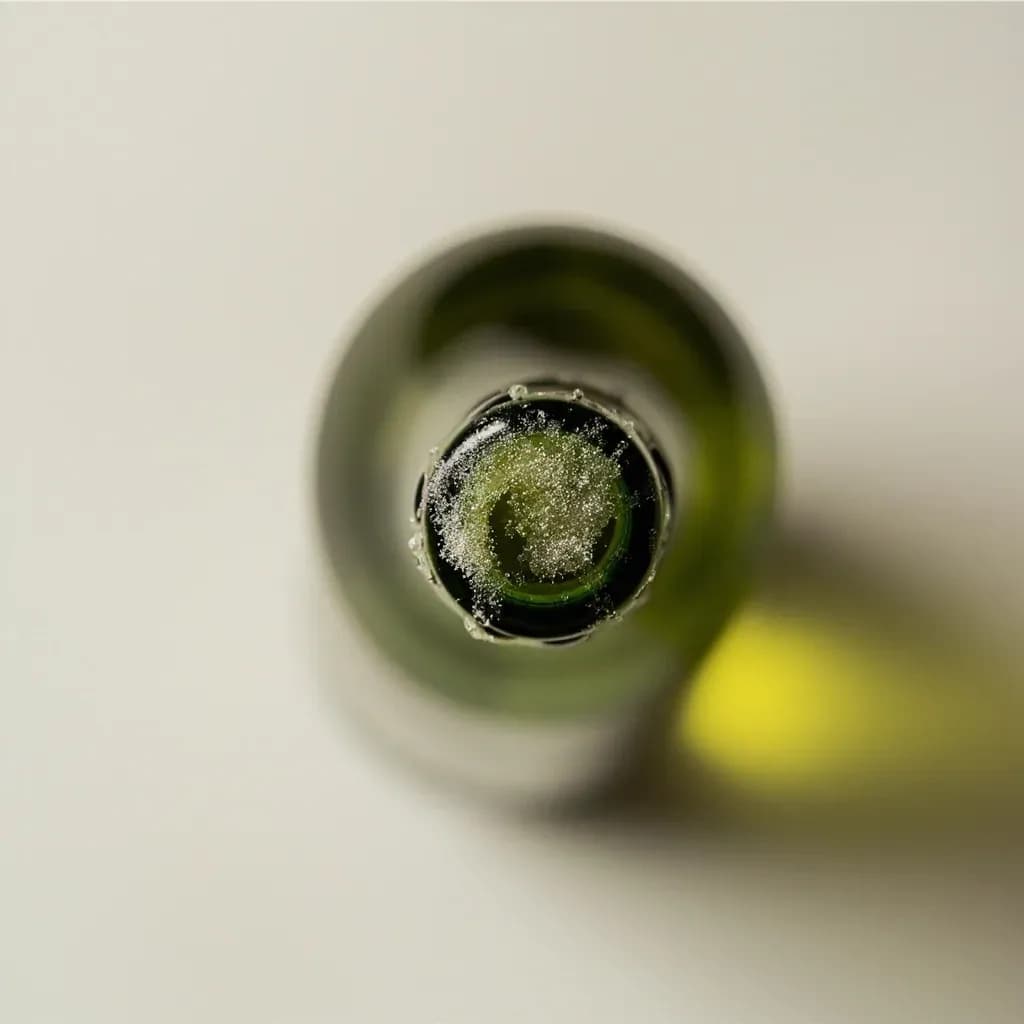
Ejecting the frozen yeast plug from a sparkling-wine bottle after secondary fermentation.
Disgorging is the sparkling-wine step where the bottle neck is frozen to trap the spent yeast sediment in an ice plug, then the cap is removed so internal pressure shoots the plug out. The bottle is topped up with dosage and corked, leaving a clear wine. In the méthode traditionnelle this finishes the long process of bottle fermentation and riddling. The same word also describes salting vegetables to draw out bitter juices.
Disgorging (French: dégorgement) is the surgical moment at the end of traditional-method sparkling-wine production, when the bottle is finally opened and the spent yeast that has been ageing on the inside of the glass is expelled as a single frozen plug. After months or years of secondary fermentation in bottle, the autolysed lees are a thick, beige slurry clinging to the inside of the crown cap. Riddling has gathered them there; disgorgement gets them out, and in doing so also creates the empty space that will be filled with the liqueur d'expédition that sets the wine's final sweetness.
The procedure works on a piece of simple physics. A fully fermented traditional-method sparkling wine sits at roughly 5–6 atmospheres of pressure, with the lees trapped against the cap. The neck is dipped into a sub-zero brine until a 3–4 cm column of wine around the sediment freezes solid; the crown cap is then twisted off and the bottle inverted, and the trapped gas fires the ice plug out cleanly with a sharp pop. From that instant, the wine is bright, the lees are gone, and the bottle can be dosed, corked, caged and labelled. In a prestige cuvée, disgorging is often done by hand a few days before shipment; on a high-volume line the same sequence happens at several thousand bottles an hour, fully automated, with liquid nitrogen doing the freezing in seconds rather than minutes.
- Difficulty
- Hard
Types & varieties
Hand operation: the worker holds the bottle, releases the cap, inverts and flicks out the plug. Standard for small cuvées and prestige bottles, and still the only practical method when bottle format, neck shape or production scale make automation uneconomic.
Riddled bottles pass through a refrigerated tunnel, are spun to remove the cap and eject the plug, dosed, and corked on a single integrated line. Common in large Champagne, Cava and Franciacorta operations.
Used on some high-speed lines: the neck is dipped into liquid nitrogen and the plug forms in seconds rather than minutes. Requires careful venting of nitrogen gas and tighter operator safety protocols.
Not a disgorgement technique per se, but the standard pre-disgorgement resting period: bottles are held neck-down on the pupitre or pallet for a few extra days after riddling is complete, so any stray lees migrate fully into the cap zone and the plug releases cleanly.
How to do it
- 1
Age on lees and finish riddling
After secondary fermentation, the bottle rests neck-down on its latte (pupitre for hand riddling, pallet for gyropalette riddling) while the yeast autolyses. Riddling has gradually inverted the bottle so that all sediment rests against the crown cap; a final 'sur pointe' rest of a few days lets any stray lees settle fully into the cap zone.
- 2
Cool the bottle
Bring the bottle to disgorging-room temperature, typically 12–15 °C. Some houses give the full bottle a brief chill before neck-freezing to keep foaming under control when the cap comes off.
- 3
Freeze the neck
Dip the neck and shoulder into a glycol or calcium-chloride brine bath at roughly −20 to −30 °C, or pass it through a refrigerated tunnel. A solid ice plug about 3–4 cm long forms around the sediment in 5–15 minutes (seconds with liquid nitrogen). The plug must be solid all the way through, with no slushy centre.
- 4
Remove the crown cap
Hold the bottle upright. Grip the cap with a disgorging key, twist or lever it off. From this moment, internal pressure of 5–6 bar is held back only by the ice plug.
- 5
Eject the ice plug
Tilt and quickly invert the bottle: the trapped gas fires the frozen plug of wine and lees out of the neck with a sharp pop. A small amount of frothy wine (the 'coup d'œil') follows — this is normal and is made up in the dosage step.
- 6
Add the liqueur d'expédition (dosage)
Top up with a measured dose of liqueur — typically the same base wine with added sugar and sometimes a little brandy — to fill the 1–2% of volume lost and to set the final sweetness. Zero dosage gives Brut Nature; 0–6 g/L Extra Brut; up to 12 g/L Brut; and so on up to Doux.
- 7
Cork, cage and agitate
Drive in the final mushroom-shaped cork with a corker, crimp on the wire muselet (cage), then gently roll and shake the bottle so the dosage mixes evenly through the wine.
- 8
Record the disgorgement date and label
Mark each bottle or case with the disgorgement date (the 'L' code on the back label) so cellar staff and consumers know how long the wine has been on its final cork.
Why the ice plug is so important
The neat trick of disgorgement is that the wine itself is the seal. Freezing only the neck — not the body of the bottle — means the bulk of the wine stays liquid, so when the cap comes off it is the gas pressure, not gravity, that does the work. The plug must be solid but not so cold that it cracks the glass on ejection, and it must contain every last bit of sediment. A bath that is too warm yields a slushy plug that exits in pieces and leaves lees behind; a bath that is too cold risks thermal shock. Most houses also keep the disgorging room itself cool, around 12–15 °C, so a warm bottle does not start foaming the moment the cap is released and waste wine as foam rather than clean liquid.
- Pressure inside the bottle does the ejecting; the worker only opens the way.
- The neck is the only part frozen — the body stays liquid and the pressure stays high.
- Bath temperature, immersion depth and time together control plug quality.
- Clean ejection is audible: a sharp, single 'pop' rather than a fizzing sigh.
Reading the disgorgement date
Because traditional-method sparkling wines evolve quickly after disgorgement — fresh, fruity, bready and vibrant in the first year, more toasty and integrated after longer ageing — the disgorgement date is genuinely useful information. The 'L' code on the back label gives year and month. For youthful styles such as non-vintage Brut or fresh fruit-forward Crémant, producers disgorge as close to release as possible; for oxidative, late-disgorged 'récemment dégorgé' cuvées, the wine is held on cork for years after.
- 'L24 05' = disgorged May 2024.
- Freshness window: typically 6–12 months for vibrant, fruity styles.
- Late-disgorged wines are designed to evolve further on cork.
Common uses
Tips & pitfalls
- Always disgorge cold bottles — a warm bottle loses fizz rapidly the moment the cap comes off and the dosage can foam out of the neck, wasting wine and upsetting the final fill level.
- Point the neck away from people; the ice plug exits at high speed. Eye protection is standard in any disgorging room, and experienced disgorgeurs stand side-on, not over the bottle.
- If the plug fails to eject cleanly, the bath was too warm or the immersion too brief. Return the bottle to the brine rather than prying at the ice — a partial ejection leaves lees in the wine and ruins clarity.
- Keep a separate disgorging key for each bottle format (half, standard, magnum, jeroboam). Neck geometry, crown-cap size and internal volume all differ, and the wrong key slips or crushes the cap.
- Track disgorgement date on every lot. Fresh, aromatic styles are at their best in the first 6–12 months post-disgorgement; late-disgorged styles are designed to age further on cork, so disgorge them only when there is a clear release window.
- Do not confuse dégorgement with dégorgeage. Dégorgeage is the rough racking of a still wine off heavy sediment, usually a few weeks after fermentation; dégorgement is the sparkling-wine operation described here. Same root, very different cellar job.
- Recover the ejected lees where you can. The big Champagne houses now distill them into fine eaux-de-vie; smaller producers sell them to flavour houses for natural yeast extract. A byproduct that used to go to drain is now a small revenue line.
Good to know
- French term
- Dégorgement (not dégorgeage — see tips for the distinction)
- In-bottle pressure
- ~5–6 bar (≈75–90 psi) at disgorgement
- Freezing-bath temperature
- −20 °C to −30 °C in glycol or calcium-chloride brine; liquid nitrogen on modern lines
- Ice-plug formation time
- 5–15 minutes in brine; seconds in liquid nitrogen
- Wine lost per bottle
- ~1–2% of volume (the ejected plug plus a small frothy loss, made up by the dosage)
- Dosage (liqueur d'expédition)
- Typically 0–35 mL per 750 mL bottle; sets the style from Brut Nature through Doux
- Minimum lees age (Champagne AOC)
- 15 months non-vintage; 36 months for vintage Champagne
- Date code on label
- 'L' followed by year and month (e.g. L24 05 = disgorged May 2024)
Also called
Dégorgement · Disgorgement
Dishes that rely on it
Related

Confit
Cook slowly submerged in fat for silky tenderness and keeping

Cure
Draw out moisture with salt and time to preserve and concentrate

Pickle
Steep in acidic brine for bright, tangy, crunchy preservation

Ferment
Let friendly microbes transform food into tangy, complex flavor

Marinate
Soak in a seasoned mix to flavor and tenderize before cooking

Brine
Soak in salt water so meat stays juicy and seasoned throughout

Dehydrate
Slowly dry out moisture to concentrate flavor and extend shelf life

Cold-Smoke
Perfume cured food with smoke without cooking it through