Prep & Assembly
Double-Tortilla Assembly
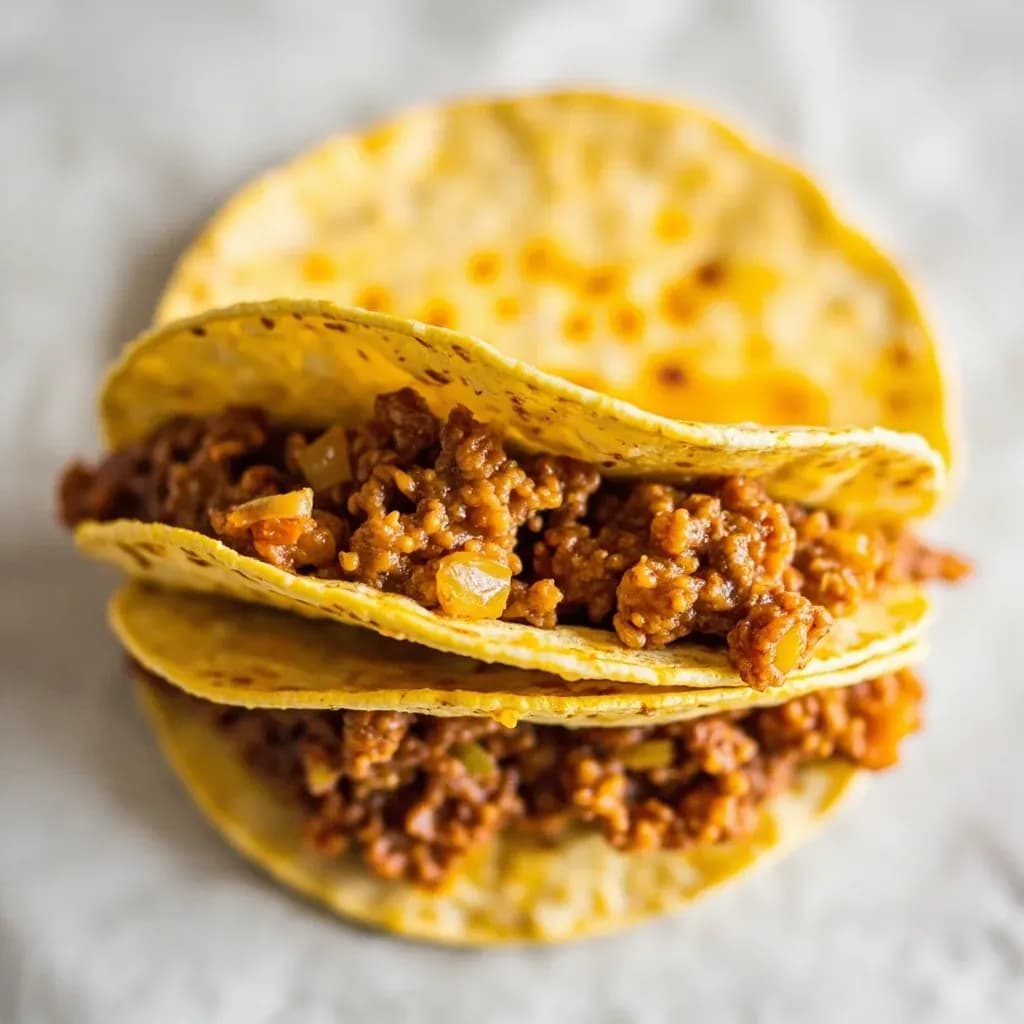
Stacking two tortillas per taco for strength and to keep fillings from breaking through.
Double-tortilla assembly serves a taco on two stacked tortillas instead of one, a hallmark of authentic Mexican street tacos. The second tortilla reinforces the first so heavy or juicy fillings don't tear through, and it acts as a backup wrap. It also adds a little more corn flavor and lets the eater rebuild a taco that starts to fall apart.
Double-tortilla assembly is the practice of stacking two tortillas before filling a taco — a small structural decision that determines whether the taco survives the journey from griddle to mouth. The second tortilla is insurance: it absorbs the first wave of juice, fat, or salsa that would otherwise soak through a single layer and leave the diner holding a soggy, torn shell. In Mexico City's taquería tradition, the outer tortilla is often meant to be eaten last, functioning as a built-in side that catches the rendered meat juices, while in Tex-Mex platter cooking the doubled flour tortilla is simply the default for a taco that needs to carry weight.
The technique matters most when the filling is wet, fatty, or loose. Carnitas, barbacoa in consomé, suadero, brisket, and any salsa-forward build will break a single tortilla in under a minute; a properly warmed double gives you several minutes of structural integrity. Done right, the two layers fuse on the comal into something that feels like one thicker tortilla but performs like armor. Done wrong — cold tortillas, oil between the layers, pre-stacked and held — the double becomes a liability, sliding apart or going gummy before it reaches the table.
It is worth noting what the technique is not. It is not a substitute for a well-made tortilla, and it will not rescue a stale, cracked, or under-hydrated one. It adds roughly 20–40 g of carbohydrate per taco and a few extra seconds of griddle time, costs that are easy to accept when the filling justifies them and wasteful when it does not. A dry cheese taco or a fajita taco with the liquid drained does not need a double; a consomé-bathed taco de barbacoa almost always does.
- Difficulty
- Easy
Types & varieties
Two corn tortillas, the classic taquería approach for street tacos; the outer tortilla shields the inner one from juice and is often eaten last as a built-in side.
Two flour tortillas, common for burrito-sized or platter-style tacos in Tex-Mex and Northern Mexican cooking where pliability matters more than corn flavor.
A corn tortilla layered over a flour tortilla to combine the pliability and fold-memory of flour with the toasted corn flavor underneath.
The stacked double is briefly fried in oil or fat on the griddle to set a crisp, grease-resistant shell — the structural foundation of griddled campechano and crisp-finish street tacos.
Two tortillas sealed around filling and steamed or pan-warmed; the format behind tacos de canasta, where soft, steamy structure matters more than crispness.
A pork shawarma-style preparation from Puebla built on a stacked tortilla-and-meat leaf; a conceptual cousin rather than a direct variant of the double-tortilla build.
How to do it
- 1
Heat the griddle
Bring a comal, cast-iron skillet, or flat griddle to medium heat, roughly 175–190°C / 350–375°F. Have a clean kitchen towel or tortilla warmer ready for any tortillas you are holding briefly.
- 2
Warm both tortillas
Lay two tortillas on the griddle for 10–20 seconds per side until pliable and lightly spotted with color. Warm them one after the other, or side by side if your surface allows; cold tortillas crack the moment you fold them and the double will fail at the first bite.
- 3
Optional: oil the outer face
For very wet fillings (consomé-style barbacoa, salsa verde, juicy carnitas), brush the face that will become the outside of the taco with a thin layer of neutral oil or melted lard. Leave the inner faces completely dry so the two layers grip instead of sliding.
- 4
Stack the tortillas
Place one warmed tortilla directly on top of the other, aligning the edges. Rotate the top one 1–2 cm off-center before folding; the offset edge gives you a natural seam to grip without the layers separating.
- 5
Fill the double
Spoon the filling onto the center, slightly toward the seam side. Leave at least 2 cm clear at the top and bottom edges so the fold seals cleanly. If the filling is extremely hot, let it rest 20–30 seconds first — heat shock is one of the main causes of mid-fold cracking.
- 6
Fold and press
Fold in half over the filling and press gently on the comal for 5–8 seconds per side. The brief press is what fuses the two tortillas into a single structural unit; skip it and the layers will slide apart when picked up.
- 7
Serve immediately
Transfer straight from the griddle to the plate. Double-tortilla tacos hold heat well but lose their structural advantage within a few minutes as steam migrates between the layers.
When a Double Is Necessary — and When It Isn't
The double is a tool, not a default. Reach for it when the filling carries visible fat, juice, or salsa that will sit against the tortilla for more than a few seconds. Skip it when the filling is dry or pre-drained, when the taco will be eaten in two bites, or when the tortillas are already thick and fresh enough to handle the job alone.
- Use a double for: carnitas, barbacoa in consomé, suadero, brisket, lengua, birria, and any salsa-heavy build.
- Skip the double for: dry cheese tacos, fajita vegetables with the liquid drained, lightly dressed fish tacos eaten immediately, and crisp-crackling chicharrón fillings.
- Use a double for: griddled finish tacos held on the comal after assembly, where a single tortilla would scorch before the filling warms through.
- Skip the double for: tacos dorados and flautas, which are already protected by their own crisp fried shell.
Why Pre-Stacking Fails
A double-tortilla taco's structural advantage comes from the bond between the two warm layers. That bond only forms on the griddle, in the seconds after assembly, when the residual heat and a brief press fuse the surfaces. A pre-stacked double held in a tortilla warmer for ten minutes behaves like two separate tortillas stacked on a plate: steam from the top one migrates down, the bottom one goes gummy, and the layers peel apart the moment the diner picks the taco up. Build and fill to order, every time.
- Steam migrates downward from the top tortilla and condenses in the bottom one.
- The contact surfaces cool and dry out before they can fuse, so the layers never bond.
- Holding for more than 2–3 minutes also over-softens the outer tortilla, which defeats its job as the structural shield.
The Taquería Tradition
In a Mexico City taquería, the double-tortilla build is rarely announced on the menu; it is simply how the taco is made. The taquero warms two tortillas on the comal, places the filling on the lower one, lays the second on top, folds the pair in half, and presses for a few seconds before sliding the taco onto the plate. The diner typically eats the upper tortilla last, often already soaked with the meat's rendered juices — a flavor carrier that the cook has quietly built into the structure of the taco itself. Reproducing this at home means resisting the urge to plate ahead and letting the griddle do the bonding work.
Common uses
Tips & pitfalls
- Warm both tortillas fully — a half-warmed inner tortilla stays stiff, fights the fold, and cracks open at the seam no matter how well the layers are aligned.
- Rotate the two tortillas 1–2 cm off-axis before folding; the offset edge gives you a built-in seam to grip and keeps the layers from separating in the hand.
- For very wet fillings, oil only the outer face of the stack — oil between the layers makes them slide apart when you bite, which is the most common home mistake.
- Use tortillas of the same diameter and freshness; pairing a fresh flexible tortilla with a stale one defeats the purpose because the dry one cracks first and tears the whole taco open.
- Don't pre-stack a large batch and hold it — the bottom tortilla absorbs steam from the top and goes gummy within minutes. Build to order, every time.
- Press the filled double on the comal for 5–8 seconds per side; this brief press fuses the two layers into a single structural unit and is the step most often skipped at home.
- If tearing still happens, the issue is usually tortilla age or a too-hot filling — cool the meat 30 seconds before building rather than reverting to a single tortilla.
- For griddled finish tacos held on the comal after assembly, oil the top of the stack only; oil underneath pools, steams the bottom tortilla, and undoes the crisp.
Good to know
- Technique family
- Tortilla-based assembly / pre-fold structural prep
- Primary purpose
- Reinforce a single taco against tearing, soaking, and filling blowouts
- Common in
- Mexican street taquerías, Tex-Mex kitchens, and home taco assembly
- Compatible tortillas
- Corn, flour, or a corn-and-flour hybrid
- Equipment
- Comal, flat griddle, cast-iron skillet, or open flame
- Difficulty
- Beginner; more about consistency than skill
- Time cost
- Adds roughly 5–10 seconds per taco beyond a single-tortilla build
- Yield impact
- Doubles tortilla count per serving; ~20–40 g more carbohydrate per taco
- Storage note
- Best filled and served immediately; do not pre-stack for long holds
- Typical pairing
- High-moisture fillings (carnitas, barbacoa, lengua, suadero, brisket) and loose salsas
Also called
Two-Tortilla Taco
Related

Whisk
Beat ingredients smooth and aerated with a looping wire motion

Sift
Pass dry ingredients through mesh to aerate and remove lumps

Strain
Pour through mesh to separate solids from liquid for a smooth result

Filter
Pass liquid through fine material to clarify out the smallest particles

Rice
Press cooked potatoes through small holes for fluffy, lump-free texture

Mash
Crush soft cooked food into a rustic, creamy purée

Grind
Crush food into a coarse to fine texture, from spices to meat

Grate
Shred food into fine bits against a sharp-toothed surface