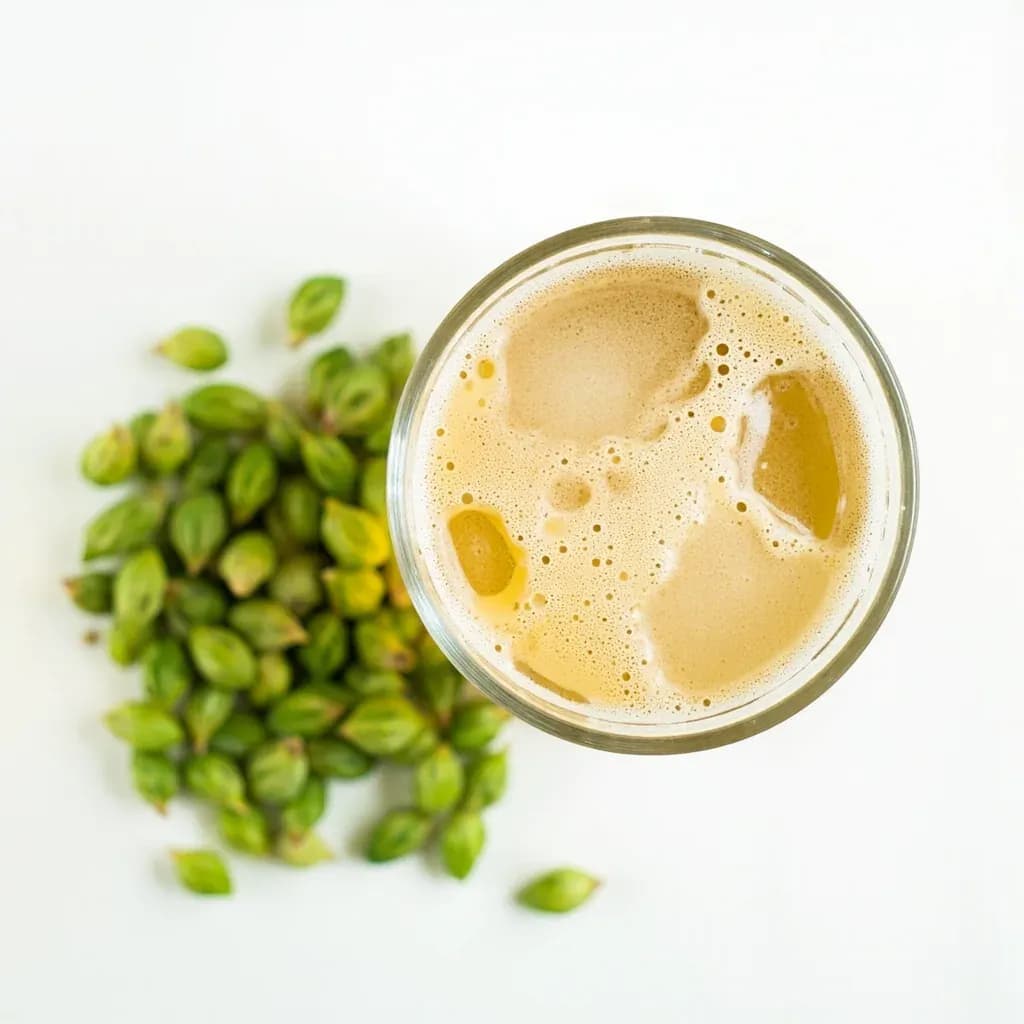
Transform & Preserve
Dry Hopping
Adding hops to beer after the boil during fermentation for aroma without bitterness.
Dry hopping steeps hops in beer during or after fermentation rather than during the boil, extracting volatile oils for bright citrus, floral, and resin aromas while adding almost no bitterness. The hops sit in contact with the cold or fermenting beer for days before removal. It is the defining step behind the punchy aroma of IPAs and hazy pale ales.
Dry hopping is the practice of adding hops to beer after the boil, during active or completed fermentation, to extract volatile aroma compounds without driving the alpha-acid isomerization that creates bitterness. Because the wort is no longer hot, the reaction that turns alpha acids into iso-alpha acids simply does not occur; instead, the hop's essential oils — terpenes such as myrcene, humulene, and linalool, plus a class of polyfunctional thiols — diffuse into the beer and survive largely intact into the glass. The result is layered hop character: tropical, citrusy, resinous, or floral notes that smell and taste bright rather than bitter.
The technique is the engine of the modern IPA. West Coast IPAs use it to amplify citrus-pine aromatics, while hazy New England IPAs lean on additions made during peak fermentation, where yeast enzymes transform bound hop precursors into free thiols (4MMP, 3MH) that read as passionfruit, grapefruit, and guava. Even traditional lagers, pale ales, and farmhouse ales benefit from restrained dry-hop additions for a finishing lift. Two parameters dominate the outcome: timing (high-krausen versus post-fermentation) and temperature, which together determine whether the finished beer smells of fresh fruit or oversteeped grass.
Dry hopping looks deceptively simple — toss hops into a fermenter and wait — but a few details separate a brilliant hop-forward beer from a dull, vegetal one. Contact time, hop form, oxygen exposure, and the management of hop creep (reactivated fermentation from residual hop sugars) all matter. Done well, the technique adds aromatic depth that no kettle addition can match.
- Difficulty
- Medium
Types & varieties
Hops pitched during high krausen (peak CO₂ activity) so yeast converts bound hop precursors into free tropical thiols like 4MMP and 3MH — the engine behind New England IPAs.
Hops added after primary fermentation completes; cleaner extraction, less thiol release, more straightforward citrus and pine character.
Addition at lagering temperatures (32–40 °F / 0–4 °C); suppresses oxidation and grassy notes but slows extraction of delicate oils.
Two or three separate additions over several days; layered aroma, perceived as a denser hop character in modern hazies.
Not strictly dry hopping — uses post-flame-off wort heat (170–200 °F / 77–93 °C) for 10–30 minutes; bridges the boil and dry hop and contributes a small amount of bitterness.
How to do it
- 1
1. Select and weigh the hops
Choose high-oil aroma varieties appropriate to the style. For a typical 5-gallon (19 L) IPA, 4–8 oz (115–230 g) of pellets split across one or two additions is common; hazies often push higher. Account for pellet absorbency: roughly 0.1–0.2 L of beer is lost per 100 g of pellets, and that loss shows up as reduced yield at packaging.
- 2
2. Choose the hop form and prep
Pellets can go directly in; whole cone hops belong in a sanitized nylon or stainless mesh bag. Cryo Hops and lupulin powder dissolve quickly but still benefit from a bag so they sink and settle cleanly. Pure hop oils and extracts can be stirred in directly or pre-diluted in a small amount of cooled, boiled wort.
- 3
3. Pick the addition window
For biotransformation, add at high krausen (24–72 hours into active fermentation for an ale). For a cleaner traditional character, add after primary fermentation has finished and the yeast has dropped 2–3 gravity points. For a delicate, late-hop character with minimal thiol release, add during cold conditioning in a brite tank or secondary vessel.
- 4
4. Add the hops to the fermenter
Sanitize gloves, bags, weights, and any dosing port. If using a bag, fill it loosely — compacted hops extract poorly. Drop the bag (or loose pellets) into the fermenter and gently stir or rock the vessel to release trapped CO₂ and fully submerge the hops in the beer.
- 5
5. Seal and hold at temperature
Re-seal the fermenter with a sanitized airlock or blow-off tube. Hold at fermentation temperature for the chosen contact time: 3 days for punchy, just-formed thiols; 4–5 days for full aroma in hazy IPAs; up to 7 days for traditional IPAs. Going beyond 10 days in warm conditions almost always introduces grassy, vegetal character.
- 6
6. Cold-crash and settle
Drop fermenter temperature to 32–40 °F (0–4 °C) for 24–48 hours. This helps hop debris, cold break, and yeast flocculate together so the trub compacts to the bottom. Avoid stirring or rousing the beer during this period.
- 7
7. Rack, filter, or package clear beer
Transfer off the hop sediment. A racking cane with a floating dip tube, a hop blocker, or a fine filter works well; alternatively, transfer to a keg through a keg-level filter pad. Expect a small loss of 0.25–0.5 gallons per 5-gallon batch from hop absorption and compacted trub.
- 8
8. Manage carbonation and refermentation
Measure final gravity after the dry-hop window. If it has dropped noticeably (hop creep), reduce priming sugar for bottle conditioning or, for kegs, carbonate to a target that accounts for residual fermentables. Allow 7–14 days of cold conditioning post-packaging for hop character to fully integrate and mellow.
The science: what dry hopping actually extracts
Dry hopping targets the volatile, oil-rich fraction of the hop cone — the lupulin glands — rather than the bittering alpha acids. Because temperatures stay well below the isomerization threshold of roughly 60 °C (140 °F), alpha acids remain largely un-isomerized, and most of the lift comes from aroma-active compounds that a hot boil would otherwise strip or transform.
- Terpenes (myrcene, humulene, caryophyllene, farnesene): the resinous, herbal, and citrus-pine backbone of hop aroma.
- Linalool and geraniol: floral and citrus-blossom notes that round out the top of the aroma profile.
- Polyfunctional thiols (4MMP, 3MH, 3MHA): tropical, Sauvignon-blanc-like aromatics released especially during biotransformation.
- Polyphenols: contribute hop astringency, body, and a touch of perceived bitterness on the finish.
- A small bitterness shift of 1–5 IBU is normal from dissolved alpha acids and oxidized polyphenols, but it is negligible compared to a 60-minute kettle addition.
Hop creep: the brewer's most common pitfall
Hop cones and pellets carry trace starches and sugars that survive the kiln and pelletizer. When those carbohydrates meet active yeast in the fermenter, they can be re-metabolized, dropping the gravity and producing extra CO₂ after the brewer believed fermentation was finished. In a keg this means creeping carbonation; in a bottle it can mean gushers or even bombs. Take a gravity reading 48–72 hours after the dry-hop window ends. If FG has fallen, reduce priming sugar, force-carbonate to a lower target, or repitch a small amount of a highly flocculent yeast to clean up the residuals before packaging.
Common uses
Tips & pitfalls
- Sanitize hop bags, weights, and any vessel contact surfaces — hops carry a small wild-yeast and bacterial load from the field.
- Add hops during high krausen (roughly 24–72 hours into fermentation for an ale) to unlock biotransformation-driven tropical character.
- Cap contact time at 3–5 days for delicate, high-oil varieties (Citra, Mosaic, Nelson Sauvin) to avoid grassy, onion-garlic, or catty off-notes.
- Cold-crash to 32–40 °F (0–4 °C) for 24–48 hours after the dry-hop window to help hop debris settle and tighten the beer before packaging.
- Use weighted stainless canisters or sanitized marble bags rather than loose pellets to keep trub out of the finished beer and protect your packaging line or keg.
- Watch for hop creep: if the beer's gravity drops again after the dry-hop window, the beer has refermented — repitch a small amount of a flocculent yeast if needed, and verify carbonation limits to prevent overcarbonation in bottles.
- Purge vessels with CO₂ before and after the addition to limit oxygen pickup, which converts hop oils into stale-smelling aldehydes such as trans-2-nonenal within weeks.
- Store hops sealed, cold, and dark before use; oxidized hops added at any stage give cardboard and sherry notes rather than fresh aroma.
Good to know
- Origin
- British brewing tradition, with references in 19th-century IPA recipes from Burton-on-Trent and London porter brewers seeking aroma without added bitterness.
- Purpose
- Extract hop aroma oils (terpenes, sesquiterpenes, thiols) and flavor polyphenols without the isomerization of alpha acids that creates bitterness during the boil.
- Temperature range
- Typically 60–70 °F (15–21 °C) for ale fermentation; cold-side dry hopping is done at 32–40 °F (0–4 °C) to suppress vegetal off-flavors.
- Typical contact time
- 3–7 days is standard; under 3 days gives weak aroma, over 7–10 days risks grassy or hay-like off-notes.
- Hop forms used
- T-90 pellets (most common), T-45 pellets, whole cone hops, Cryo Hops (concentrated lupulin), and pure hop oils/extracts.
- When to add
- Three main windows: during high krausen for biotransformation, post-fermentation in primary, or in a secondary/conditioning vessel.
- Hop creep
- Residual starches and sugars in hop flowers and pellets can reactivate yeast, causing re-fermentation, rising FG, ABV creep, or bottle bombs if not managed.
- Yield effect
- Does not raise bitterness meaningfully; measured IBU change is usually within 1–5 points regardless of hop quantity.
Also called
Dry-Hopping
Related

Confit
Cook slowly submerged in fat for silky tenderness and keeping

Cure
Draw out moisture with salt and time to preserve and concentrate

Pickle
Steep in acidic brine for bright, tangy, crunchy preservation

Ferment
Let friendly microbes transform food into tangy, complex flavor

Marinate
Soak in a seasoned mix to flavor and tenderize before cooking

Brine
Soak in salt water so meat stays juicy and seasoned throughout

Dehydrate
Slowly dry out moisture to concentrate flavor and extend shelf life

Cold-Smoke
Perfume cured food with smoke without cooking it through