Water & Steam
En Papillote
Steaming food sealed in a parchment or foil parcel so it cooks in its own juices and aromatics.
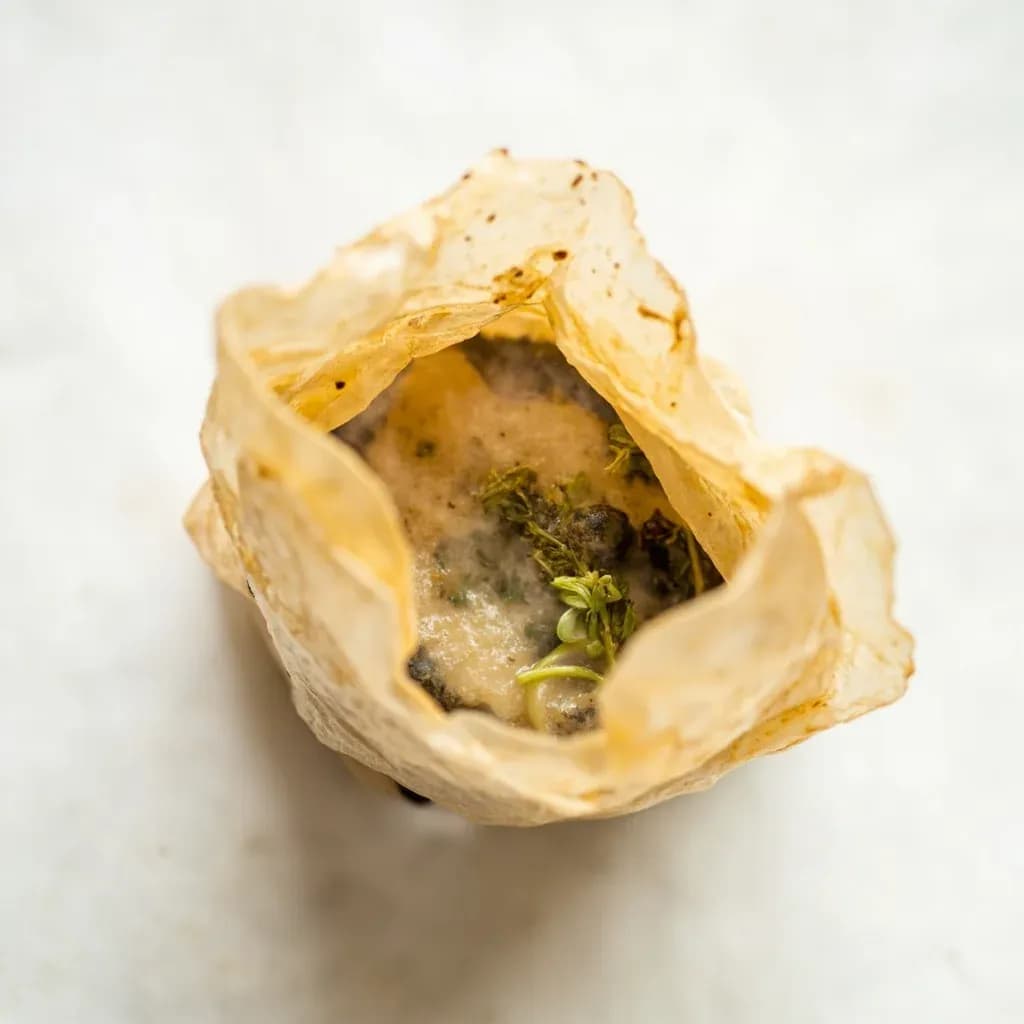
En papillote, French for 'in parchment', wraps fish, vegetables or other delicate foods in a sealed paper or foil packet that puffs in the oven as trapped steam gently cooks the contents. The parcel keeps moisture and aromatics in, so flavors concentrate and nothing dries out. It is opened at the table to release the fragrant burst of steam.
En papillote is the French technique of enclosing food in a sealed paper parcel so it cooks in the steam it generates from itself. The parchment browns, swells into a taut pillow, and is opened at the table with the tip of a knife — releasing a concentrated burst of aroma and leaving behind a clean, naturally emulsified jus that becomes the sauce. The technique is essentially oven steaming, and it succeeds or fails on the quality of the crimp.
Its value lies in what it does not do: it never sears, it never boils dry, and it never relies on carryover heat to finish cooking delicate proteins like sole, salmon, or chicken breast. The food rests on a bed of aromatics and cooks in a small amount of added liquid plus its own moisture, so the result is a piece of fish or meat that is gently steamed from every side, evenly cooked from edge to center, and intensely flavored because nothing has escaped. It is a beginner-friendly method once the fold is mastered, and one of the rare techniques where the cooking vessel is also the serving vessel.
- Difficulty
- Easy
Types & varieties
The canonical version. Parchment browns, puffs dramatically, and can be opened tableside for an aroma release.
Practical and faster to seal; does not puff or brown, gives no aroma release on opening, and produces a slightly steamed rather than roasted character.
A loose parchment lid placed over a pan; not sealed. A related idea that cooks by gentle steam rather than trapped vapor.
Tropical adaptation that imparts a faint grassy, tea-like note and tolerates higher heat or direct grilling.
A dough or salt shell enclosing the food; same trapped-steam logic, with an edible or discarded shell.
Parallel East Asian traditions of steaming in paper or leaf parcels.
How to do it
- 1
Preheat and prep
Heat the oven to 200–230 °C / 400–450 °F. Cut a heart-shaped or round piece of parchment large enough to fold over the food with at least 5 cm (2 in) of clearance on all sides so steam has somewhere to go.
- 2
Build the base layer
Brush the center of the parchment with soft butter or olive oil. Add a bed of sturdy aromatics — sliced shallot, leek, fennel, or carrot — so the protein sits slightly elevated rather than stewing in direct liquid.
- 3
Season the protein
Pat the fish or meat dry, season with salt and pepper, and lay it skin-side up on the aromatics. Score thick fillets lightly so heat penetrates evenly from edge to center.
- 4
Add flavorings and steam liquid
Top with herbs (thyme, parsley, tarragon, chervil), citrus zest or a thin slice of lemon, a pat of butter, and 2–4 tablespoons of liquid — dry white wine, fish stock, vermouth, or citrus juice. Keep the liquid away from the very edge of the paper so it does not interfere with the seal.
- 5
Fold and seal
Fold the parchment over. Starting at one end, crimp the edges together with tight, overlapping 1–2 cm folds, working your way around the parcel. Twist or tuck the final end firmly underneath so the parcel sits flat and sealed.
- 6
Bake
Place on a rimmed sheet pan — parcels sometimes weep, and the pillow can collapse. Bake until the parchment is tightly puffed and lightly browned: 8–12 min for a thin fillet, 12–18 min for a chicken breast or small whole fish, up to 25 min for thicker cuts.
- 7
Serve and open
Slide the parcel onto a warm plate (a flat sheet is easier than a bowl) and bring it to the table. Each guest slits the paper with the tip of a knife — the released vapor carries the full aroma of the dish, and the jus pooled inside is spooned over as a natural sauce.
Parchment versus foil: what actually changes
Parchment and foil both trap steam, but they cook differently and present differently. Parchment allows dry oven heat to reach the food from above while the steam circulates below, producing a faint roasted character on the surface of the protein. Foil reflects heat, so the parcel behaves more like a steamer insert than a tiny oven. Parchment browns and inflates visibly — a built-in timer and a built-in reveal. Foil does neither, so a cook must rely on clock and probe alone, and the tableside moment is lost. Use foil when speed and reliability matter more than theater, and when the aromatics are strong enough that a parchment puff is not worth the effort. Reach for parchment whenever the dish is delicate, the aroma is the point, or you want the jus to read as a sauce at service.
Common uses
Tips & pitfalls
- Cut parchment at least 30 cm (12 in) larger than the food in every direction; steam needs room and a too-small parcel scorches at the creases.
- Always butter or oil the inner surface where the protein sits — it prevents sticking and adds the first layer of flavor.
- Add 2–4 tablespoons of liquid. Without it the parcel stays dry, the food steams unevenly, and the parchment can scorch from the inside out.
- Crimp by folding the edge over itself in 1–2 cm increments around the parcel, then twisting or tucking the final end under so the pillow sits flat on the sheet pan.
- Do not pierce the parcel to 'let steam out.' The whole point is the seal — open it at the table instead, and away from your face, because the initial puff of vapor is genuinely hot.
- Place parcels on a rimmed sheet pan; they occasionally weep, and a collapsed pillow still cooks fine but loses the reveal.
- Bring cold fish or chicken to room temperature for 10 minutes before sealing so the center finishes in step with the edges; very thick cuts are poor candidates — slice thinner or butterfly first.
- If the parchment has not puffed after 10 minutes, the seal has leaked; rescue by tenting with foil and finishing uncovered, though the jus will be thinner.
Good to know
- French name
- En papillote — 'in parchment'
- Origin
- French classical technique, codified in 19th-century cuisine alongside the adoption of sulfur-treated parchment (papier sulfurisé)
- Primary material
- Parchment paper, silicone-coated or sulfur-treated; aluminum foil is a workable but less traditional substitute
- Do not use
- Wax paper or butcher paper — they scorch, smoke, or leak steam at oven temperature
- Typical oven temperature
- 200–230 °C / 400–450 °F
- Visual signal of a good seal
- Parchment swells and browns into a tight pillow — proof that no steam escaped
- Key principle
- A sealed environment forces the food to steam in its own juices plus any added liquid and aromatics
- Yield
- Produces a clean, naturally emulsified jus that can be spooned over the protein or reduced briefly for a sauce
Also called
al cartoccio · in parchment
Related

Boil
Cook in vigorously bubbling liquid at full rolling heat

Simmer
Hold liquid at a gentle shimmer for tender, unhurried cooking

Poach
Cook gently in barely-trembling liquid for silky, tender results

Steam
Cook in rising vapor to keep color, nutrients, and shape intact

Blanch
Plunge briefly in boiling water, then shock cold to lock color

Braise
Sear, then cook slow in a little liquid until fall-apart tender

Stew
Simmer bite-sized pieces fully submerged into a rich, unified pot

Sous-Vide
Seal and cook in precise warm water for edge-to-edge doneness