Transform & Preserve
Enzymatic Binding (Transglutaminase)
Using transglutaminase to chemically bond proteins into seamless larger pieces.
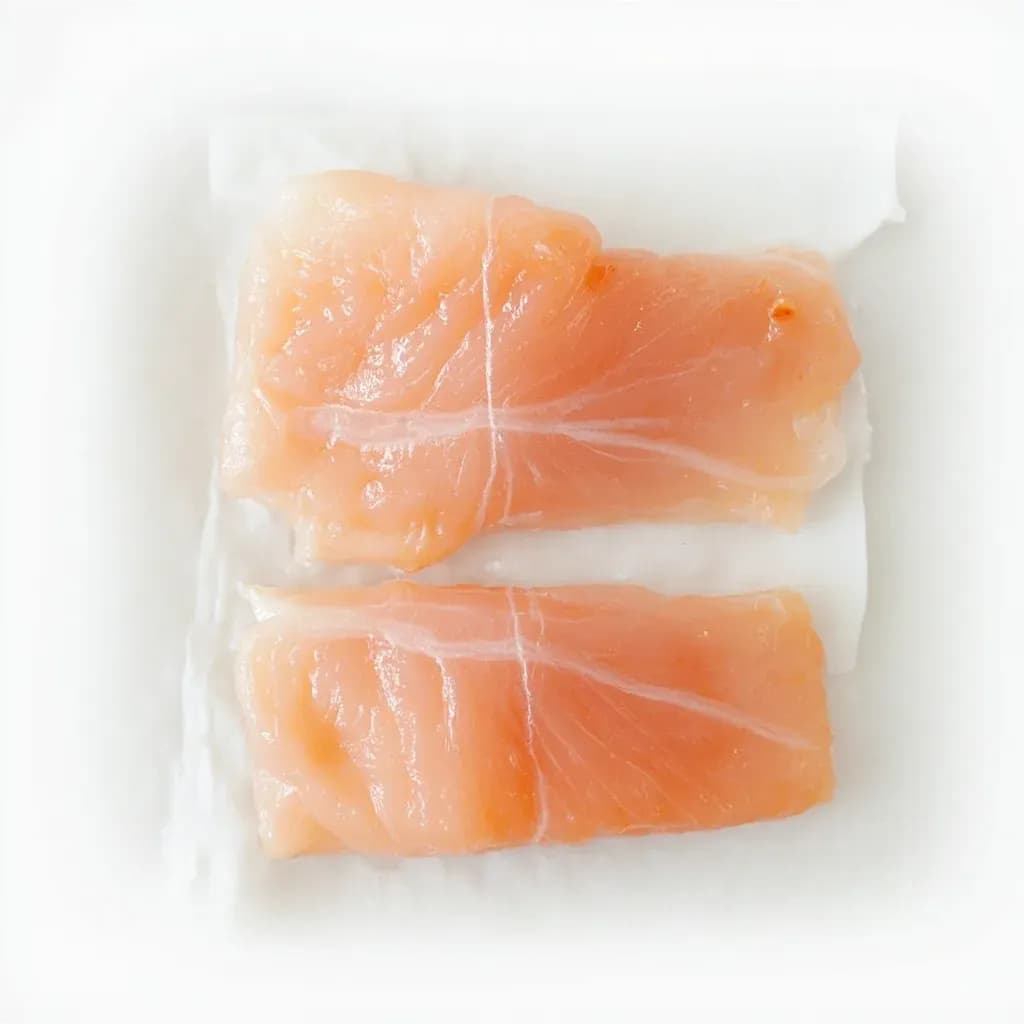
Enzymatic binding uses transglutaminase (meat glue) to cross-link protein strands, fusing trimmings or separate cuts into a single seamless piece. Chefs dust it between surfaces, press them together, and chill to set the bond. It is used to build uniform portions, wrap proteins, or bind delicate fish, and must be handled with food-safety care.
Enzymatic binding uses the enzyme transglutaminase — almost always the microbial form known as mTG, sold commercially as Activa and similar powders — to forge covalent chemical bonds between protein molecules. Specifically, the enzyme knits together a glutamine residue on one protein chain to a lysine residue on another, effectively stitching two pieces of meat, fish, or poultry into a single, seamless whole. Because the reaction creates a genuine chemical cross-link rather than a fragile physical glue, the resulting bond is extraordinarily strong: it survives slicing, grinding, and full cooking, and once formed it is permanent.
The enzyme is unusual among kitchen tools in that it works best cold, even on raw protein. It is most active between roughly 0 and 50°C with a sweet spot near 40°C, which is why bonded pieces are typically rested overnight in the refrigerator. Heat above about 70–75°C deactivates the enzyme, but the bonds it already formed remain intact, so a steak glued together with transglutaminase cooks and eats like a single cut. This cold-setting behavior, combined with a need for direct protein-to-protein contact (no fat or water films), is what makes the technique both powerful and exacting.
In the kitchen it is used for two broad purposes: honest cookery, such as reducing waste by binding trim and offcuts into uniform cuts, and modernist construction, where chefs fuse different proteins into a single log that reveals a mosaic cross-section when sliced. It belongs to the same enzyme family as the transglutaminases that mammals use in wound healing (Factor XIIIa, in blood clotting) and as the endogenous transglutaminase in fish muscle that Japanese fish-paste makers have long exploited in kamaboko. The modern microbial form simply isolates and concentrates the reaction so it can be used predictably on any protein.
- Difficulty
- Hard
Types & varieties
Standard raw-meat binder; the workhorse grade for steaks, chops, and trim restructures.
General-purpose blend formulated to tolerate modest salt levels in the protein.
Designed for binding whole-muscle pieces into a uniform piece with minimal visible seam.
Tender-binding grade suited to poultry, fish, and delicate proteins where a softer set is wanted.
Formulated for surimi, kamaboko, and seafood gels.
Higher-concentration blends with little or no salt carrier; require precise dosing by weight.
How to do it
- 1
Select and trim the protein
Choose pieces of the same protein, or two compatible proteins, and trim away silver skin, large fat caps, and loose moisture. Cut the pieces so that at least one face is flat and free of fat; the two bonding surfaces should be pure protein.
- 2
Dry and chill the surfaces
Pat the bonding faces with paper towels until there is no visible moisture or fat sheen. Chill the pieces to 0–4°C (32–40°F) — the enzyme works best on cold, firm protein, and dryness is essential to a strong bond.
- 3
Dust with transglutaminase
Sprinkle a thin, even layer of Activa or equivalent powder — about 1% of the weight of the protein in that seam — across the bonding face. A fine sieve or shaker gives the most even coverage. Do not mix the powder with salt; salt competes with the enzyme for the active site.
- 4
Mate and press the pieces
Press the two dusted faces together firmly, squeezing out any trapped air. The most reliable setup is to vacuum-seal the assembly in a pouch at full pressure; a tight wrap of plastic film under a weight is the next-best option. Full, even contact across the seam is the single biggest factor in bond strength.
- 5
Refrigerate to set the bond
Hold the pressed assembly in the refrigerator for 2 to 12 hours; overnight is the safest margin. The cross-linking happens at cold temperatures, and the bond is essentially complete after 24 hours.
- 6
Unwrap, portion, and cook
Remove the weight or vacuum bag. The pieces will now behave as a single piece of meat: portion with a sharp knife (a brief stint in the freezer makes the cleanest cross-section) and cook as you would a single, intact cut. The enzyme is inactivated by heat above about 70°C, but the bond it left behind survives any normal cooking method.
The Science, Briefly
Transglutaminase is a transferase: it moves an acyl group from a glutamine side chain to the ε-amino group of a lysine side chain, releasing ammonia and leaving a stable isopeptide bond between the two proteins. Because that bond is covalent, it is many times stronger than the hydrogen bonds, surface tension, and mechanical interlocking that hold, say, a meatball together. In practice this means a piece of cod fused to a piece of scallop behaves, when cooked, like one piece of fish — they share juices, cook evenly, and cannot be pulled apart along the seam.
- mTG is promiscuous: any two proteins with accessible glutamine and lysine residues will bond, which is why the powder works on beef, pork, poultry, fish, shellfish, and even some dairy proteins.
- The same cross-linking chemistry that helps blood clot and heal wounds — performed in mammals by a related enzyme called Factor XIIIa — is what makes a bonded steak hold together. The kitchen powder is the microbial form, not the human clotting factor.
- Because mTG only acts on proteins, you cannot use it to glue meat to a vegetable or to a piece of fat; for that you need to lay the meat over the fat and bond meat to meat around it.
History and Cultural Roots
Long before any cook had a tin of Activa, Japanese fish-paste makers understood that washing minced white fish in cold water released a soluble protein (myosin) that, when salted and kneaded, formed a strong, elastic gel. That gel is kamaboko, and the active principle in it is endogenous transglutaminase in the fish muscle. The modern microbial form, isolated in the late 1980s and commercialized in the 1990s, simply made the reaction controllable, predictable, and applicable to any protein — which is why it migrated from surimi factories into restaurant kitchens and, eventually, modernist tasting menus.
- The enzyme was first identified in animal liver tissue in 1959.
- Microbial food-grade transglutaminase entered commercial production in Japan in the early 1990s.
- Its arrival in Western fine-dining kitchens in the mid-2000s is closely associated with chefs like Wylie Dufresne, who used it to build shrimp 'discs' and other impossible-looking constructions.
Common uses
Tips & pitfalls
- Dry both bonding faces thoroughly with paper towels; even a thin film of water or fat will stop the bond from forming.
- Apply transglutaminase BEFORE salting, or use a low-salt (under about 1% in the moist protein) seasoning blend — salt out-competes the enzyme for the active site and weakens the set.
- Sprinkle the powder evenly with a fine shaker rather than dabbing it on; lumps create soft spots in the seam.
- Vacuum-seal the assembled piece in a pouch at full pressure — it is the most reliable way to guarantee full, even contact across the seam.
- Never try to bond already-cooked protein: heat has already changed the shape of the proteins, leaving the enzyme nothing to cross-link.
- Lightly score very smooth, glossy surfaces (the cut face of a tenderloin, for instance) so the powder makes contact with the protein itself, not the shiny exterior.
- For the cleanest cross-section when portioning, freeze the bonded piece for 20–30 minutes before slicing; the seam will not tear.
- Keep dedicated tools — brushes, boards, and vacuum bags — for transglutaminase work. The enzyme is a powerful glue that will bond any protein residue it touches, so it readily fouls boards, blades, and bags used for other tasks.
Good to know
- Active component
- Microbial transglutaminase (mTG), which catalyzes covalent bonds between glutamine and lysine residues on protein chains.
- Source organism
- Fermentation of Streptoverticillium mobaraense, a soil actinomycete.
- Best-known brand
- Activa, produced by Ajinomoto in Japan and sold in food-service and home-cook sizes worldwide.
- Commercial form
- Off-white powder, typically about 1% active enzyme carried on salt, maltodextrin, or dextrose.
- Typical dosage
- 0.5% to 1.5% of the weight of the protein being bound at the seam.
- Active pH range
- Roughly 5 to 8, with peak activity near pH 6 to 7.
- Active temperature
- 0 to about 50°C (32–122°F); works well under refrigeration, with optimum activity near 40°C (104°F).
- Setting time
- 1 to 12 hours of firm contact, usually overnight under refrigeration; essentially permanent after 24 hours.
- Inactivation
- The enzyme is denatured above 70–75°C (160–170°F); the bonds it has already formed are heat-stable.
- Bonds only with
- Proteins. Fat, skin, and water films between the surfaces will prevent or weaken the bond.
- Salt sensitivity
- High salt (above roughly 1–1.5% in the moist protein) inhibits the enzyme; it is usually applied before salting.
- Regulatory status
- GRAS in the US and approved as a food enzyme in the EU, Japan, and most major markets; some jurisdictions require that restructured products be labeled as such.
Also called
Primary Protein Bind (Myosin Extraction)
Related

Confit
Cook slowly submerged in fat for silky tenderness and keeping

Cure
Draw out moisture with salt and time to preserve and concentrate

Pickle
Steep in acidic brine for bright, tangy, crunchy preservation

Ferment
Let friendly microbes transform food into tangy, complex flavor

Marinate
Soak in a seasoned mix to flavor and tenderize before cooking

Brine
Soak in salt water so meat stays juicy and seasoned throughout

Dehydrate
Slowly dry out moisture to concentrate flavor and extend shelf life

Cold-Smoke
Perfume cured food with smoke without cooking it through