Transform & Preserve
Fat Washing
Infusing a spirit or liquid with savory fat, then chilling to remove the solidified fat.
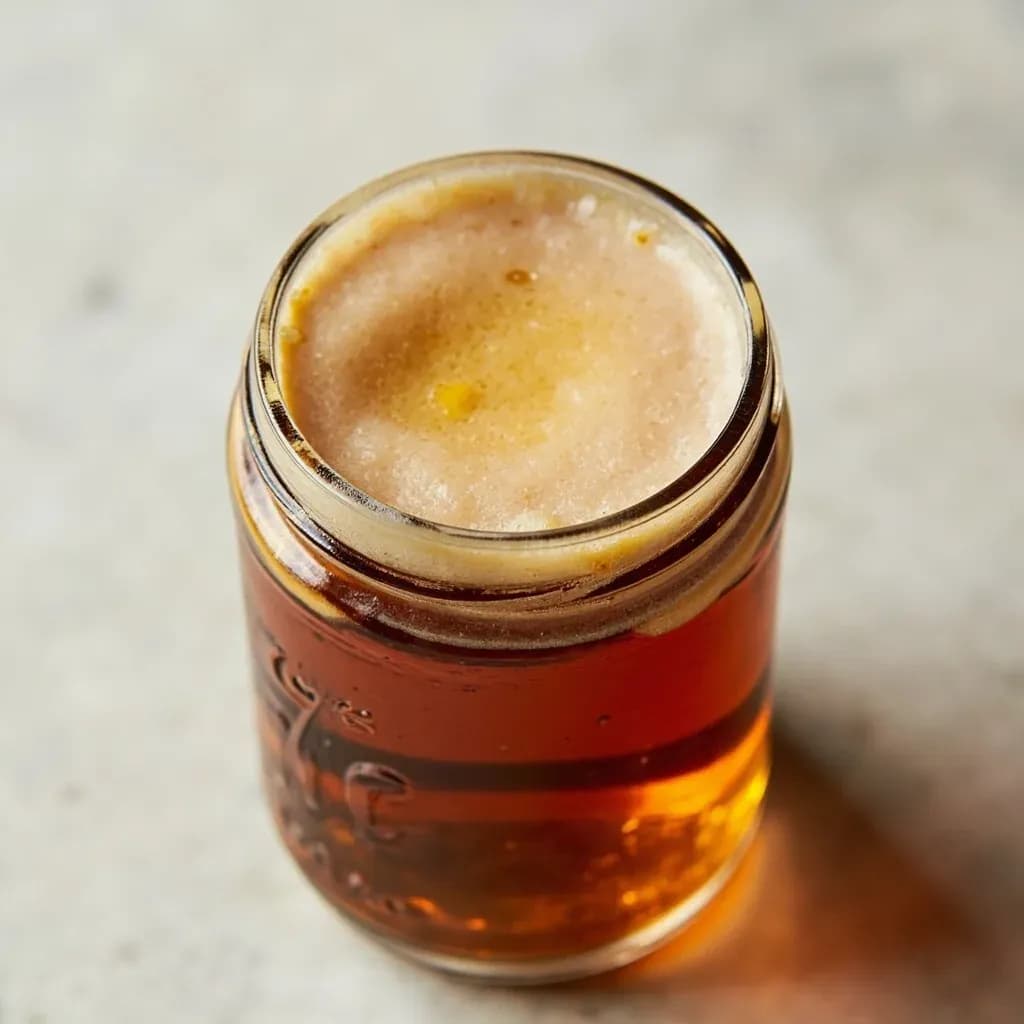
Fat washing blends a melted fat such as bacon drippings, browned butter, or sesame oil into a spirit or liquid, lets the flavors meld, then freezes the mixture so the fat hardens and can be lifted or strained off. What remains is a liquid carrying the fat's aroma and savory notes without greasiness. Bartenders use it for cocktails and cooks for infused oils and stocks.
Fat washing borrows a simple piece of food chemistry: many of the most compelling savory and smoky flavors — wood smoke, roasted meat, browned butter, toasted nuts — are carried by fat-soluble molecules. By dissolving those compounds into a small amount of warmed fat, whisking that fat into a spirit or other liquid, and then chilling the mixture, the fat re-solidifies and can be lifted or filtered away, leaving behind a finished liquid that tastes rich and savory but shows no visible grease.
The technique is most closely associated with craft cocktails, where it was popularized by Dave Arnold in the late 2000s through his book Liquid Intelligence. Bacon-washed bourbon, brown-butter-washed whiskey, and olive-oil-washed gin have become bar mainstays. The same principle, though, underlies older kitchen practices: fat-washed vinegars, clarified stocks, and infused finishing oils in which a small amount of fat carries flavor into a liquid that is then separated cleanly from it.
- Difficulty
- Medium
Types & varieties
The canonical example; rendered bacon fat infused into bourbon or rye, used in smoky, savory Old Fashioned and Manhattan variations.
Richer and more savory than bacon; prized for autumnal whiskey drinks and steak-house-style cocktails.
Browned butter adds nutty, toffee-like aroma; works especially well in bourbon-based stirred drinks.
Deep, meaty undertone; a specialty application in high-end cocktail programs.
Softens gin's botanicals and adds a rounded, grassy mouthfeel; common in dirty Martini riffs.
Cold method (no heating needed); introduces toasted-nut aroma for Asian-inspired drinks.
Coconut oil solidifies cleanly at refrigerator temperatures, making it a reliable, tropical-leaning choice.
Adds roasted-nut depth; a signature move at certain New York cocktail bars in the 2010s.
Imparts a soft, buttery finish without the milk solids that can turn rancid.
How to do it
- 1
Render and clarify the fat
If using a solid fat such as bacon, duck, or beef tallow, render it slowly over low heat until fully liquid. Strain through cheesecloth to remove all solids and moisture. For butter, brown it first for nutty flavor, then clarify into ghee. Liquid oils like sesame, olive, or coconut need no rendering but should be fresh and clean.
- 2
Combine fat and spirit
Warm the spirit gently in a saucepan or bain-marie just until lukewarm — never simmer, and never boil, or you will flash off the aromatics. Remove from heat and whisk in roughly 1–2 oz (30–60 g) of the rendered fat per 750 ml of spirit until fully emulsified. For liquid-at-room-temperature oils, simply whisk together in a jar.
- 3
Infuse
Cover and let the mixture rest 30 minutes to 4 hours, either at room temperature or set over a warm (not hot) bain-marie. The goal is to bind the fat-soluble aromatics without cooking the spirit. Stir or swirl occasionally.
- 4
Chill until the fat solidifies
Transfer to a wide, freezer-safe container — a metal loaf pan works well. Freeze 2–6 hours, or refrigerate 12+ hours, until the fat forms a firm, opaque layer on top (or the entire mass freezes solid).
- 5
Remove the fat cap
Lift or skim off the solidified fat in one piece. If fully frozen, briefly invert the block onto a cutting board and chip the fat cap off with a knife. Discard the fat (or save for cooking).
- 6
Strain and filter
Pour the liquid through a fine-mesh sieve, then through a layer of cheesecloth, and finally through a paper coffee filter set in a funnel. Replace the coffee filter as soon as flow stalls. Expect this last stage to take time; do not squeeze the filter or you will force fat globules through.
- 7
Taste, adjust, and store
Taste the wash. If it feels heavy or greasy, cut it with a small pour of the original unwashed spirit. Bottle in a clean glass container, label with the fat, spirit, and date, and refrigerate. Use within 4–8 weeks for best flavor.
The science, briefly
Flavor molecules are not all created equal. Water-soluble compounds (sugars, salts, many fruit acids) move easily into water-based liquids, but the molecules that give us smoke, char, roasted meat, browned dairy, and toasted nuts are predominantly lipophilic — they prefer fat. By dissolving those compounds into a small amount of warm fat and then whisking that fat into a spirit, you create an emulsion in which the aromatic molecules migrate between both phases. When the mixture is chilled, the fat coalesces and re-solidifies, and most of the fat-bound aromatics are lifted out with it; what remains in the spirit are the more water-soluble fractions of the same flavor profile plus trace lipids that the palate reads as richness rather than grease. Choose a fat with a melting point comfortably above refrigerator temperature (around 4 °C / 40 °F) and the separation is clean and reliable.
Beyond the bar
The same technique is quietly useful in the kitchen, where the goal is often to add depth to a clear or low-fat liquid without clouding it. The principles are identical; only the vehicle changes.
- Fat-washed vinegars: bacon or duck fat whisked into sherry vinegar, chilled, and decanted, for a smoky vinaigrette.
- Fat-washed stocks: a spoonful of roasted chicken or beef fat warmed into veal stock before a consommé raft, adding body without a visible slick.
- Fat-washed sake or mirin: a brief infusion of toasted sesame oil adds nuttiness to glazes and dipping sauces.
- Finishing oils with herbs or spices: when using a fat that solidifies at cool temperatures (such as coconut oil), the same warm–chill–filter sequence yields a clear, intensely flavored finishing oil.
Common uses
Tips & pitfalls
- Render solid fats (bacon, duck, beef) gently and strain through cheesecloth first; any solids left behind will cloud the finished spirit.
- Use clarified butter or ghee rather than whole butter; milk proteins will not strain out cleanly and will sour.
- Never let the spirit boil or simmer when warming — you will drive off the very aromatics you are trying to capture.
- Freeze in a wide, shallow container so the fat cap is thin and easy to remove in one piece.
- If the fat refuses to solidify, your freezer is not cold enough or you used an oil with a very low melting point (some olive oils); switch to coconut or palm oil, or use an ice bath.
- Filter through a paper coffee filter in stages, replacing it as soon as flow slows; a single pass clogs fast and squeezing the filter pushes fat through.
- Taste the wash before final filtering; if it reads greasy or heavy, dilute with a portion of unwashed spirit rather than washing it down further.
- Label and date every bottle. Fat-washed products are not shelf-stable like plain spirits, and the flavor can drift or turn waxy within weeks.
Good to know
- Technique type
- Flavor infusion via fat-soluble compound extraction, followed by temperature-driven phase separation
- Popularized by
- Dave Arnold, in his 2007 writings and the 2012 book Liquid Intelligence; widely adopted in craft cocktail bars afterward
- Underlying principle
- Many aromatic compounds (smoke, maillard notes, savory umami molecules) are fat-soluble; binding them to fat, then removing the fat, leaves the liquid richly flavored but not greasy
- Typical fat-to-liquid ratio
- About 1–2 oz (30–60 g) rendered fat per 750 ml of spirit; heavy fats like duck or beef may need less, neutral oils more
- Infusion time
- 30 minutes to 4 hours at room temperature or gentle heat; longer infusions risk muddy or soapy results
- Chilling time
- 2–6 hours in a freezer, or 12+ hours in a refrigerator, until the fat fully solidifies
- Best fats
- Rendered bacon, duck, beef tallow, clarified butter, brown butter, sesame oil, olive oil, coconut oil, peanut oil
- Shelf life
- Refrigerated, 4–8 weeks; high-proof spirits last longer than low-proof or wine-based washes
Also called
Fat-Washing
Related

Confit
Cook slowly submerged in fat for silky tenderness and keeping

Cure
Draw out moisture with salt and time to preserve and concentrate

Pickle
Steep in acidic brine for bright, tangy, crunchy preservation

Ferment
Let friendly microbes transform food into tangy, complex flavor

Marinate
Soak in a seasoned mix to flavor and tenderize before cooking

Brine
Soak in salt water so meat stays juicy and seasoned throughout

Dehydrate
Slowly dry out moisture to concentrate flavor and extend shelf life

Cold-Smoke
Perfume cured food with smoke without cooking it through