Water & Steam
Grandpa-Style Steeping
Casual tea method of dropping loose leaves straight into a cup and topping up with water all day.
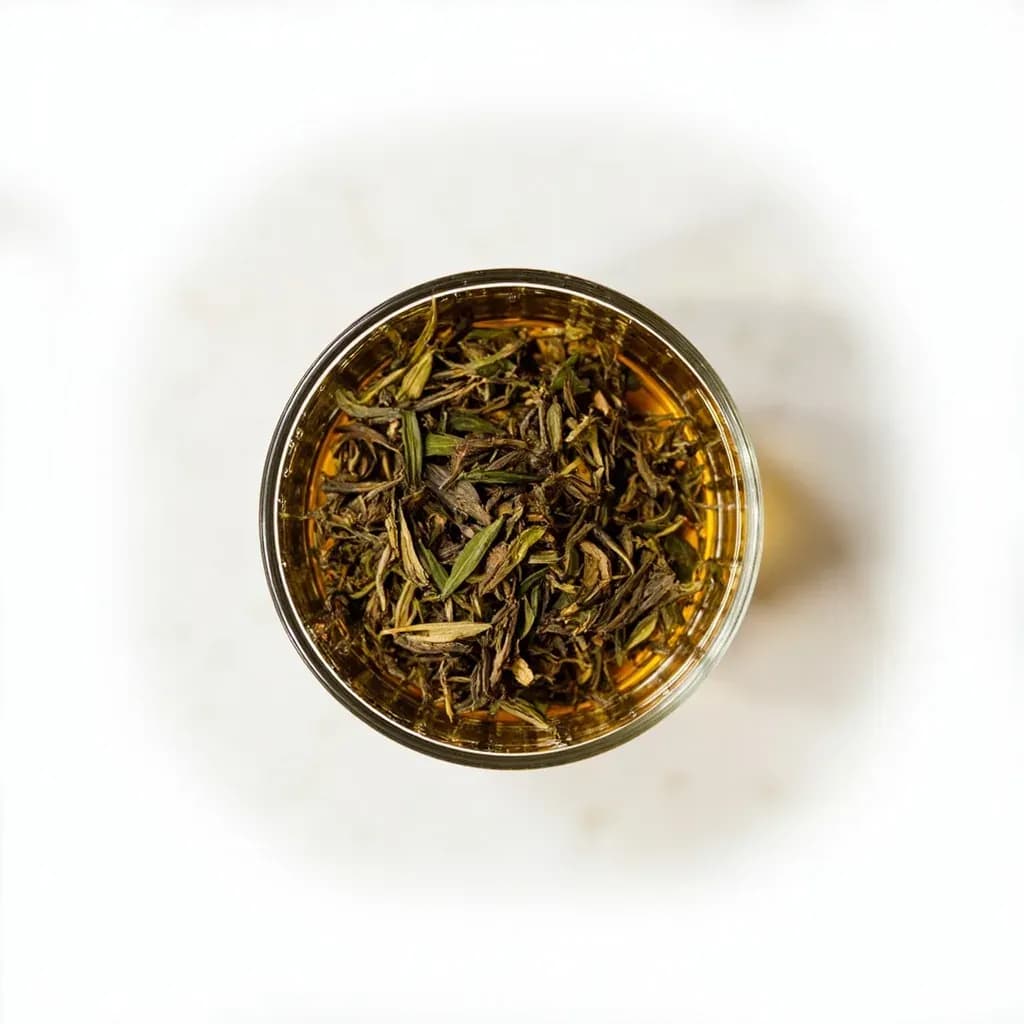
Grandpa-style steeping puts loose tea leaves directly in a mug or jar and adds hot water without straining, sipping as you go and refilling with more water when the cup runs low. The leaves settle and continue infusing slowly, so the brew stays drinkable for hours. It is the simplest, most informal way to drink Chinese tea, with no special equipment.
Grandpa-style steeping, sometimes called lǎo yé chá (老爷茶) or 'grandpa tea' in Chinese, is the most informal end of the loose-leaf tea spectrum: a pinch of dry leaf goes into an ordinary drinking vessel, hot water is poured over it, and the drinker sips from the same cup for the rest of the afternoon, refilling as the level drops. There is no strainer, no teapot, no fairness pitcher, and no decanting — the leaves stay in the cup from first pour to last, and the drinker sips around them. It is, in effect, the anti-gongfu method: where gongfu cha prizes ritual, control, and a quick series of short, concentrated brews, grandpa-style prizes ease, patience, and one cup that carries you through a long stretch of work or reading.
The mechanics are simple but consequential. Because the leaves remain in contact with the water for hours rather than minutes, the dose must be considerably lower than a Western mug brew — roughly 1–2 g per 200 ml, against the 2.5–3 g a Western mug brewer would use for a three-minute steep. Water temperature is chosen for the tea rather than the method: a rolling boil for black, dark/ripe pu-erh, and roasted oolong; around 90 °C for green and most oolong; 80–85 °C for white and young sheng pu-erh. Each refill extracts a little less than the last, so the cup softens rather than strengthens over time, and a session can run six to ten top-ups before the leaf is spent.
What makes the method worth understanding is what it reveals about a tea. Long, continuous contact exposes how well a leaf holds up: a great white needle or twisted oolong will still be fragrant at the tenth refill, while a young sheng or a broken black collapses into bitterness in the second or third. It is also the most honest way to taste a tea alone, without committing to a full session of gear-warming and rinsing, which is why it remains a default office and travel method for serious Chinese tea drinkers, and a useful first brew when evaluating an unfamiliar loose-leaf purchase.
- Difficulty
- Easy
Types & varieties
The classic Chinese iteration using a lidded steel or enamel mug; the lid is tilted to hold back leaves while sipping.
Modern visual version in a tall glass — favored for watching leaves unfurl and for lighter teas.
Some drinkers pour the first steep into a fairness pitcher and then return the liquor to the cup, removing the leaves for a cleaner mouthfeel while keeping the casual refill rhythm.
How to do it
- 1
Choose a vessel and tea
Pick a tall, heat-resistant glass, mug, or lidded steel/enamel cup. Pair it with a whole-leaf or bud-style tea — white needles, green mao feng, twisted oolong, or loose ripe pu-erh all work well. Avoid broken or dusty grades.
- 2
Measure the leaf
Add roughly 1–2 g of dry leaf per 200 ml of cup volume. Use a little more for heavily roasted oolongs and ripe pu-erh, a little less for delicate greens. Err low — you can always add a few leaves next time, but you cannot undo over-extraction.
- 3
Heat water to the tea's temperature
Boil for black, dark/ripe pu-erh, and heavily roasted oolong; cool to ~90 °C (185 °F) for green and most oolong; cool to 80–85 °C (175–185 °F) for white and young sheng pu-erh.
- 4
Optional quick rinse
Pour just enough water to cover the leaves, swirl for 5–10 seconds, and discard. This 'awakens' tightly rolled oolongs and pu-erh and reduces any storage mustiness. Skip it for tender greens and whites if you prefer a fuller first cup.
- 5
Fill the cup and start drinking
Top up with hot water and wait only until the liquid is comfortable to drink — usually 30–90 seconds for the first cup, faster later. Sip from the surface, tilting the cup so the leaves stay pooled at the bottom or pushed to the back.
- 6
Refill repeatedly
When the cup is about one-third to one-half full, add more hot water at the same temperature. Do not remove the leaves. Each top-up extracts less than the last, so the cup naturally softens as the afternoon goes on.
- 7
End the session when the leaf is spent
Stop when the cup no longer smells of tea and the liquor is thin, pale, or grassy. Compost or discard the spent leaves, rinse the cup thoroughly, and you're done — no teaware to wash, no tray to empty.
Why whole leaves matter here
Because grandpa-style never filters the leaf, the physical shape of the tea does the work that a strainer would otherwise do. Long, twisted, or needle-shaped leaves either settle at the bottom or float at the top, leaving the middle of the cup relatively clear so the drinker can sip without chewing tea. Broken, cut, or dusty grades do the opposite: they disperse evenly through the liquid, release tannin fast under continuous contact, and turn the cup cloudy and astringent within an hour. The rule of thumb is that any tea sold as 'tea bag grade' or broken for quick brewing will over-extract in a grandpa cup; any tea sold as whole-leaf for gongfu will generally behave well.
- White needles (Bai Hao Yin Zhen), mao feng greens, and twisted rolled oolongs are ideal — they sink or float cleanly.
- Broken CTC black, fannings, and very fine green dust turn muddy and bitter within the first or second refill.
- Ripe (shou) pu-erh tolerates long contact well; young sheng pu-erh often turns harsh and should be used sparingly or skipped.
- Scented or heavily flavored teas (jasmine pearls, smoked lapsang) work, but their aroma flattens faster than in a gongfu session.
Reading the cup as the day goes on
One of the quiet pleasures of the method is that the same cup documents a tea's life cycle. The first refill is loud — bright, possibly astringent, fully aromatic. By the third or fourth top-up, the middle has settled into a balanced, often sweeter profile as tannins outpace the slower-releasing flavor compounds. By the eighth or tenth, the liquor is pale, thin, and slightly grassy, and the cup itself smells more of wet leaf than of tea. That fading arc is itself useful information: it tells you how long a tea is worth buying in quantity, and it teaches your palate the difference between a leaf that endures and one that quits.
Common uses
Tips & pitfalls
- Use noticeably less leaf than a Western mug brew — continuous contact makes under-dosing the right instinct, not over-dosing. If anything tastes harsh, the answer is usually fewer leaves rather than cooler water.
- Skip very small-particle teas (broken CTC, fannings, fine dust); they over-extract and turn the cup muddy and bitter within an hour.
- Drink from the top of the cup and tilt gently. Whole leaves mostly sink or float high, so the middle layer stays clear.
- Top up while there is still a finger or two of liquid in the cup — never let it go fully dry, or the next pour will taste harsh as the leaves re-steep from bone-dry.
- For boiled-water teas (black, dark, ripe pu-erh, roasted oolong), pre-wet the dry leaves with a splash of hot water, swirl, and dump after 5–10 seconds before filling. This 'wakes' the leaf and prevents a flat first sip.
- A tall, narrow cup is easier on the throat than a wide, shallow mug — it concentrates the leaves away from the rim and slows cooling.
- Don't blow on the surface to cool it; the breath disturbs the leaves and stirs up sediment. Use a lid, or simply wait.
- Stop topping up when the cup smells more like wet leaf than tea — usually 6–10 refills for whole-leaf, fewer for younger greens. Pushing past that point brews thin, tannic water.
- Rinse the cup well between sessions. Residual oils from a previous tea muddy the next brew and can make a clean white or green taste unexpectedly heavy.
Good to know
- Origin
- China; an everyday home method long associated with older men drinking tea from a personal cup through the day.
- Chinese names
- Lǎo yé chá (老爷茶, 'grandpa tea'); gāng bēi fǎ (钢杯法) when a lidded steel or enamel mug is used.
- Tea-to-water ratio
- About 1–2 g per 200 ml — roughly one-third to one-half of a standard Western mug brew, because leaves remain in contact for hours.
- Water temperature
- 100 °C for black, dark/ripe pu-erh, and roasted oolong; ~90 °C for green and most oolong; 80–85 °C for white and very young sheng pu-erh.
- Filtration
- None. Leaves stay in the cup from first pour to last; the drinker sips from the surface.
- Session length
- Several hours, commonly 6–10+ refills, until flavor fades.
- Best leaf shapes
- Long, wiry, whole-leaf teas and bud-heavy teas (white needles, mao feng greens, twisted oolongs) — they sink or float high rather than pouring into the mouth.
- Difficulty
- Beginner; the only equipment is a cup and a kettle.
Also called
grandpa style tea · grandpa steeping
Related

Boil
Cook in vigorously bubbling liquid at full rolling heat

Simmer
Hold liquid at a gentle shimmer for tender, unhurried cooking

Poach
Cook gently in barely-trembling liquid for silky, tender results

Steam
Cook in rising vapor to keep color, nutrients, and shape intact

Blanch
Plunge briefly in boiling water, then shock cold to lock color

Braise
Sear, then cook slow in a little liquid until fall-apart tender

Stew
Simmer bite-sized pieces fully submerged into a rich, unified pot

Sous-Vide
Seal and cook in precise warm water for edge-to-edge doneness