Prep & Assembly
Straining
Passing liquid through a sieve or cloth to separate out solids.
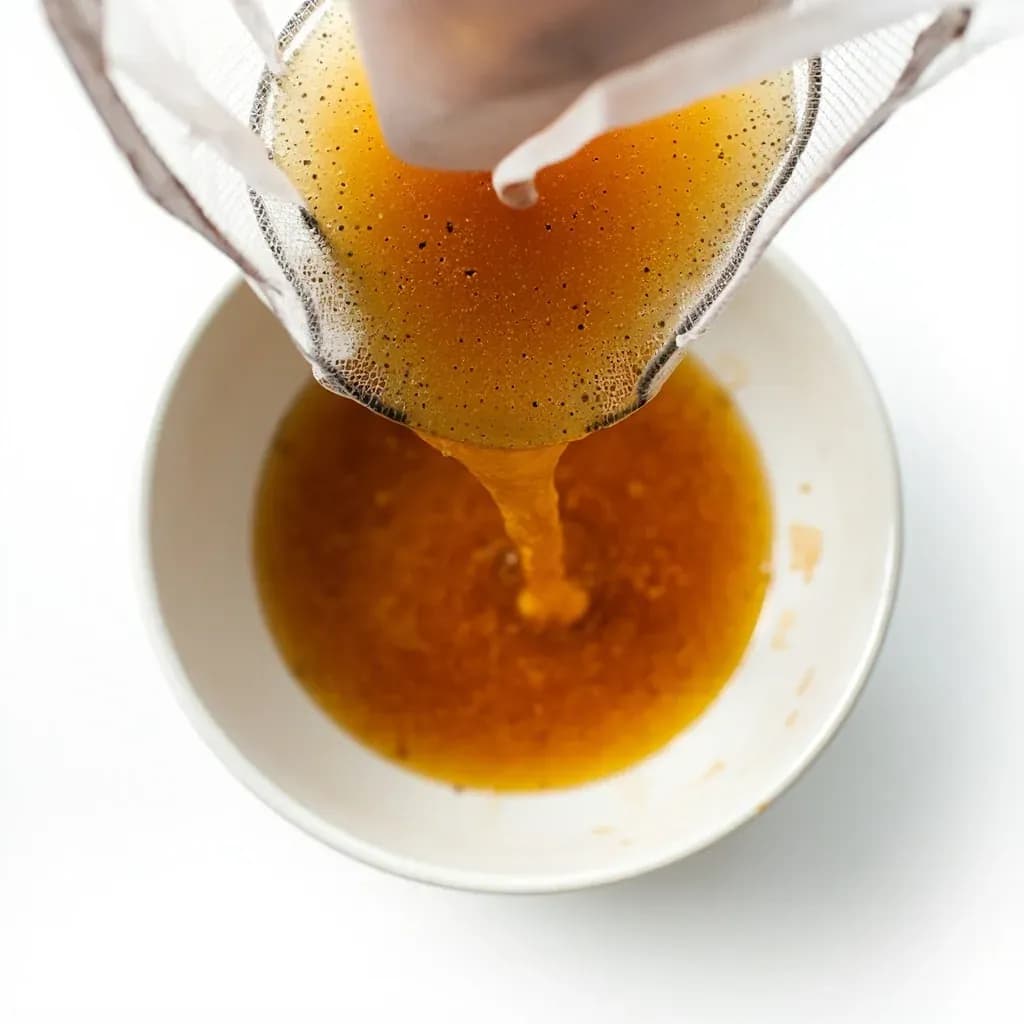
Straining pours a liquid through a sieve, chinois, or cloth to catch solids and produce a clear, smooth result. It clarifies stocks and sauces, removes seeds and pulp from juices, and drains pasta or blanched vegetables. A fine-mesh strainer or muslin gives the silkiest texture, and pressing or letting it drip undisturbed changes how much body passes through.
Straining is the mechanical separation of solids from liquids using a porous barrier, and it underpins nearly every liquid-based preparation in a working kitchen — from draining a pot of pasta to clarifying a consommé clear as glass. At its core, the technique hinges on two variables a cook controls: the fineness of the mesh and the amount of pressure applied. Finer mesh combined with gravity-only drainage yields a clear, polished liquid; coarser mesh and gentle pressing recovers more volume at the cost of body and clarity.
The right tool matters as much as the right technique. A colander is a strainer, and so is a piece of dampened cheesecloth draped over a sieve, and so is a tamis, a drum-shaped screen used to push berry purée through until it is seedless. Professionals often layer strainers — a china cap to catch the bulk of a stock's solids, then a chinois lined with muslin to polish it further — to reach a result no single tool could produce alone.
Straining also makes a kitchen more efficient and less wasteful. The solids left behind are rarely trash: tomato seeds and skins deepen a stock, berry pulp feeds a sorbet base, herb stems go back into broth, and rendered cracklings season bread. Knowing which remnants to keep, press, or discard is part of knowing the technique well.
- Difficulty
- Easy
Types & varieties
Wire mesh with openings around 1 mm; the workhorse for everyday sauces and gravies
Cone-shaped fine-mesh strainer used for the smoothest purées, veloutés, and consommés
Perforated metal, conical, with a long handle; classic for straining stocks and large batches
Large bowl with big holes; used for pasta, blanched vegetables, and rinsing produce
Drum-style screen stretched over a hoop; ideal for ultra-smooth purées and seedless berry coulis
Loosely woven cotton graded from #10 (open) to #90 (tight); sold by the yard
Tighter, more durable weave than cheesecloth; reusable; preferred for stocks and consommé
Fine-mesh nylon or cotton bag used for plant milks and cold-brew coffee
Flared fabric bag on a stand that lets jelly drip clear without pressing
Wire-mesh basket on a long handle for lifting solids from hot liquids during frying or blanching
Small handheld cone with fine mesh for finishing cocktails and clarifying small batches
How to do it
- 1
Select the strainer
Match the mesh size and shape to the job: coarse colander for pasta, fine-mesh sieve for sauces, chinois and cheesecloth for consommé, tamis for seedless purées.
- 2
Set up the receiving vessel
Place a bowl, pot, or measuring cup directly under the strainer. A wide-mouth vessel prevents splashing and catches the full flow without overflow.
- 3
Prepare a liner if needed
For ultra-fine work, line the strainer with dampened cheesecloth, muslin, or a nut-milk bag so the cloth hugs the mesh instead of bunching or slipping.
- 4
Pour or ladle in batches
Transfer the liquid slowly and in manageable amounts; for hot stocks, ladle rather than pour to avoid splashing and burns.
- 5
Let gravity do the work
Allow the liquid to drain on its own. Tap the side of the strainer lightly or stir the surface to release trapped liquid. Resist the urge to press when clarity matters.
- 6
Press only if the recipe allows
For purées, sauces, and coulis, use the back of a ladle or a flexible spatula to press the solids against the mesh. For stocks, consommés, and clarified liquids, stop short of pressing.
- 7
Discard or reserve the solids
Move solids to a separate bowl — most strained remnants can be reused in stocks, fritters, breads, or compost, not the trash.
- 8
Clean while fresh
Rinse the strainer under hot water right away; starches and purées harden fast and clog the mesh if left to dry.
Mesh and pressure: the two levers
Every straining decision comes back to two choices: how fine the barrier is, and how hard you push. Changing either one changes the result dramatically. A coarse colander drains pasta in seconds but lets vegetable fines pass through; a chinois lined with muslin takes minutes but returns a consommé that needs no further clarification. Pressing always speeds the job and increases yield, but it forces suspended particles and cloudiness back into the liquid, undoing the work the mesh has done. Read the recipe before you press — clarity-driven preparations (stocks, consommés, jellies, clarified butter) want gravity only, while purée-driven preparations (coulis, puréed soups, fruit butters) welcome a firm hand.
Layering strainers for the cleanest result
Professional kitchens rarely rely on a single pass. A common sequence: ladle a stock through a china cap to catch bones and aromatics, then run the liquid through a fine-mesh sieve, then finish through a chinois lined with dampened muslin. Each layer catches what the last one missed, and the result is a liquid that gleams. The same principle works at home — strain a tomato sauce through a sieve, then push it through cheesecloth for a silken texture suitable for a delicate pasta course. The trade-off is time and yield; use the layered approach when clarity is the goal, not when you want every last drop.
Common uses
Tips & pitfalls
- For crystal-clear stocks and consommés, never press the solids — let gravity drain, then discard the solids.
- Line a fine-mesh sieve with dampened cheesecloth or muslin to reach near-chinois fineness without specialty gear.
- Always place the receiving vessel close to the strainer to reduce splashing and the introduction of air bubbles.
- Use the back of a ladle or a flexible spatula to press purées; save the press for dishes where clarity does not matter.
- Pre-wet cheesecloth so it clings to the sieve and does not absorb your finished liquid.
- Tap the side of the strainer or stir the surface gently with a spoon to encourage flow rather than forcing it.
- Save strained solids: tomato seeds and skins enrich stocks, berry pulp goes into sorbet bases, herb stems flavor broth.
- Clean strainers immediately — starches and purées dry hard and clog the mesh within minutes.
- When making jelly or consommé, suspend the bag and do not squeeze, or the result will turn cloudy.
- A chinois sits perfectly over a stockpot or rondeau, making large-batch work ergonomic and steady.
Good to know
- Technique type
- Mechanical separation of solids from liquids using a porous barrier
- Fineness range
- From coarse (colander, roughly 5 mm holes) to ultra-fine (chinois with cheesecloth, sub-millimeter)
- Key variables
- Mesh size and applied pressure — finer mesh plus gravity-only yields clarity; coarser mesh plus pressing yields volume
- Equipment
- Fine-mesh sieve, chinois, china cap, colander, cheesecloth, muslin, nut-milk bag, tamis, skimmer, jelly bag
- Effect on yield
- Gravity-only straining gives clearer liquid; pressing extracts more volume but stirs sediment back into the liquid
- Origin
- Ancient practice; specialized tools such as the chinois and china cap were refined in professional French kitchens
- Cost
- Basic sieve and cheesecloth are inexpensive; chinois and tamis are mid-range professional investments
- Typical kitchen stations
- Saucier, garde manger, pastry, and stockpot station
Also called
Sieving · Draining
Dishes that rely on it



Related

Whisk
Beat ingredients smooth and aerated with a looping wire motion

Sift
Pass dry ingredients through mesh to aerate and remove lumps

Strain
Pour through mesh to separate solids from liquid for a smooth result

Filter
Pass liquid through fine material to clarify out the smallest particles

Rice
Press cooked potatoes through small holes for fluffy, lump-free texture

Mash
Crush soft cooked food into a rustic, creamy purée

Grind
Crush food into a coarse to fine texture, from spices to meat

Grate
Shred food into fine bits against a sharp-toothed surface