Prep & Assembly
Hand-Tossing Salad
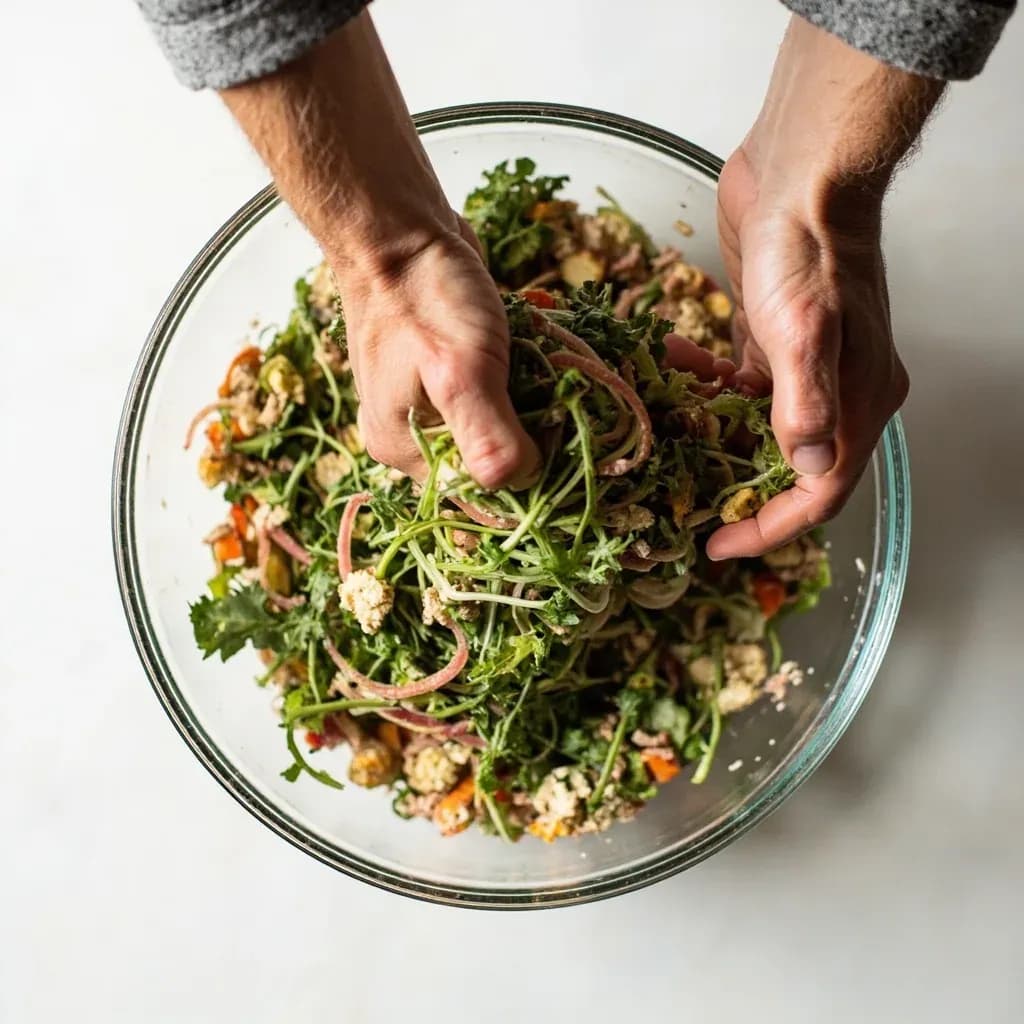
Mixing salad ingredients and dressing by hand or layering them for even coating.
Hand-tossing salad combines greens, vegetables, and dressing using the hands or utensils so every piece is evenly coated without bruising. In Burmese thoke, the hand mixes pungent, crunchy components into a balanced whole, while layered salads like sloyoniy salat stack ingredients instead. Tossing just before serving keeps greens crisp and prevents sogginess. The gentle, attentive motion distributes acid, salt, and texture throughout.
Hand-tossing is the foundational technique behind virtually every composed green salad: lifting and turning leaves in a bowl so that a thin, even film of dressing clings to every surface without bruising the greens or pooling at the bottom. Unlike folding or stirring, tossing is a vertical motion that coats by air and movement rather than pressure, which is why it preserves the snap of a romaine rib, the curl of a baby arugula leaf, and the velvet of a butter lettuce cup. The method is deceptively simple, but it is governed by a few non-negotiable physical rules — chiefly that water repels oil, and that delicate cells rupture under a closed fist faster than you can say 'wilted.' Get those right and a salad dresses in thirty seconds; get them wrong and you serve a watery puddle with a few dressed leaves floating in it.
The technique rose to theatrical prominence with the Caesar salad, traditionally prepared tableside from a wooden bowl in restaurants from Tijuana to New York beginning in the 1920s. That performance aspect — the rhythmic lift-and-turn in front of guests — is not merely showmanship: a wooden bowl is slightly porous, so it absorbs excess oil rather than letting it slide off, and it does not conduct cold the way metal does, so dressed greens stay at a comfortable temperature. Most home cooks toss in a chilled stainless or glass bowl, and the method still works beautifully so long as the greens are bone dry and the dressing is added in stages.
At its heart, hand-tossing is a lesson in restraint. A good toss is light, brief, and stopped the moment every leaf glistens. It is also a sensory skill — you read the salad through your fingertips, feeling when leaves begin to soften or stick together, and you adjust before the damage is done. Master the dry-greens rule and the less-dressing-more-toss principle, and the rest of composed-salad cookery opens up.
- Difficulty
- Easy
Types & varieties
Greens and dressing combined in a single large bowl, lifted from the bottom and turned repeatedly with hands or servers.
Dressing is mixed into greens in one bowl, then the salad is transferred to a clean serving bowl to discard any pooled liquid.
Tossed in a wooden bowl in front of guests, often with anchovies, croutons, or shaved cheese added mid-toss.
Hearty ingredients (roasted roots, legumes, grains) dressed first, with delicate greens and herbs folded in last.
Used for sturdy greens (romaine, kale, cabbage) or where hand contact is not appropriate.
Fingertips only, with clean dry nails — the gentlest method, reserved for butter lettuce, mâche, and other fragile leaves.
How to do it
- 1
Prep the greens
Wash greens in cold water, then dry them thoroughly in a salad spinner. Layer the spun greens between clean kitchen towels or paper towels and pat dry — they should feel completely dry to the touch. Any residual moisture will cause the dressing to slide off and pool.
- 2
Chill the bowl and greens
Refrigerate the mixing bowl (a wooden bowl can rest in the fridge for 15 to 30 minutes) and the dried greens. Cold greens stay crisp longer after dressing and resist bruising during the toss.
- 3
Add dressing to the bowl first
Pour the dressing into the empty chilled bowl — start with about 1 tablespoon per 4 oz (110 g) of greens. Adding dressing to the bowl first lets you see the coverage and stop short of overdressing.
- 4
Add the greens and begin lifting
Place the greens on top of the dressing. Slide your fingertips, salad servers, or tongs down to the bottom of the bowl and lift upward, turning the greens over so the dressed bottom layer rises to the top.
- 5
Turn and repeat
Continue lifting and turning from the bottom for 20 to 30 seconds, rotating the bowl slowly as you work. Stop as soon as every leaf carries a light, even sheen — no glossy puddles and no dry spots.
- 6
Adjust seasoning and transfer
Taste a leaf. Add more dressing only if needed, then season with salt and freshly ground black pepper. Transfer immediately to a clean serving bowl or plates.
- 7
Garnish and serve at once
Add delicate garnishes — herbs, edible flowers, shaved cheese, toasted nuts — after the toss so they sit on top rather than sinking into the dressed leaves. Serve within minutes; hand-tossed salads do not hold.
Why hands beat tools for delicate leaves
A pair of fingertips is the most sensitive implement in the kitchen. You can feel a leaf begin to tear before it actually does, and you can distribute pressure across a handful of leaves the way tongs never can. Tongs pinch; servers scoop; hands lift. For butter lettuce, mâche, baby lettuces, and other fragile leaf mixes, this matters enormously. The caveat is hygiene: wash with unscented soap, rinse thoroughly, and dry completely so no soap residue or skin oil transfers to the leaves.
- Use only the pads of the fingers and thumbs, never the palm or a closed fist.
- Trim nails short and scrub under them; long nails shred leaves and harbor residue.
- Hands should be cool and dry — warm hands raise the temperature of cold greens and accelerate wilting.
- Remove rings; they catch and tear leaves mid-toss.
The science of a clean coat
Dressing clings to a leaf through surface tension and a thin film of oil. Water breaks that film instantly, which is why wet greens produce a watery, unevenly dressed salad that pools at the bottom of the bowl. Drying greens in a spinner and then patting them with a towel removes the barrier. Salt, by contrast, draws moisture out of leaf cells, so seasoning is always the last step in a hand-tossed salad; salt early and the leaves begin to weep before they reach the table.
- Water and oil-based vinaigrette do not mix — water wins, dressing slides off.
- Salt osmotically pulls water out of plant cells, accelerating wilting.
- Acid (vinegar, citrus) firms cell structure briefly, which is why dressed greens stay crisp for several minutes before succumbing.
- Cold greens have firmer cell walls and resist bruising better than warm ones.
Common uses
Tips & pitfalls
- Dry greens thoroughly — a salad spinner followed by a clean kitchen towel is non-negotiable. Water repels oil-based dressing and pools at the bottom of the bowl.
- Add dressing to the bowl first, not the greens, so you can control coverage and stop short of overdressing.
- Use your fingertips, not a closed fist — lifting and turning beats squeezing, which crushes and bruises delicate leaves.
- Toss only at the last minute. Dressed greens begin to wilt within minutes, and a salad held too long tastes tired and watery.
- Season with salt and pepper only after tossing; salt draws moisture out of leaves and accelerates wilting.
- For sturdy greens like kale, cabbage, or romaine hearts, a 30-to-60-second massage with dressing tenderizes the leaves before other ingredients are added.
- Wooden bowls are traditional because they breathe slightly and absorb excess oil, but a chilled metal or glass bowl works well at home.
- If you must hold a dressed salad for more than a few minutes, dress it lightly and re-toss gently just before plating.
Good to know
- Technique type
- Mixing method
- Difficulty
- Easy (technique-driven, not recipe-driven)
- Active time
- 20 to 60 seconds per pound of greens
- Key requirement
- Greens must be thoroughly dried
- Ideal bowl
- Wooden bowl, chilled; metal or glass also work
- Working temperature
- Cold greens and room-temperature dressing coat most evenly
- Standard ratio
- About 1 tablespoon dressing per 4 oz (110 g) greens, adjusted to taste
- Origin of style
- Iconicized by Caesar salad service from the 1920s onward
Also called
Hand-Tossing Salad (Thoke) · Layering Salad (Sloyoniy Salat)
Related

Whisk
Beat ingredients smooth and aerated with a looping wire motion

Sift
Pass dry ingredients through mesh to aerate and remove lumps

Strain
Pour through mesh to separate solids from liquid for a smooth result

Filter
Pass liquid through fine material to clarify out the smallest particles

Rice
Press cooked potatoes through small holes for fluffy, lump-free texture

Mash
Crush soft cooked food into a rustic, creamy purée

Grind
Crush food into a coarse to fine texture, from spices to meat

Grate
Shred food into fine bits against a sharp-toothed surface