Prep & Assembly
Hot-Water Dough Making
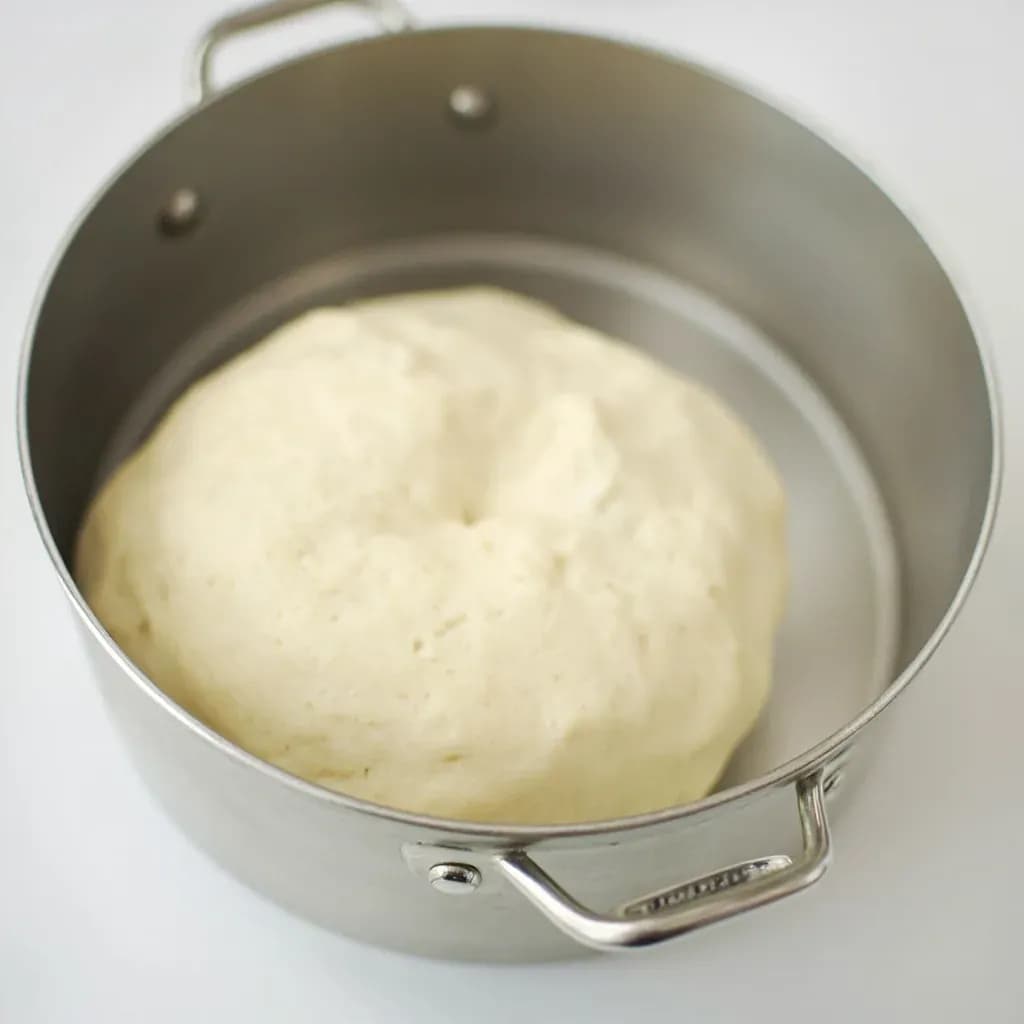
Mixing flour with boiling water to scald the starch for soft, pliable wrappers.
Hot-water dough is made by mixing flour with boiling or very hot water, which partially gelatinizes the starch and denatures some gluten. The resulting dough is soft, smooth, and stretchy yet less elastic, making it ideal for pan-fried dumplings, potstickers, and scallion pancakes. The scald also gives a more translucent, tender cooked wrapper.
Hot-water dough — 烫面 (tàng miàn), literally 'scalded dough' — is a Chinese technique in which a portion of the flour is hydrated with boiling water before the dough is kneaded, rested, and rolled. The heat gelatinizes the wheat starch: starch granules absorb water, swell, and burst, pre-cooking a fraction of the structure before the dough is fully formed. Because that gelatinized starch physically crowds in on the proteins and limits gluten network formation, the resulting dough is noticeably softer, more pliable, and less chewy than an all-cold-water equivalent. It also handles a thinner roll-out without springing back, which is why the technique underpins so many delicate dumpling and dim sum wrappers.
The same principle that gives pâte à choux its characteristic tenderness applies here: scalding changes how the starch behaves for the rest of the dough's life, not just for a few minutes after mixing. A full scald produces something almost pastry-like; a 50/50 hot-and-cold split (the everyday 'half-scald') lands in a middle zone that is still rollable to gossamer thickness but holds together when wrapped around a filling. Swapping wheat flour for wheat starch (essentially pure starch with very little protein) moves the technique into territory where the wrapper becomes translucent — the foundation of har gow and other crystal dumplings.
Hot-water dough is forgiving once you have temperature and stirring under control, and it is one of the most useful upgrades a home cook can make to a pan-fried or steamed dumpling. The skin stays tender through cooking, does not turn leathery as it cools, and seals cleanly without a heavy crimp.
- Difficulty
- Medium
Types & varieties
100% boiling water. Very tender, almost no chew, slightly translucent; used for pastry-like wrappers and steamed buns where softness outweighs elasticity.
About 50% boiling water plus 50% cold. The everyday compromise — soft and pliable yet still rollable to thin skins; the standard for potsticker and steamed jiaozi wrappers.
About 30% boiling water and 70% cold. A touch of scald for slightly softer texture with more elasticity; common for boiled jiaozi where the cooking water itself softens the skin.
Wheat starch (澄粉) blended with tapioca or cornstarch, scalded with boiling water and finished with a little hot oil or lard. Produces the translucent, glassy wrapper of Cantonese shrimp dumplings.
Half-scald approach with slightly higher hydration and a touch of oil, suited to the open-topped Cantonese pork dumplings where the skin should be supple enough to pleat open at the top.
How to do it
- 1
Measure and combine dry ingredients
Weigh flour into a heatproof mixing bowl. For every 100 g flour, add a small pinch of salt, which strengthens whatever residual gluten remains. For a crystal dough, substitute or blend in wheat starch and tapioca or cornstarch here.
- 2
Bring the water to a full boil
Heat the water in a kettle or small saucepan until it is at a vigorous, rolling boil. Have the cold or room-temperature water (if making a half- or third-scald) measured and ready beside the bowl.
- 3
Pour and stir at the same time
Pour the boiling water into the flour in a steady stream while stirring continuously with chopsticks or a wooden spoon. The mixture steams heavily and clumps within seconds; keep stirring until no dry flour remains and the mass looks shaggy and waxy.
- 4
Add the cold water for a half-scald
Drizzle in the cold or room-temperature water and continue to mix. This portion does not scald the starch further; it brings the dough up to a workable hydration and a temperature you can handle.
- 5
Cool briefly, then knead
Let the dough stand 1–2 minutes until it is cool enough to handle without burning. Turn it out and knead for 1–2 minutes — just until it forms a smooth, pliable ball. Do not work it further; you are not trying to develop gluten.
- 6
Wrap and rest
Flatten the dough into a disc, press plastic wrap directly onto the surface (or invert a snug bowl over it), and rest 20–30 minutes at room temperature. This lets the gelatinized starch relax so the dough rolls out evenly.
- 7
Portion and roll
Unwrap, divide into small portions (typically 8–12 g for dumpling wrappers), and keep the unused pieces covered as you work. Roll each piece into a thin round, dusting lightly with starch for translucent skins or flour for opaque skins.
- 8
Use promptly or store short-term
Use the wrappers within 1–2 hours for the most pliable seal. Stacked and covered, they can be refrigerated up to a day; stiff wrappers can be refreshed with 10–15 seconds in a steamer before filling.
The science: why scalded starch behaves differently
Wheat flour is roughly 70–75% starch and 10–12% protein. In a normal cold-water dough, the two proteins glutenin and gliadin hydrate, link up, and form an elastic network that traps gas and gives bread its chew. Starch granules meanwhile sit quietly in that matrix until heat sets them during cooking. Hot-water dough inverts the order: the starch cooks first, then everything else has to adapt. Above about 60 °C the starch granules absorb water, swell, and leach amylose into the surrounding liquid, which thickens and partly glues the flour together. The proteins still hydrate, but the gelatinized starch physically crowds in and prevents them from aligning into long elastic strands, so the dough binds without springing, rolls thin without snapping back, and stays tender when cooked. Translucency follows the same logic at higher starch concentrations: when you use wheat starch (almost no protein) and fully gelatinize it, the wrapper cooks through and reads as glassy rather than chalky.
- Starch gelatinization begins around 52–65 °C; boiling water gives a generous margin.
- Gelatinized starch physically limits gluten strand formation, which is the whole point of the technique.
- Higher scald ratio = more tenderness, less chew, slightly more translucency.
- Wheat starch (very low protein) is required for true translucency; wheat flour will always read as opaque.
Common uses
Tips & pitfalls
- Use a full rolling boil — water that has just been taken off the heat and cooled a few minutes will not fully gelatinize the starch and partly defeats the purpose.
- Stir immediately and continuously with chopsticks or a wooden spoon; the surface layer sets fast and lumps form within seconds of the water hitting the flour.
- Do not touch the dough with bare hands until it has cooled to a comfortable warmth (around 50 °C / 120 °F); you will get a steam burn and uneven hydration.
- Cover resting dough tightly — press plastic wrap onto the surface or invert a bowl over it. Exposed dough forms a dry, unworkable skin in just a few minutes.
- Resist over-kneading. The whole point of the scald is to limit gluten, so a few folds to bring the dough together is plenty.
- For crystal or translucent wrappers, use wheat starch (澄粉), not wheat flour — the protein in flour turns the dough chalky and opaque.
- If the dough cools and stiffens while shaping, microwave it for 5–10 seconds or rest it briefly over a bowl of warm water to relax the starch.
- Common mistake: using bread flour for soft wrappers. The extra protein re-forms gluten quickly and the scald effect is partly lost; stick to all-purpose unless you specifically want chew.
- Common mistake: pouring all the boiling water in at once without stirring. You end up with a doughy exterior and dry flour pockets inside.
- Common mistake: skipping the rest. Cut dough will snap back when rolled because the gelatinized starch has not yet relaxed.
Good to know
- Chinese name
- 烫面 (tàng miàn), literally 'scalded dough'
- Mechanism
- Boiling water gelatinizes the wheat starch, pre-cooking part of the structure and physically limiting gluten network formation
- Starch gelatinization range
- Roughly 52–65 °C / 125–149 °F; boiling water (~100 °C) ensures full scald
- Water-to-flour ratio
- About 45–55% water by weight of flour, depending on flour absorption
- Hot-to-cold split
- Ranges from 30/70 to 100/0 boiling-to-cold; 50/50 half-scald is the most common household version
- Resting time
- 20–30 minutes, covered, at room temperature
- Kneading time
- 1–3 minutes only — over-kneading works against the technique
- Working window
- Best used within 1–2 hours; exposed surfaces form a dry skin quickly
Also called
Scalded Dough · Tangmian
Related

Whisk
Beat ingredients smooth and aerated with a looping wire motion

Sift
Pass dry ingredients through mesh to aerate and remove lumps

Strain
Pour through mesh to separate solids from liquid for a smooth result

Filter
Pass liquid through fine material to clarify out the smallest particles

Rice
Press cooked potatoes through small holes for fluffy, lump-free texture

Mash
Crush soft cooked food into a rustic, creamy purée

Grind
Crush food into a coarse to fine texture, from spices to meat

Grate
Shred food into fine bits against a sharp-toothed surface