Heat & Fire
Kottu Chopping (Griddle Mincing)
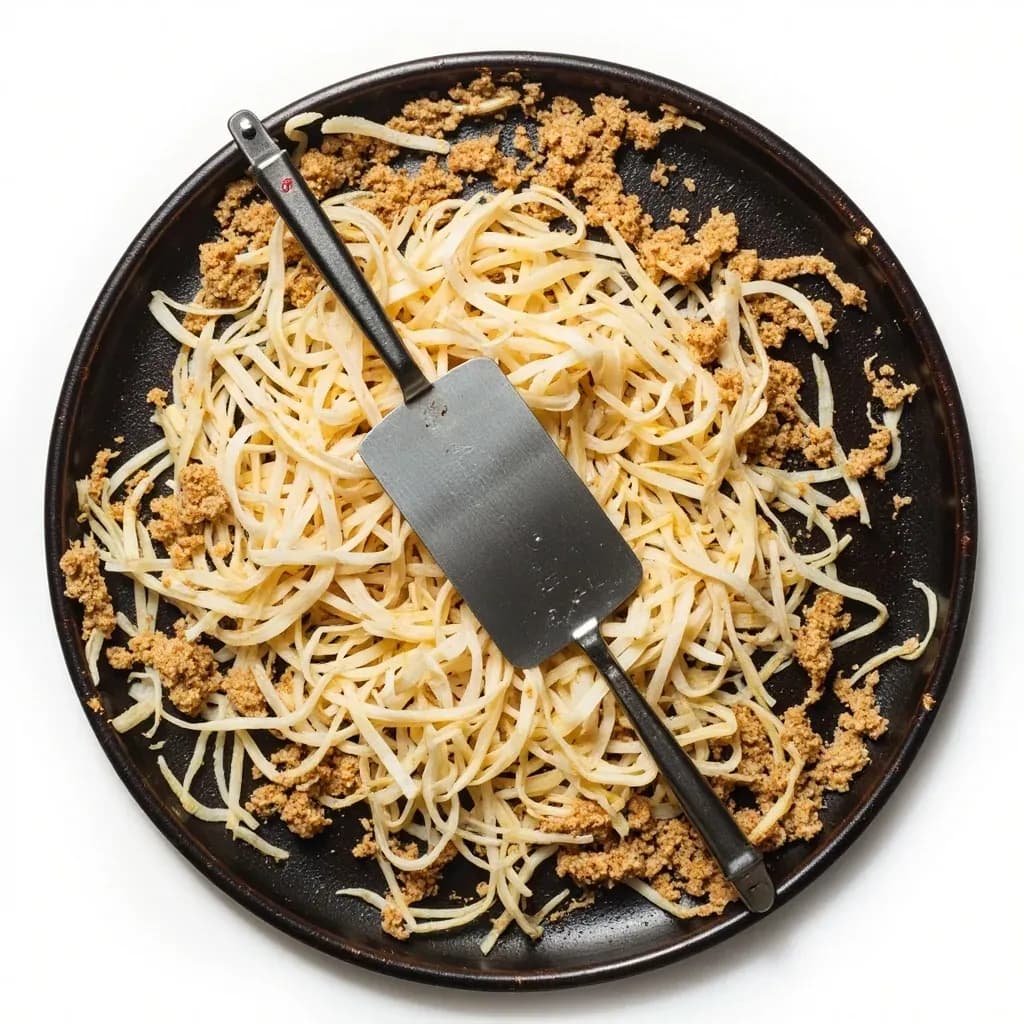
Rhythmically chopping roti, vegetables and egg together on a hot griddle with twin metal blades.
Kottu chopping is the Sri Lankan street-food technique of shredding godamba roti together with vegetables, egg and curried meat directly on a flat griddle using two flat metal blades in a fast clanging rhythm. The constant chopping and tossing tears the roti into ribbons while the griddle heat melds the components and crisps the edges. The signature percussive sound is part of the dish's identity and signals the cook's pace.
Kottu chopping is a Sri Lankan street-cooking technique built around a single flat griddle and a pair of metal blades. Pre-cooked curries, shredded vegetables, and shredded godamba roti — a flaky paratha-like flatbread — are piled onto a smoking-hot tava and chopped together with alternating, scissor-like strokes of the two blades. A practiced cook finishes a portion in three to five minutes without ever lifting the steel off the iron, and the action is meant to be heard as much as seen.
The technique behaves less like a stir-fry and more like a controlled chop-and-fry: the bread crisps on the griddle while being chopped into finer shreds, the vegetables wilt just enough to keep a residual crunch, and a raw egg poured over the top binds everything into glossy, sauce-coated strands. Heat is high and dry, the blades stay in contact with the surface, and rhythm — not force — is what determines the final texture.
It matters because kottu chopping solves a specific end-of-service problem: turning day-old roti, leftover curry, and trimmings into a hot, satisfying plate at speed, while doubling as a form of street theater. The cross-chop sound is the stall's advertisement; customers often order by ear before they read a menu. Outside Sri Lanka the same method has spread into coastal South India and Bangladesh, where the technique is identical even when the spice blend shifts toward bhaja masala.
- Difficulty
- Medium
Types & varieties
The standard; uses boneless chicken, usually pre-curried
Spiced minced or shredded beef, common at Muslim-run stalls
Heartier and fattier, popular in hill-country restaurants
A lighter, vegetarian-friendly base; one or two eggs chopped through
Cabbage, leeks, and carrots, with no meat
A modern addition; processed or mozzarella melted through at the end
Stronger spice load with extra chili, sometimes finished with Maldive fish chips
Coastal variant using cuttlefish, prawn, or dry fish
Combination of meats plus egg, often a leftover-driven plate
How to do it
- 1
Set up the griddle and tools
Place a flat cast-iron tava over high heat for several minutes until it is evenly smoking-hot. Lay the two chopper blades on the surface to warm; cold blades drag heat out of the griddle and will tear rather than cut the roti.
- 2
Bloom the aromatics and spices
Drizzle a small amount of oil onto the hot iron. Add finely chopped onion, garlic, ginger, and green chili and toss briefly with the blades. Sprinkle in Sri Lankan curry powder and a pinch of crushed chili and let the spices toast for 10–15 seconds without burning.
- 3
Add vegetables
Toss in shredded cabbage, leek, and carrot. Chop and lift with the blades for about 30 seconds so the vegetables wilt but still have a slight bite.
- 4
Add cooked protein
Stir in pre-cooked curried or roasted meat, fish, or seafood so it warms through and the sauce coats the vegetables. Push the mixture into a loose mound at the center of the griddle.
- 5
Add the shredded roti
Scatter shredded godamba roti evenly over the mound. Press lightly with the flat of the blades so the bread soaks up the sauce and contacts the hot griddle to crisp on the underside.
- 6
Pour the egg and chop through
Pour a beaten egg (or crack a whole egg) over the top. Begin the rhythmic cross-chop: alternate the two blades up and down across the pile, scraping the griddle between each stroke. Continue for 20–40 seconds until the egg sets and binds the shreds without clumping.
- 7
Season, finish, and plate
Splash in soy sauce, a pinch of salt, or extra chili. Give a final short chop to distribute. Scoop onto a plate, finish with a fried egg or cheese if using, and serve immediately with chili sauce or a wedge of lime.
The blades and the rhythm
The two tools that define kottu chopping are flat mild-steel strips, roughly 25–30 cm long, with a bare-metal or simple wooden grip. They are filed and resharped daily, and they are never sharpened into a knife edge — a blunt, weighted edge crushes and tears the roti into shreds rather than slicing it cleanly. The two blades are held in each hand, kept at the same height, and worked in alternating up-and-down strokes across the pile. Because they rarely leave the iron, they double as scrapers and as spatulas, lifting, turning, and mincing in the same motion. The steady, audible clatter — louder and more even the better — is what tells a regular customer that a skilled cook is on the tava.
- Blades should be flat mild steel, around 25–30 cm long, sharpened blunt rather than knife-edged
- Keep both blades at the same height and let the steel's weight do the work; hammering the griddle shreds the roti unevenly and dulls the edges
- Rest the blades flat on the iron between chops; lifting them wastes heat and breaks the audible rhythm that customers listen for
- A file and a whetstone are part of the kit — daily re-sharpening keeps the edges blunt but even
Roti, egg, and the finish
The roti is the backbone of the dish and the main reason the technique exists: godamba, a layered paratha-style flatbread common in Sri Lanka, holds its shape when shredded and crisps beautifully on a dry tava. Day-old or twice-cooked roti is preferred because fresh bread turns gummy. The egg, poured over the assembled mound near the end, is chopped through with the blades and acts as both a binder and a gloss, coating each shred without clumping. Final seasoning — soy sauce, salt, chili, or a squeeze of lime — is added late so the vegetables keep a slight crunch and the bread keeps its crisp edge.
- Use day-old or twice-cooked godamba roti; fresh roti goes gummy on the griddle
- Pour the egg over the mound and chop straight through it — do not stir it in separately
- Salt, soy, and chili go in at the very end so cabbage stays crunchy and shreds stay crisp
- Finish with a fried egg on top, cheese melted through, or chili sauce on the side
Common uses
Tips & pitfalls
- Use day-old or twice-cooked godamba roti so the shreds hold their bite and crisp on the griddle; fresh roti turns gummy
- Hold both blades at the same height and let the weight of the steel do the chopping — hammering the griddle tears the bread unevenly and dulls the edges
- Keep every ingredient pre-cut and lined up within arm's reach; service moves at one plate per few minutes
- Lightly oil the tava between portions; too much oil makes the roti soggy instead of crisp
- Add the egg last and chop straight through it so it acts as a binder and a gloss rather than scrambling in clumps
- Hit a steady, audible rhythm — customers order by sound, and uneven chopping is the clearest tell of an amateur
- Salt and sauce go in toward the end so the cabbage stays slightly crunchy
- If the griddle cools, push everything to the center, not the edges, to recover temperature quickly
Good to know
- Origin
- Sri Lanka, most likely the Colombo area
- Likely developed
- Late 1970s to early 1980s
- Primary equipment
- Flat cast-iron griddle (tava) and two metal chopper blades (saral/saranu)
- Base starch
- Shredded godamba roti, ideally day-old or twice-cooked
- Cutting motion
- Alternating vertical chop, scissor-like, blades kept flat on the griddle
- Skill level
- Intermediate — requires rhythm, coordination, and heat control
- Texture goal
- Slightly crisp shred-sized pieces with soft, flavor-soaked interiors
Also called
rice-tempering-kottu · kottu roti chopping · griddle mincing
Related

Sear
Blast the surface hot for a deep-browned, savory crust

Sauté
Cook quickly in a little fat over lively heat, tossing as you go

Stir-Fry
Toss bite-sized pieces over roaring heat for fast, smoky cooking

Pan-Fry
Crisp food in a shallow layer of hot fat, turning once or twice

Deep-Fry
Submerge in hot oil for an all-over crackling crust

Roast
Cook uncovered in dry oven heat for browned edges and tender centers

Bake
Cook with steady, surrounding oven heat — the soul of bread and pastry

Broil
Hit food from directly above with fierce overhead heat