Transform & Preserve
Levain Build
Feeding flour and water to a sourdough starter to grow an active, ripe leaven before mixing dough.
A levain build is the staged feeding of a portion of mature sourdough starter with fresh flour and water to create an active leaven for a specific bake. The build is timed so the levain peaks in activity, with plenty of wild yeast and bacteria, just as it is added to the final dough. Ratios and temperature control the flavor, rise strength, and sourness of the finished bread.
A levain build is a scheduled refresh of sourdough starter — a measured portion lifted from the mother culture, fed with fresh flour and water, and grown to peak activity before being folded into the final dough. The practice predates commercial yeast by centuries and remains the foundation of traditional bread baking across Europe. Unlike casually spooning starter into dough, a build is a deliberate fermentation step: you choose the ratio, flour, hydration, and temperature, then watch the culture climb to a known peak that you can time to your schedule.
The build is the baker's main lever for shaping both flavor and timing. A 1:1:1 levain at warm room temperature peaks in a few hours with mild, yogurty acidity; a 1:5:5 build left overnight develops deeper, fruitier, more complex sourness. By aligning the levain's peak with the moment you plan to mix — and synchronizing that with autolyse, bulk fermentation, and shaping — the baker turns an unpredictable wild culture into a predictable, schedulable ingredient. Mastery of the build is what separates sourdough baking that "works" from sourdough baking you can plan a day around.
Mechanically, a build is just flour, water, and live starter held at a controlled temperature until microbes multiply, gas accumulates, and the mass reaches roughly 2.5–4× its starting volume. But the choices made at this single step — the ratio, the flour, the hydration, the warmth — echo through the rest of the bake in crumb structure, crust color, and tang.
- Difficulty
- Medium
Types & varieties
Built at the same hydration as the final dough; the simplest approach and the default in most baguette and country-loaf formulas.
Built at 100% hydration or higher; pourable, fast-fermenting, contributes to an open crumb — typical in ciabatta and high-hydration pan loaves.
Built at 50–65% hydration; slower, more acidic, gives a chewier crumb and blistered crust; common in German and rustic rye breads.
Built with whole-wheat, rye, or other whole-grain flours; introduces wild enzymes and stronger flavor, and acclimates the culture to the flours it will ferment.
Warm-temperature build used within 3–6 hours; milder flavor profile and convenient for short timelines.
Cool-temperature build for 10–14 hours; develops deeper, more aromatic sourness; the workhorse of morning-mix formulas.
A build that combines levain with a scalded flour paste (tangzhong/yudane) or a soaker to add moisture and flavor in enriched or high-hydration doughs.
How to do it
- 1
Calculate the amount of levain needed
Decide what percentage of total dough flour will come from the levain — 15–20% is a balanced default for most sourdough. Multiply that percentage by the total flour in the formula; the levain's total weight equals levain flour + levain water + the starter you feed it. A typical home loaf uses 60–150 g of ripe levain.
- 2
Choose the ratio and timing
Pick a starter:flour:water ratio that matches when you plan to mix. Use 1:1:1 for same-day builds (3–6 hr peak), 1:2:2 or 1:3:3 for mid-range timing, and 1:4:4 or 1:5:5 for overnight (10–14 hr) builds. Adjust up or down for ambient temperature.
- 3
Choose the flour and hydration
Match the levain flour to the final dough, or include a portion of the whole-grain or rye you will bake with to acclimate the culture. Set hydration: 100% is the all-purpose default, 80% for stiffer styles, 110–125% for a pourable liquid levain.
- 4
Reserve mother starter and combine
Before feeding, remove and store the small amount of mother starter you will refresh separately. In a clean jar, weigh the calculated starter, flour, and water. Mix thoroughly with a spatula or chopstick until no dry flour remains and the consistency is uniform throughout.
- 5
Mark and cover
Mark the level of the mixture on the jar with a rubber band, tape, or erasable marker so the rise is easy to read. Cover loosely — a lid set ajar, a cloth secured with a band, or a jar lid cracked — to let gas escape while keeping debris out.
- 6
Proof at a controlled temperature
Place the jar in a stable environment: a warm corner of the kitchen (24–27 °C / 75–80 °F) for fast builds, a cooler spot (20–22 °C / 68–72 °F) for longer builds, or the fridge (3–5 °C) for a long, slow, aromatic build. Avoid drafts and direct sun.
- 7
Watch for peak activity
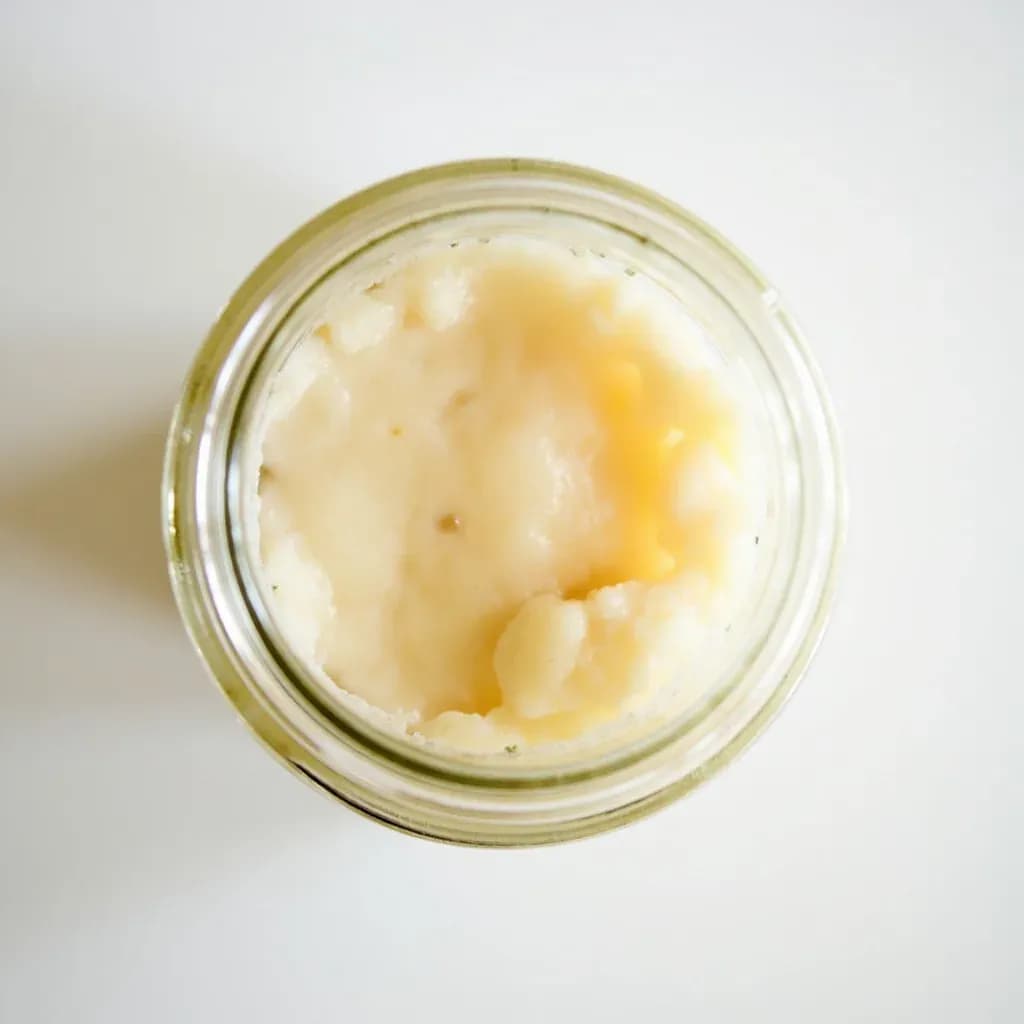
Peak is reached when the levain has roughly 2.5–4× its starting volume, the top is domed with a slight central dip, the surface is full of bubbles, the texture is light and ribbon-like when scooped, and the aroma is pleasantly tangy-sweet. A fully deflated, flat surface with sharp acetone or alcohol notes means it has gone too far.
- 8
Use or briefly hold
Use the levain at peak (or within a short window of peak) in the final dough. If you need to hold it, refrigerate for 30–90 minutes to slow activity; bring it back to room temperature before mixing so it disperses evenly throughout the dough.
- 9
Refresh the mother starter
Feed the reserved mother starter with fresh flour and water at its usual ratio, return it to storage, and let it recover fully before its next build. A neglected mother is the most common cause of a sluggish levain.
Reading ratio, hydration, and temperature together
Ratio, hydration, and temperature are the three knobs that determine when the levain peaks and what it tastes like. Once you understand how they interact, you can plan almost any build to finish when you need it to.
- Ratio (1:1:1, 1:2:2, 1:5:5) controls how long the culture takes to peak: low ratios peak fast because the starter is a large fraction of the mass; high ratios peak slowly because the microbes have more flour and water to work through.
- Hydration affects speed and texture: a 100% levain is pourable and ferments briskly; a 60% stiff levain ferments more slowly and trends toward acetic (vinegary) acidity rather than lactic (milky).
- Temperature is the multiplier on every other choice. A 1:5:5 build at 21 °C / 70 °F may peak in 10 hours; the same build at 26 °C / 79 °F can peak closer to 6. Adjust ratio before adjusting temperature — it is the more predictable lever.
Why match the levain flour to the final dough
A sourdough culture adapts to the flour it is fed. Building with a different flour than the one in your dough means the microbes are working on unfamiliar starch and enzyme profiles, and the levain will underperform until it adjusts. The practical rule is simple: build with the same flour (or a subset) you will bake with.
- White-flour doughs build fastest with a white-flour levain; adding 20–40% whole grain to the build injects enzymes and micronutrients that brighten fermentation.
- Rye-heavy doughs benefit from a rye or whole-rye levain, which breaks down pentosans and phytic acid and gives the crumb flexibility.
- Switching flours in the build (for example, feeding the mother with spelt after years on wheat) is a multi-feed transition — one build is not enough to acclimate the culture.
Common uses
Tips & pitfalls
- Build the levain with the same flour (or a subset) used in the final dough so the culture is acclimated and performs predictably.
- Mark the level on the jar with a rubber band or marker and read the rise objectively — eyeballing volume is the most common reason bakers miss peak.
- Use a kitchen scale, never volume measures; ratios are the point, and densities vary with hydration and flour type.
- For an easy overnight build, lean on a 1:5:5 ratio — it gives a wide peak window and forgives a 30–60 minute timing error.
- Use the levain at peak, not after collapse; an exhausted levain still tastes sour but will not lift the dough.
- In a hot kitchen, lower the ratio (from 1:5:5 to 1:2:2) or chill the levain to slow it down; in a cold kitchen, build a smaller ratio or proof in a warm spot such as an oven with the light on, a proofing box, or on top of the fridge.
- Always reserve a small amount of mother starter before building the levain — depleting the culture is unrecoverable and easily avoided.
- Trust the smell: pleasant yogurt and ripe-fruit notes mean good activity; sharp acetone or nail-polisher notes mean the levain has gone too far and will underperform in the dough.
Good to know
- French term
- Levain (also leaven or preferment) — a refreshed portion of starter, grown to peak, used to leaven the final dough.
- Common ratios
- Starter : flour : water by weight, typically 1:1:1, 1:2:2, 1:3:3, 1:4:4, or 1:5:5. Higher ratios take longer to peak.
- Target in final dough
- Levain usually supplies 10–25% of total dough flour (up to 30% in some formulas); 15–20% is a balanced default for most sourdough loaves.
- Hydration
- 75–100% is standard, often matched to the final dough. High-hydration builds (110–125%) are pourable; stiff builds (50–65%) ferment more slowly and trend toward acetic (vinegary) acidity.
- Peak time
- Roughly 3–6 hours for a 1:1:1 at 24–27 °C / 75–80 °F; 8–12+ hours for a 1:5:5 at 18–21 °C / 65–70 °F; overnight fridge builds run 12–24 hours.
- Signs of peak
- Domed top with a slight central dip, bubbles throughout the surface, 2.5–4× starting volume, ribbon-like scoop, and a sweet yogurt-to-ripe-fruit aroma.
- Equipment
- Clear glass jar (to read the rise), kitchen scale, spatula or chopstick, loose lid or cloth cover, rubber band or marker to track the level.
- Storage of mother
- Reserve a small portion of the original starter before building; refresh and store it separately — refrigerated for weekly bakers, on the counter for daily bakers.
Also called
Starter Feeding (Refreshment) · Making a Yeast Starter · Building a Leaven · Refreshment
Dishes that rely on it
Related

Confit
Cook slowly submerged in fat for silky tenderness and keeping

Cure
Draw out moisture with salt and time to preserve and concentrate

Pickle
Steep in acidic brine for bright, tangy, crunchy preservation

Ferment
Let friendly microbes transform food into tangy, complex flavor

Marinate
Soak in a seasoned mix to flavor and tenderize before cooking

Brine
Soak in salt water so meat stays juicy and seasoned throughout

Dehydrate
Slowly dry out moisture to concentrate flavor and extend shelf life

Cold-Smoke
Perfume cured food with smoke without cooking it through