Prep & Assembly
Matcha Whisking
Whisking powdered green tea with hot water into a smooth, frothy bowl of matcha.
Matcha whisking blends sifted matcha powder with hot (not boiling) water using a bamboo chasen, moving in a brisk W or M motion to break up clumps and aerate. The goal is a lump-free liquid topped with fine, even foam. Water temperature around 70 to 80 degrees Celsius keeps the tea from turning bitter.
Matcha whisking is the technique of suspending powdered green tea in hot water with a bamboo whisk (chasen) to produce a smooth, evenly aerated drink with a fine crema on top. Unlike steeped tea, every particle of matcha is meant to be ingested, so the goal is twofold: dissolve the powder completely and incorporate just enough air to lighten the body and mellow the vegetal notes. Done well, the bowl has a glossy jade-green surface of pin-fine bubbles; done poorly, it is dull, chalky, or bitter.
The technique was formalized within the Japanese tea ceremony from the Muromachi period onward, and its rhythm — sift, add water, whisk in a zig-zag, lift to foam — is built around the geometry of a bamboo whisk splitting water across a wide ceramic bowl. The motion is less about force than about wrist shape: a loose zig-zag pulls air from the surface and folds it into micro-bubbles, while circular stirring churns the liquid and flattens the foam. Water temperature and ratio do the rest of the work, and once you can read a bowl — color, crema, viscosity — you can adjust any of them on the fly.
- Difficulty
- Medium
Types & varieties
The everyday preparation: about 2 g matcha to roughly 70 ml water, whisked briskly in a zig-zag to build a light crema.
Ceremonial thick tea: about 4 g matcha to 30–40 ml water, kneaded slowly with the chasen into a smooth, syrupy paste with no foam at all.
Whisked in a bowl with an electric milk frother or handheld mini-whisk; produces larger, less stable bubbles and is common in cafés.
Whisked into a small amount of water to a paste, then combined with steamed or cold milk; foam quality matters less because the milk does the aerating.
How to do it
- 1
Sift the matcha
Place 1.5–2 chashaku scoops (about 2 g) of matcha into a dry chawan. Press it through a fine strainer (furui) with the back of a chashaku or spoon to break up any clumps and aerate the powder.
- 2
Prepare the chasen
Soak the bamboo prongs in warm water for 1–2 minutes, then shake off the excess. This softens the tines so they flex rather than snap, and it primes the whisk to move freely through the liquid.
- 3
Add hot water
Pour 60–70 ml of water cooled to 70–80°C (158–176°F) over the sifted matcha. Never pour boiling water; if you do not have a thermometer, boil and then let the water rest for about 5 minutes.
- 4
Whisk in a zig-zag
Hold the chasen vertically with the prongs touching the bottom of the bowl. Using a loose wrist, sweep the whisk briskly back and forth in an 'M' or zig-zag pattern across the surface for 20–30 seconds, gradually lifting the whisk as foam builds so you are incorporating air from the top, not churning the depth.
- 5
Finish and serve
Stop when a fine, pale-green crema of micro-bubbles covers the surface. Tap the chasen gently on the rim of the chawan to shed water, rest it on a whisk holder (kasen), and lift the bowl to drink from the front (omote) side.
Reading the bowl
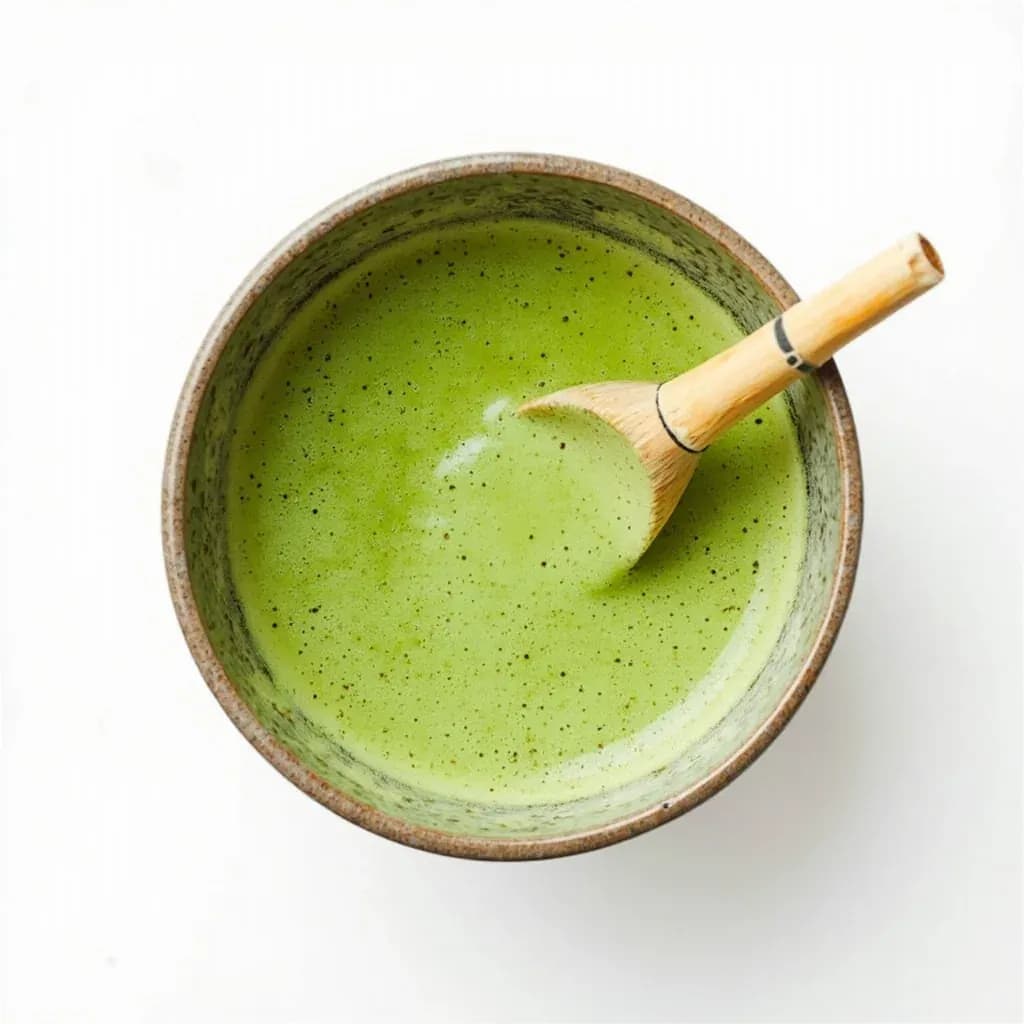
A finished bowl of usucha tells you almost everything about the technique behind it. A good bowl is glossy, with a pale jade-green crema of micro-fine bubbles, and a slight viscosity on the lips. A bowl that is dull, yellow-green, and chalky on the tongue was almost certainly under-whisked or added to water that was too cool to release the powder. A bowl that is foamy in a coarse, soapy way and tastes grassy or sharply bitter was likely poured with water that was too hot, over-whisked, or both. Color is the fastest signal: bright jade means the chlorophyll is intact; olive or khaki means the leaf has been scorched.
- Glossy, pin-fine crema — correctly whisked at 70–80°C.
- Dull, chalky texture — under-whisked or water too cool.
- Coarse, soapy foam with bitterness — water too hot or over-whisked.
- Yellow-olive color — chlorophyll damaged, usually by boiling water.
Usucha vs. koicha
The same powder and the same whisk are used, but the two preparations are functionally different drinks. Usucha is aerated; koicha is not. In usucha the chasen is held vertically and driven in a quick zig-zag across the surface to incorporate air and lighten the body. In koicha the chasen is held loosely, lowered only into the lower third of the bowl, and moved in slow, small circles to knead the powder into the water into a paste the consistency of warm honey. Foam is a fault in koicha; the surface should be smooth and reflective, like poured cream.
- Usucha: 2 g matcha to ~70 ml water; whisked briskly; light foam desired.
- Koicha: 4 g matcha to ~30–40 ml water; kneaded gently; no foam.
- Same bowl and whisk; the change is in wrist motion, depth, and time.
Common uses
Tips & pitfalls
- Always sift the matcha through a fine mesh strainer before adding water — clumping is the most common flaw in home whisking.
- Bring water to a boil, then cool it to roughly 70–80°C before pouring; boiling water scorches the powder and turns the drink grassy and bitter.
- Soak the chasen tines in warm water for 1–2 minutes before use to soften the bamboo and prevent the prongs from snapping.
- Hold the chasen vertically and move it in a brisk 'M' or zig-zag pattern with a loose wrist — circular stirring flattens the foam instead of building it.
- Aim to whisk the surface, not the depth; the goal is to fold air in from the top and form a creamy micro-foam, not to churn the liquid underneath.
- If the foam comes out coarse and soapy, your water is almost certainly too hot — cool it and try again before changing your whisking motion.
- Rinse the chasen under running water, shake it out, and air-dry it upright on a whisk holder; never put it in a dishwasher and never leave it sitting in water.
- A pinch of salt in koicha is traditional in some schools (notably Urasenke) to round the flavor; do not add it to usucha.
Good to know
- Origin
- Japan, formalized within chanoyu from the 12th century onward; bamboo chasen use dates to the Muromachi period.
- Primary tool
- Chasen — bamboo whisk carved from one piece of bamboo; common prong counts are 16 (kazuho, for koicha), 80 (standard usucha), and 100 (fine-tip usucha).
- Bowl
- Chawan (tea bowl); flat-bottomed or wide-rimmed shapes give the whisk room to move and build foam.
- Water temperature
- 70–80°C / 158–176°F; boiling water scorches the powder and produces a bitter, dull-green drink.
- Usucha ratio
- About 2 g matcha to 60–70 ml water (roughly 1.5 chashaku scoops or 1 teaspoon).
- Koicha ratio
- About 4 g matcha to 30–40 ml water; kneaded slowly into a paste rather than whisked.
- Active whisking time
- 20–30 seconds for usucha; koicha is kneaded gently for 1–2 minutes.
- Target texture
- Fine, even micro-foam with a creamy crema, no visible clumps of powder.
Related

Whisk
Beat ingredients smooth and aerated with a looping wire motion

Sift
Pass dry ingredients through mesh to aerate and remove lumps

Strain
Pour through mesh to separate solids from liquid for a smooth result

Filter
Pass liquid through fine material to clarify out the smallest particles

Rice
Press cooked potatoes through small holes for fluffy, lump-free texture

Mash
Crush soft cooked food into a rustic, creamy purée

Grind
Crush food into a coarse to fine texture, from spices to meat

Grate
Shred food into fine bits against a sharp-toothed surface