Prep & Assembly
Organoleptic / Sensory Assessment
Evaluating food by taste, smell, sight, and feel to judge quality and balance.
Organoleptic assessment is structured tasting and sensing, judging aroma, flavor, texture, appearance, and sometimes sound to evaluate quality, ripeness, or seasoning. Professionals use it on cheese, wine, coffee, and finished dishes, often in blind panels for objectivity. It is the cook's most fundamental quality-control tool and guides every adjustment.
Organoleptic assessment is the deliberate, systematic use of sight, smell, taste, touch, and sound to judge a food's quality, balance, and doneness. In a working kitchen it shows up in the smallest gestures — a pinch tasted from the tip of a spoon, a steak pressed for spring, a sauce sniffed before it goes on the plate — and in the most rigorous, where a trained panel scores dozens of attributes against a defined rubric. The phrase comes from late 19th-century chemistry, but the discipline underneath it is as old as cooking: the cook who tastes with intent rather than reflex catches a sauce that has gone flat, a stock tipping toward sour, a chocolate that has lost its snap.
What separates an organoleptic check from casual tasting is structure. You are not just asking "is it good?" — you are asking "is the salt right, the acid bright, the texture clean, the aroma intact, the color true?" You sequence the senses (look, listen, smell, touch, taste), you reset between samples, and you write down what you notice before the impression fades. Done well, the practice turns a kitchen's intuition into a shared language that survives shift changes, staff turnover, and the gap between what a chef imagines and what a guest receives.
- Difficulty
- Medium
Types & varieties
Determine whether samples differ at all — triangle test, duo-trio, paired comparison, and A-Not-A.
Trained panels quantify attributes using methods such as Quantitative Descriptive Analysis (Stone & Sidel) and the Spectrum method.
Measure liking with the 9-point hedonic scale or JAR scale, the workhorse of consumer research.
8–12 calibrated assessors scoring against agreed reference standards for repeatable, objective results.
Larger groups of untrained users measuring acceptance or preference under realistic eating conditions.
Order samples by intensity of a single attribute such as saltiness or bitterness.
Track how a sensation evolves during tasting — attack, peak, and aftertaste.
Each panelist develops their own vocabulary, then data is aligned statistically — useful when descriptors are unknown.
How to do it
- 1
Set the stage
Choose a quiet, odor-neutral space with consistent, neutral lighting (daylight or 6500 K). Gather identical vessels — white plates or coded glasses — along with room-temperature water and palate cleansers such as plain crackers or apple slices. Confirm each sample is at its proper tasting temperature before you begin.
- 2
Look first
Observe color, uniformity, gloss, transparency, surface texture, and shape. Note browning, syneresis, weeping, oxidation, or off-colors. For liquids, tilt the glass and check clarity, viscosity (legs or tears on the side), and any sediment.
- 3
Listen when relevant
Note sound cues that often predict texture: the crackle of a bread crust, the snap of fresh vegetables, the sizzle in a hot pan, the pop of a cork, the cut resistance under a steak knife. Sound is the most underused sense in tasting and one of the most honest.
- 4
Smell — orthonasal
Take three or four short, gentle sniffs rather than one deep inhale, which causes olfactory fatigue. Identify top notes first, then secondary aromas. Categorize descriptors (fruity, floral, earthy, roasted, dairy, vegetal, off-notes) and rate intensity.
- 5
Touch — in hand and in mouth
Feel weight, firmness, surface moisture, and springiness between thumb and forefinger. In the mouth, evaluate initial bite, chew resistance, particle size, moistness, and afterfeel — astringency, coating, melting, residual film.
- 6
Taste — gustatory and retronasal
Confirm the five basic tastes: sweet, sour, salty, bitter, umami. Move the sample across the entire palate and pay attention to the retronasal phase, where aromas reach the nose through the back of the throat during chewing. Note attack, peak, and finish or length.
- 7
Synthesize and record
Weigh intensity against balance, complexity against clarity, and flag any defects. Score against a defined scale or rubric, and write structured notes immediately — impressions fade within minutes. In formal panels, avoid discussion until all samples have been scored to prevent bias.
- 8
Decide and act
Translate findings into action: more salt, longer rest, lower cooking temperature, an adjustment to acid or fat. For quality control, accept, rework, or reject against pre-set specifications. Communicate the decision using the team's agreed shared vocabulary so the fix can be carried out by anyone on the line.
From kitchen instinct to formal panel
The same five senses power both a line cook's mid-service spoon-taste and a 12-person descriptive panel in a sensory lab. What changes is the rigor, the vocabulary, and the statistical treatment. In the kitchen, an organoleptic check is fast, intuitive, and aimed at a single decision: accept, adjust, or reject. In product development and quality control, it is slowed down, calibrated, and scored against agreed references so that results can be reproduced across days, panelists, and sites. A cook moving into formal sensory work needs three things: training on reference standards (what does a 'bright' acidity actually feel like at a defined pH?), a structured environment, and a willingness to separate personal preference from objective description.
Building a shared kitchen vocabulary
The single most useful habit a brigade can build is agreeing on what words mean. 'Bright' and 'flabby,' 'grassy' and 'metallic,' 'cloying' and 'short' — these descriptors only carry weight when the team uses them the same way. Hold a 30-minute calibration session: line up a range of sauces or oils, taste them blind, and write down descriptors independently. Compare notes, debate the outliers, and settle on shared definitions tied to reference products. The vocabulary that emerges becomes the kitchen's working language for tasting notes, QC reports, and recipe iteration.
Catching common defects
Trained tasting surfaces problems that no instrument catches cleanly. Rancidity in fats and nuts shows up as a paint-like or waxy off-note. Oxidation in wine, beer, and fruit sauces reads as bruised apple or sherry-like. Fermentation faults include buttery diacetyl in beer, volatile acidity (an acetic, nail-polish-remover sharpness) in wine, and barnyard Brettanomyces character when unwanted. Staleness in bread and pastries appears as a flat, papery aroma and a tough crumb. Salt out of balance either flattens the dish or dominates it. Training the kitchen to name these defects — and to know what causes them — turns a vague complaint into a fixable problem.
Common uses
Tips & pitfalls
- Taste from mildest to strongest, and rinse with room-temperature water plus a plain cracker or apple slice between samples to reset the palate.
- Standardize the environment — neutral lighting, an odor-free room, quiet space, consistent serving temperature — or your results will drift session to session.
- Do not taste when extremely hungry, full, ill, or fatigued; perception drifts and personal bias sharpens. Avoid coffee, smoking, and strongly flavored food for at least 30 minutes beforehand.
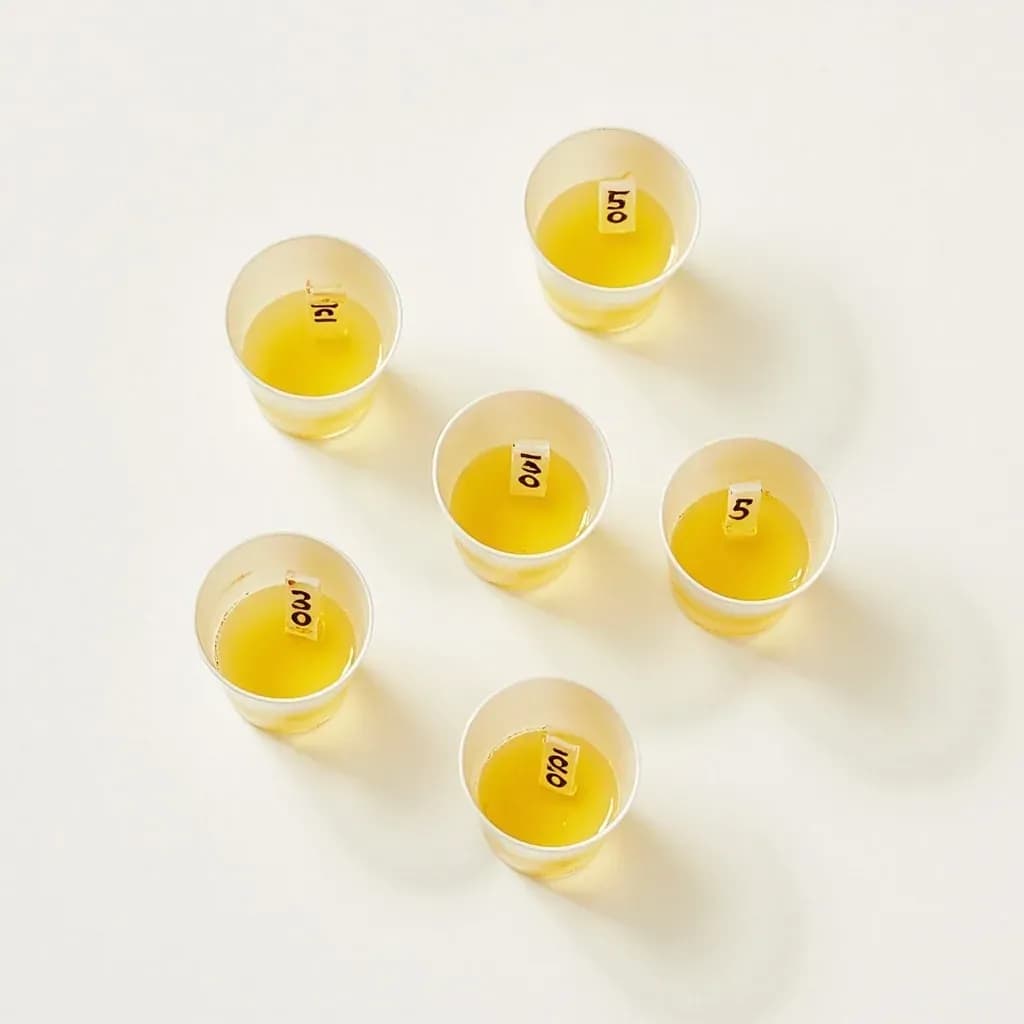
- Use closed, numbered, or blind-coded samples so appearance, brand, and expectation cannot bias the call.
- Give aroma its own moment: short, gentle sniffs before tasting, then retronasal perception during chewing. Chewing deliberately eight to twelve times releases most of the volatile compounds.
- Evaluate intensity and balance together — a sauce can be technically correct on salt yet still feel heavy because the acid has gone flat.
- Combine at least two cues for doneness (color plus probe resistance, or crust color plus internal temperature) — never trust a single sense.
- Keep a tasting journal with date, sample, descriptors, and decision; over time it shows you how your palate drifts and where your vocabulary is weakest.
Good to know
- Origin of term
- Coined in late 19th-century chemistry and pharmacology; modern sensory science formalized mid-20th century through food-science research.
- Senses used
- Sight, smell (both orthonasal through the nose and retronasal through the back of the throat), taste, touch/mouthfeel, and sound.
- Basic tastes
- Sweet, sour, salty, bitter, and umami, with fat/kokumi, pungency, and astringency typically assessed alongside.
- Common scales
- 9-point hedonic scale (Peryam & Pilgrim, 1950s), just-about-right (JAR) scale, structured line scales, and intensity scales.
- Panel types
- Trained expert panels of 8–12 calibrated assessors versus untrained consumer panels of 50 or more respondents.
- Standard testing temperature
- 20–25 °C (68–77 °F) for most products; specific items tasted at service temperature (red wine 16–18 °C, olive oil ~28 °C).
- Difficulty
- Basic checks (seasoning, doneness) are easy; formal panel work requires training, calibration, and statistical literacy.
- Time required
- Seconds for a quick check; 30–90 minutes per session for descriptive panel work; full panel studies span days.
- Key equipment
- White or neutral plates, coded glasses, room-temperature water, plain crackers or apple slices as palate cleansers, and either paper forms or dedicated software such as RedJade or Compusense.
- Relevant standards
- ISO 6658 (general methodology), ISO 8586 (panel selection and training), ISO 3972 (taste sensitivity methods), and ASTM E253 (terminology).
Also called
Sensory Panel Tasting
Related

Whisk
Beat ingredients smooth and aerated with a looping wire motion

Sift
Pass dry ingredients through mesh to aerate and remove lumps

Strain
Pour through mesh to separate solids from liquid for a smooth result

Filter
Pass liquid through fine material to clarify out the smallest particles

Rice
Press cooked potatoes through small holes for fluffy, lump-free texture

Mash
Crush soft cooked food into a rustic, creamy purée

Grind
Crush food into a coarse to fine texture, from spices to meat

Grate
Shred food into fine bits against a sharp-toothed surface