Prep & Assembly
Phyllo Layering
Stacking and brushing tissue-thin pastry sheets to build flaky layered pies and pastries.
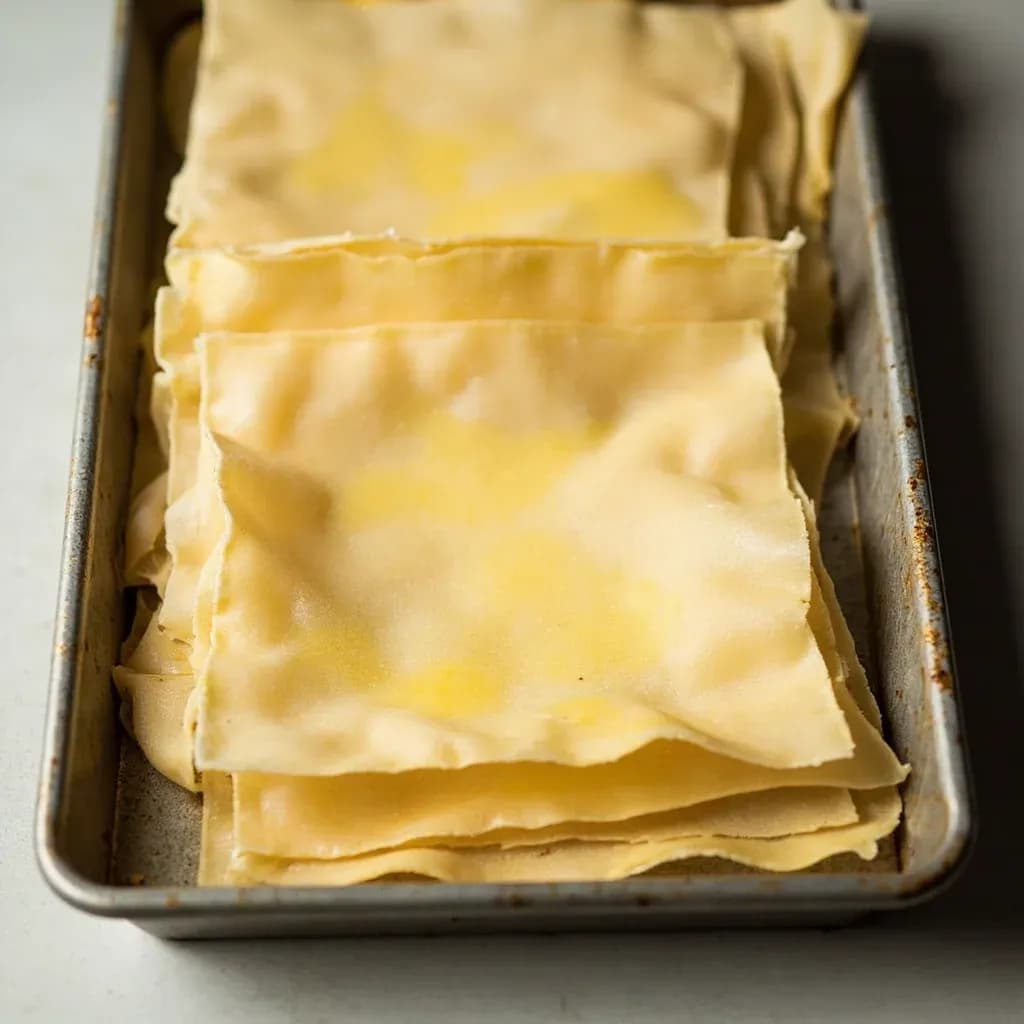
Phyllo layering builds the shatteringly crisp structure of pies like byrek, pita, and bourek by stacking paper-thin dough sheets and brushing each with melted butter or oil. As it bakes, the moisture between layers steams off and the sheets separate into countless delicate flakes. The sheets dry out fast, so cooks work quickly and keep the unused stack covered with a damp cloth to prevent cracking.
Phyllo layering is the technique of stacking tissue-thin unleavened dough sheets, brushing each with fat, and baking until the air trapped between them expands into shatter-crisp flakes. The Greek word phyllo (φύλλο, "leaf") describes the ideal: each commercially produced sheet is roughly 0.1 mm thick, translucent when held to the light, and incapable of supporting any weight on its own. A finished spanakopita or baklava is, mechanically, a stack of microscopic starch sheets separated by microscopic fat layers — the flake you bite into is just those gaps exploding outward as steam.
The technique is forgiving in outcome and demanding in pace. Two failure modes account for nearly every problem a home cook encounters: sheets that dry out and fuse into leathery clumps, and stacks that get pressed or weighted down and lose the air pockets that produce flake. Everything else — the choice of fat, the number of layers, the brushing pattern, the oven temperature — flows from managing those two risks. Work quickly, keep the unused stack covered, and never press.
Regional traditions vary the formula but not the principle. Greek pastry tends to use many sheets (30–40+ for baklava, 6–12 for savory pies) brushed generously with clarified butter. Turkish yufka is often slightly thicker and oil-brushed, while North African warqa is paper-thin (like commercial phyllo) and traditionally oil-brushed; both lean on more folding, rolling, or wrapping than the Greek stack-and-brush approach. Once you understand the flake, those regional differences become a vocabulary of possibilities rather than a list of separate techniques to learn.
- Difficulty
- Hard
Types & varieties
Stacked sheets brushed generously with melted or clarified butter; the standard for spanakopita, tiropita, baklava, and galaktoboureko.
Slightly thicker sheets rolled by hand in Turkey and the Balkans; often oil-brushed and shaped into trays, cigars, or rolled coils with fewer, more pronounced layers.
Paper-thin sheets traditionally stretched by hand over a hot pan; used for b'stilla and briouats, and egg is sometimes added to the dough for pliability.
A smaller number of layers (often 3–6) wrapped around cheese, spinach, or minced-meat fillings and brushed with olive oil, as in fatayer and sambousek.
Phyllo used in place of pulled strudel dough for apple, cherry, or cabbage fillings, with each sheet buttered; a practical shortcut, though it lacks the elasticity of true strudel dough.
How to do it
- 1
Thaw the phyllo
If frozen, move the sealed package to the refrigerator 12–24 hours ahead, or leave it on the counter 2–3 hours still sealed. Never microwave — the sudden steam welds the sheets together, and the damage is irreversible.
- 2
Stage the workstation
Have the greased baking dish, melted (or clarified) butter or oil, a wide pastry brush, the filling, a sharp knife, and a barely-damp towel within reach before you unroll the dough. Once the roll is exposed, the clock is running.
- 3
Unroll and cover
Unroll the phyllo onto a clean, dry sheet pan or counter. Immediately drape plastic wrap over the stack and lay the damp towel on top. Lift only one sheet at a time, replacing the cover each time.
- 4
Build the base layers
Lay the first sheet in the pan with edges overhanging all sides. Brush evenly from corner to corner with butter. Lay the next sheet, slightly rotated or offset to cover any dry edge, and brush again. Repeat for roughly half the total sheet count — about 6–10 for savory pies, 15–20 for baklava.
- 5
Add the filling
Spread or mound the filling evenly over the base, leaving a 1–2 cm border so the top layers can seal to the base. Level nut fillings firmly; do not compress loose spinach or cheese fillings — they should stay loose enough that the layered pastry above can puff freely without being pushed up into the top sheets.
- 6
Top and seal
Layer the remaining sheets over the filling, brushing each the same way. Fold the overhanging base sheets up and over the top, tuck them in, then brush the final sheet generously to seal and crisp the surface.
- 7
Score before baking
With a sharp knife, cut through the top layers only — about a third of the way down — in the portions or diamonds you want. This guides the rise and prevents random cracking. Full-depth cuts are cleaner made after baking if you want pristine edges.
- 8
Bake until deeply golden
Bake at 325–375°F (165–190°C) for 30–60 minutes, until the surface is a deep even gold and the center is set. For syrup-soaked pastries, cool 5 minutes, then pour cool syrup over the hot pan (or chill the pastry and pour hot syrup) so the layers stay crisp rather than turning soggy.
Fat: Butter, Oil, or Both
The fat you brush is the cooking medium of the finished pastry, not just a lubricant. It conducts heat, browns the starch, flavors the layers, and — most importantly — physically separates one sheet from the next so they puff rather than fuse. A few rules of thumb cover most situations a cook will face.
- Clarified butter is the gold standard for Greek sweets like baklava and galaktoboureko: it browns deeply, brushes evenly without the milk solids scorching, and adds the nutty flavor the tradition expects. Strain the milk solids and reserve them for another use.
- For everyday savory pies (spanakopita, tiropita, leek pie), a 50/50 blend of melted butter and mild olive oil brushes cleanly, browns well, and stretches the butter budget without sacrificing flavor.
- Use olive oil alone for vegan preparations and for many Turkish and Levantine savory börek and fatayer, where the olive oil flavor is part of the point rather than a compromise.
- Whichever fat you use, brush it warm. Cold butter congeals on contact with the cool dough and leaves uneven patches that never crisp properly. Keep the bowl over a warm spot and refresh as needed.
Common uses
Tips & pitfalls
- Let thawed phyllo sit at room temperature 20–30 minutes before unrolling — cold sheets crack, shrink, and brush unevenly.
- Use clarified butter for sweets (Greek tradition), a 50/50 butter-olive oil blend for savory pies, and pure olive oil for vegan preparations and most Levantine börek.
- Brush edge-to-edge in long, even strokes; missed spots will not crisp and will bond to neighboring sheets.
- Never press down on the stack — the air gaps between sheets are what shatter into flakes in the oven. Resist the urge to compact.
- Score only through the top third of layers before baking; full-depth cuts made beforehand tend to seal shut with butter and obscure the final portions.
- For baklava, pour cool syrup over hot pastry (or hot syrup over chilled pastry) so the layers stay crisp rather than turning soggy.
- A bench scraper is the safest tool for lifting sheets and for cutting finished portions; a knife drags butter across the surface and tears the top.
Good to know
- Origin
- Eastern Mediterranean — Greek, Turkish, and broader Levantine traditions; the word 'phyllo' (φύλλο) is Greek for 'leaf.'
- Composition
- Unleavened dough of flour, water, and a little oil (sometimes with vinegar, lemon juice, or egg); no yeast or chemical leavening.
- Sheet thickness
- Commercially produced sheets are roughly 0.1 mm thick — translucent when held to the light.
- Standard sheet size
- U.S. brands (Athens, Apollo) sell roughly 14×18 in (35×45 cm) sheets in 1 lb packages, about 40 sheets per pound.
- Fat for brushing
- Greek tradition favors melted or clarified butter; Turkish, Balkan, and North African recipes commonly use olive oil or a butter-and-oil blend.
- Typical layer counts
- Spanakopita and tiropita: 6–12 sheets per stack; baklava: 30–40+ sheets total; börek: 4–8 per fold, often repeated.
- Oven temperature
- Generally 325–375°F (165–190°C); the lower end for syrup-soaked pastries so the layers stay crisp.
- Storage of raw phyllo
- Unopened, refrigerated 2–3 weeks or frozen 2–4 months; once opened, re-wrap tightly to exclude air. Exposed sheets begin to dry and shatter within 2–3 minutes.
Also called
Phyllo Layering · Filo Layering · Warqa Layering · Bourek Shaping
Dishes that rely on it
Related

Whisk
Beat ingredients smooth and aerated with a looping wire motion

Sift
Pass dry ingredients through mesh to aerate and remove lumps

Strain
Pour through mesh to separate solids from liquid for a smooth result

Filter
Pass liquid through fine material to clarify out the smallest particles

Rice
Press cooked potatoes through small holes for fluffy, lump-free texture

Mash
Crush soft cooked food into a rustic, creamy purée

Grind
Crush food into a coarse to fine texture, from spices to meat

Grate
Shred food into fine bits against a sharp-toothed surface