Prep & Assembly
Piping Filling
Using a piping bag to inject or deposit a soft filling neatly and evenly.
Piping filling means loading a soft mixture, such as cream, custard, mousse, or a savory farce, into a piping bag and squeezing it through a tip or nozzle to fill pastries, dumplings, or deposit precise portions. It gives clean, repeatable results and reaches into cavities like éclairs or stuffed pasta that a spoon can't. Consistent bag pressure and the right tip size control how much filling lands each time.
Piping filling is the workhorse assembly move of the pastry kitchen: loading a soft mixture into a bag fitted with a tip, building pressure, and using that pressure either to inject filling into a hollow baked good or to deposit it in a controlled shape on a surface. The technique matters because hand-spooned filling is almost always uneven — too much in one corner, too little in the other — and the seam of a sandwich cookie or the inside of a choux puff will show it. A piping bag gives you repeatable volume, clean placement, and the ability to work inside fragile shells without splitting them, which is why it has been the standard in professional bakeries for well over a century.
The success of the technique rests on three variables working together: the consistency of the filling, the shape and size of the tip, and your pressure control. A filling that is too soft slumps and oozes; one that is too stiff bursts the bag or tears the item you are piping into. Tips are chosen by function — a plain round tip for clean injection and smooth dollops, a long narrow Bismarck tube for piercing, a star tip for texture. The single most important physical skill is maintaining steady pressure as you finish, particularly when injecting, because the moment you release and pull away you create a vacuum that sucks filling (or air) back out and leaves a hollow, messy result.
- Difficulty
- Easy
Types & varieties
Using a Bismarck/Georgian tube to pierce and fill a baked good from the inside — used for cream puffs, éclairs, jelly donuts, and filled cupcakes.
Piping a single mound of filling onto a flat surface, such as macaron shells, whoopie pie halves, or cake layers.
Piping filling in a flat spiral to cover a surface evenly — common for layer cakes and entremets.
Using an open star tip to create a textured, ridged swirl for visual appeal on cupcakes, choux, and Viennese-style pastries.
Using a closed star tip for finer textured ribbons and rosettes of filling.
Piping small dots or beads of filling in patterns for entremets and modern plated desserts.
How to do it
- 1
Bring filling to the right consistency
Prepare the filling and adjust so it is smooth, soft, and pipeable. Chill cream-based fillings 15–30 minutes until they hold a soft peak; bring ganache to a soft, pipeable state; buttercream should be smooth and pliable at room temperature. A test dollop on a plate should hold its shape but flow under steady hand pressure.
- 2
Choose and fit the tip
Select a plain round tip for smooth fillings, a Bismarck or Georgian tube for injection into baked goods, or a star tip for a textured finish. Fit the tip into the bag, or use a coupler if you may need to change tips or refill partway through.
- 3
Fill the bag
Spoon the filling into the bag using a spatula or bench scraper, filling only the bottom half to two-thirds. Twist the open end of the bag closed and push the filling down toward the tip, expelling any air pockets as you go.
- 4
Build pressure and test
Hold the bag with your dominant hand squeezing from the top, and guide the tip with your other hand. Squeeze a small test amount onto a plate or scrap to check flow, consistency, and whether the tip size suits the job.
- 5
Inject or deposit the filling
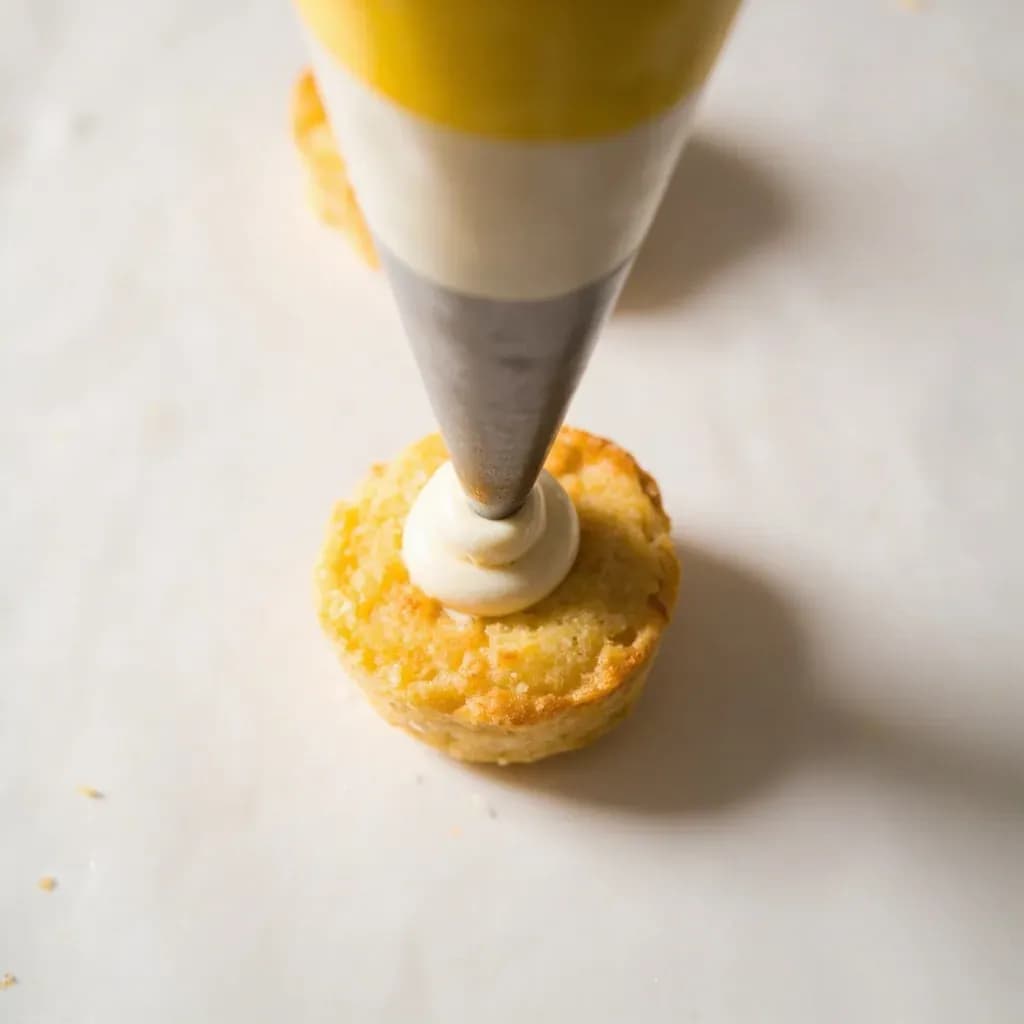
For injection: pierce the baked good with the tip, squeeze steadily, and withdraw slowly while maintaining pressure until the tip clears the surface. For sandwich or layer piping: hold the tip just above the surface, squeeze to build a base, then lift while releasing pressure to form a peak or smooth dome.
- 6
Clean as you go
Wipe the tip with a damp cloth between each item to keep the surface clean. For large batches, cap the bag with a clip between refills to prevent the filling from drying out at the tip.
- 7
Store or finish
Once filled, store the items according to the filling type — refrigerate cream- or dairy-based fillings, keep jam or ganache items sealed at room temperature or chilled, and consume within the safe window for the filling used.
The Bismarck tube
The Bismarck tube — also called a Georgian tube, syringe tube, or simply a filling tube — deserves its own mention because it is the only tip designed specifically for piercing rather than decorating. It is long, narrow, and often slightly pointed at the end so it can slide through the wall of a choux bun, éclair, or yeast donut without tearing it. A plain round tip will work for very soft fillings on tender surfaces, but the longer, thinner profile of a Bismarck tube gives you reach into deep cavities and lets you feel when you have entered the hollow center. Most bakers own just one size; common diameters are 4–6 mm at the opening, which is wide enough for pastry cream and thick ganache but narrow enough not to split a fragile shell.
Matching filling to method
Not every filling pipes the same way, and the technique only works if the consistency matches the job.
- Whipped cream, mascarpone cream, and pastry cream: chill 15–30 minutes until they hold a soft peak; pipe cold for clean dollops and spirals.
- American buttercream and cream cheese frosting: work at cool room temperature; if the bag feels stiff or the tip clogs, the frosting is too cold.
- Ganache: cool to 24–27°C (75–80°F); below that it seizes and breaks, above that it runs and loses shape.
- Fruit curds and jams: warm slightly if they have been refrigerated so they flow, but not so warm that they soak into the item you are filling.
- Caramel and praline paste: warm gently until just pourable-plastic; cold caramel will not pipe at all.
Common uses
Tips & pitfalls
- Twist the top of the bag firmly before piping to build pressure and prevent filling from seeping out the back.
- When injecting, keep steady hand pressure as you withdraw the tip — releasing pressure while pulling out creates a vacuum that pulls filling back and leaves an air pocket.
- Wipe the tip clean with a damp cloth or paper towel between insertions to keep the surface neat.
- Chill soft fillings (pastry cream, whipped cream, cream cheese) for 15–30 minutes before piping so they hold their shape.
- Bring ganache to about 24–27°C (75–80°F) before piping — too cold and it breaks, too warm and it sags.
- Don't overfill the bag — half to two-thirds full gives the best control and prevents blowout at the twist.
- If the filling is too thick, thin with a small amount of cream, milk, or simple syrup; never water, which breaks buttercream and ganache.
- If the filling is too thin, chill it or fold in more of a stiffening component (more butter, more chocolate, or more powdered sugar).
- Use a coupler when you plan to swap tips or need to refill partway through; it saves the bag and reduces waste.
- For very small injection work on delicate items, snip a disposable bag to a 2–3 mm opening rather than using a metal tip to minimize damage.
Good to know
- Difficulty
- Beginner to intermediate; accessible to home bakers with basic equipment
- Core equipment
- Piping bag, appropriate tip, optional coupler, optional bag clip
- Common tip shapes
- Plain round, long pointed Bismarck/Georgian tube, small open star
- Typical tip sizes
- Small to medium round tips (e.g., Wilton 12 for fine work, Wilton 2A for larger fillings; roughly 4–10 mm openings)
- Filling consistency
- Soft, smooth, pipeable; soft-peak to stiff-peak depending on filling, flowing under steady hand pressure
- Bag fill level
- Half to two-thirds full — overfilling causes blowout at the twist
- Working temperature
- Buttercream at room temperature; pastry cream chilled; ganache cooled to 24–27°C (75–80°F) for piping
- Named specialty tube
- Bismarck tube (also called Georgian or syringe tube) — a long, thin, often pointed metal tip for injecting filling into baked goods
Also called
Piping · Filling with a Piping Bag
Dishes that rely on it
Related

Whisk
Beat ingredients smooth and aerated with a looping wire motion

Sift
Pass dry ingredients through mesh to aerate and remove lumps

Strain
Pour through mesh to separate solids from liquid for a smooth result

Filter
Pass liquid through fine material to clarify out the smallest particles

Rice
Press cooked potatoes through small holes for fluffy, lump-free texture

Mash
Crush soft cooked food into a rustic, creamy purée

Grind
Crush food into a coarse to fine texture, from spices to meat

Grate
Shred food into fine bits against a sharp-toothed surface