Prep & Assembly
Pounding Taro (Ku'i)
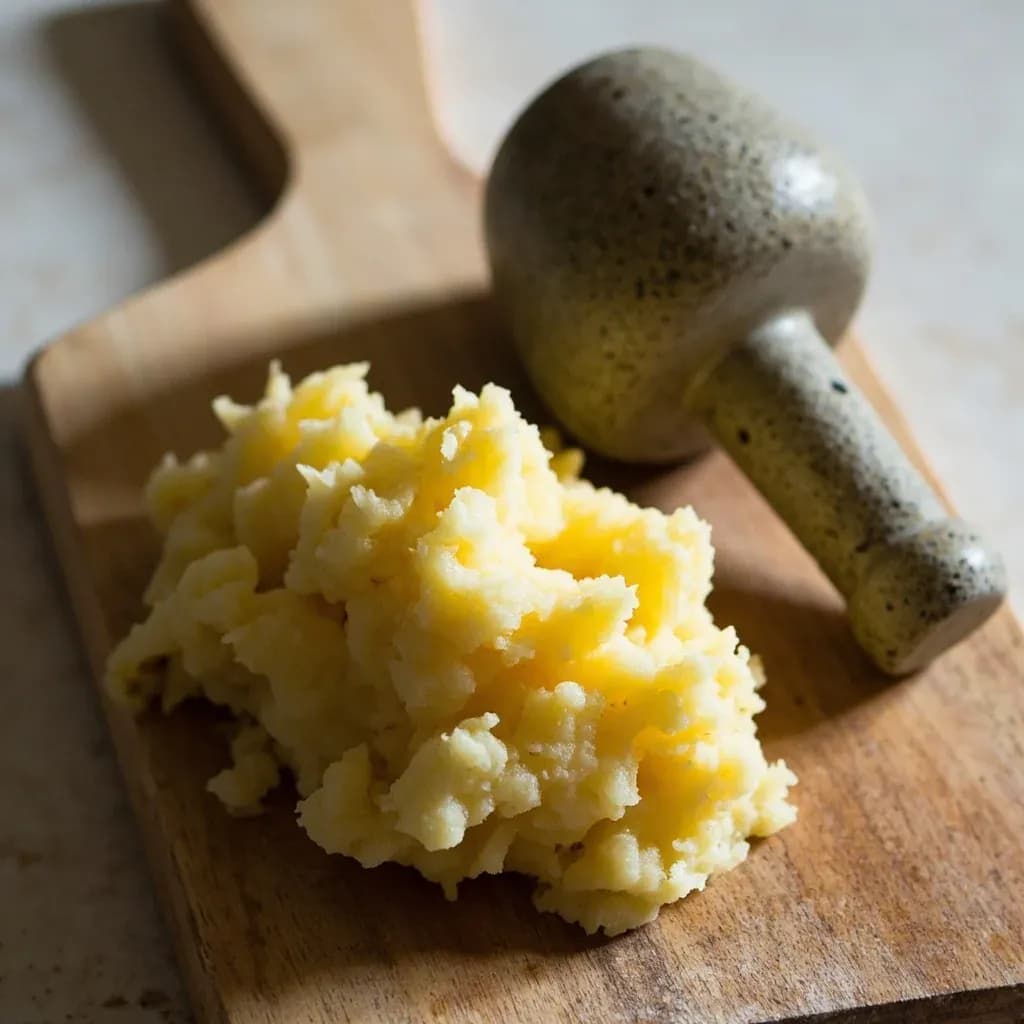
Mashing cooked taro corm with a stone pounder into the Hawaiian staple poi.
Pounding taro, or ku'i, is the Hawaiian practice of mashing steamed taro corm on a wooden board (papa ku'i 'ai) with a stone pounder (pohaku ku'i 'ai), gradually adding water until it becomes the smooth, sticky paste called poi. The rhythmic pounding breaks down the fibers into a glossy, cohesive mass whose thickness is described by how many fingers it takes to scoop. It is a deeply cultural skill central to traditional Hawaiian foodways.
Ku'i is the Hawaiian technique of repeatedly striking cooked taro corm with a heavy basalt pestle (pohaku ku'i) on a thick wooden board (papamu), working the mass in a steady cadence of strike, scrape, and turn until the starchy flesh becomes a smooth, elastic paste. The technique is older than written contact with the islands and remains culturally central: the rhythmic sound of the pounder is still heard at luaus, cultural festivals, and family gatherings throughout Hawai'i.
The result is not simply mashed taro. Each blow ruptures individual starch cells, and over twenty to forty-five minutes the paste transforms from a lumpy, crumbly mass into something almost dough-like — cohesive, slightly glossy, and willing to stretch rather than tear. That aligned-starch texture is what distinguishes hand-pounded poi from anything a food processor can produce, and it is also why the same paste, thinned with water, becomes the pourable poi that complements salted meats and raw fish. The earliest stage of the work, before water is added in any quantity, is called pa'i'ai; everything from that point on is a question of how much water the cook chooses to work in.
Beyond textural character, the pounding sets up natural fermentation. Once the paste is covered and left undisturbed, wild yeasts and lactic bacteria begin working the sugars in the taro, and a fresh-bland poi deepens into a tangy, mildly sour condiment over several days. That built-in keeping quality is part of why the technique endured: pounded taro could be made in quantity, stored in a cool corner, and eaten over the next several days without spoilage.
- Difficulty
- Hard
Types & varieties
Classic red-skinned Hawaiian poi taro; sticky, sweet, and the traditional favorite for pounding.
Premium Hawaiian variety grown on Kauai; produces prized thick, smooth poi.
Common commercial taro; works for poi but milder and less starchy than Lehua.
Older Hawaiian variety with long corms; yields dense, flavorful poi.
Smaller Hawaiian variety with yellowish flesh; mild flavor for lighter poi.
Wetland (lo'i) Hawaiian variety producing poi with a slightly sour tang.
How to do it
- 1
Cook the taro corm thoroughly
Wash whole taro corms. Steam over boiling water for 1.5–2 hours, pressure-cook for 25–35 minutes, or bake wrapped in ti leaves at 350°F for about 2 hours, until a skewer or fork passes through the thickest part with no resistance. Undercooked taro feels chalky and will not pound smooth no matter how long you work it.
- 2
Peel while warm
While the corm is still hot enough to handle, slice off the top and root ends and pull the skin away with a paring knife. The skin slips off easily at this stage but bonds to the flesh as it cools, so don't wait until the taro is fully cool or you'll lose flesh with the skin.
- 3
Set up the pounding board
Place the papamu (heavy wooden board, traditional materials include koa, breadfruit, or 'ōhi'a) on a stable surface at waist height, ideally over a damp mat or towel to keep it from sliding. Set the warm peeled corms in the center of the board.
- 4
Begin the first pound
Wet the face of the pohaku ku'i briefly. Deliver firm, vertical blows with a slight wrist twist at the end of each stroke. Start at the outer edges of the corm and work inward, letting the pounder ride over the lump to break it apart rather than crushing straight down.
- 5
Scrape and rotate
After every two or three strokes, use the 'ono pa'i (wooden scraper) to pull the paste from the edges of the board back into the center and rotate the mass a quarter turn. This prevents sticking to the board and ensures even pounding.
- 6
Add water gradually
Once the paste starts to look dry or tears rather than spreads under the pestle, sprinkle a tablespoon or two of cool water over the surface. Continue pounding. Add water only as needed; the goal is a smooth, glossy, elastic mass, not a wet slurry.
- 7
Pound to pa'i'ai or dilute to poi
After 20–45 minutes the taro should be a uniform, sticky, lump-free paste — this is pa'i'ai. For poi, work in additional water tablespoon by tablespoon until the paste flows slowly when the board is tilted. The traditional stages are 1-finger (thick), 2-finger (medium), 3-finger (pourable), and 4-finger (drinkable).
- 8
Transfer and store
Scrape the finished pa'i'ai or poi into a clean bowl (traditionally a calabash ipu). Cover the surface with a thin layer of water to prevent a crust from forming. Refrigerate for longer storage, or leave at cool room temperature for a few days to encourage the traditional mild fermentation.
Reading the consistency stages
Traditional Hawaiian cooks describe poi thickness by the number of fingers the paste must be lifted to break — a rough but reliable way to gauge hydration at the end of pounding. Knowing the stages helps a cook stop at the right point instead of overshooting.
- Pa'i'ai: the driest stage, pounded with no added water (or very little). It holds its shape on a fork and is eaten as a thick scoopable side, often with lomi salmon or kalua pork.
- 1-finger poi: barely flows when the board is tilted; clings to a spoon. A common everyday thickness for adults who want substance with their meal.
- 2-finger poi: flows slowly and settles to a level surface in a bowl. The most common restaurant and family thickness; the yield reference point in most recipes.
- 3-finger poi: pours in a steady ribbon; used for younger eaters or as a side sauce.
- 4-finger poi: thin enough to drink, sometimes given to infants and the elderly, or used as a base for sweet preparations.
The rhythm of strike, scrape, turn
The cadence of traditional pounding is its own skill. A single worker typically delivers two or three firm, vertical strikes, then uses the scraper to fold the outer paste back into the center and rotate the mass a quarter turn before striking again. This sequence matters because taro paste sticks aggressively to a dry wooden board, and a scraper left unused will pull the mass apart instead of consolidating it. The slight twist at the end of each stroke — turning the wrist as the pestle lands — helps shear the paste against the board and produces a finer result than straight crushing.
Common uses
Tips & pitfalls
- Cook the corm until a fork slides in with no resistance — undercooked taro will not break down smoothly and tastes chalky, no matter how long you pound.
- Peel the cooked corm while still warm; the skin slips off easily but sets hard as the flesh cools, costing you taro flesh.
- Start pounding at the outer edges and rotate the mass inward, scraping the board constantly so the paste doesn't stick and tear.
- Add water sparingly — a tablespoon or two at a time — only after the paste begins to look dry; too much water at once makes it gluey and lumpy.
- Use a heavy, broad-ended basalt pestle rather than a narrow one; the flat face spreads the impact and produces a finer paste.
- Watch for a slight darkening of the paste as you pound; that color shift means starch cells have ruptured and the paste is properly developing.
- Don't substitute a food processor if you want true poi texture — the pounding action aligns the starch differently than blades cut it, and the result is noticeably coarser.
- Skip the salt; traditional Hawaiian poi is unsalted, and adding it changes both flavor and the natural fermentation.
- Cover finished poi with a thin film of water (about 1/8 inch) to keep it from crusting over during storage.
- Adjust water to the variety: dry commercial taro wants a touch more water, while waxy Bun-long needs less.
Good to know
- Hawaiian name
- Ku'i (koo-ee)
- Output product
- Pa'i'ai (thick pounded taro) or poi (diluted with water)
- Source ingredient
- Cooked taro (kalo) corm, traditionally steamed, boiled, or imu-baked
- Safety note
- Raw taro contains calcium oxalate raphides that itch and irritate skin and mouth; never pound an uncooked corm
- Traditional pounder
- Pohaku ku'i — heavy basalt pestle, often several pounds
- Traditional board
- Papamu or kua kahi — heavy wooden board of koa, 'ōhi'a, or breadfruit
- Scraper
- 'Ono pa'i — wooden or stone scraper used to clear the board between strokes
- Consistency stages
- Pa'i'ai (thickest), then poi in 1-, 2-, 3-, or 4-finger thickness (more water = thinner)
- Yield
- Roughly 1 lb cooked taro yields about 1 lb pa'i'ai, or 1.5–2 cups poi at 2-finger thickness
- Time
- 20–45 minutes of pounding per 1–2 lb batch of cooked taro
- Shelf life
- Fresh poi keeps 3–5 days at cool room temperature and ferments mildly; longer when cold
- Difficulty
- Moderate; technique is simple but endurance and rhythm matter
Also called
Ku'i · Poi Pounding
Related

Whisk
Beat ingredients smooth and aerated with a looping wire motion

Sift
Pass dry ingredients through mesh to aerate and remove lumps

Strain
Pour through mesh to separate solids from liquid for a smooth result

Filter
Pass liquid through fine material to clarify out the smallest particles

Rice
Press cooked potatoes through small holes for fluffy, lump-free texture

Mash
Crush soft cooked food into a rustic, creamy purée

Grind
Crush food into a coarse to fine texture, from spices to meat

Grate
Shred food into fine bits against a sharp-toothed surface