Transform & Preserve
Rotary Distillation
Using a rotary evaporator under vacuum to gently distill delicate aromas at low heat.
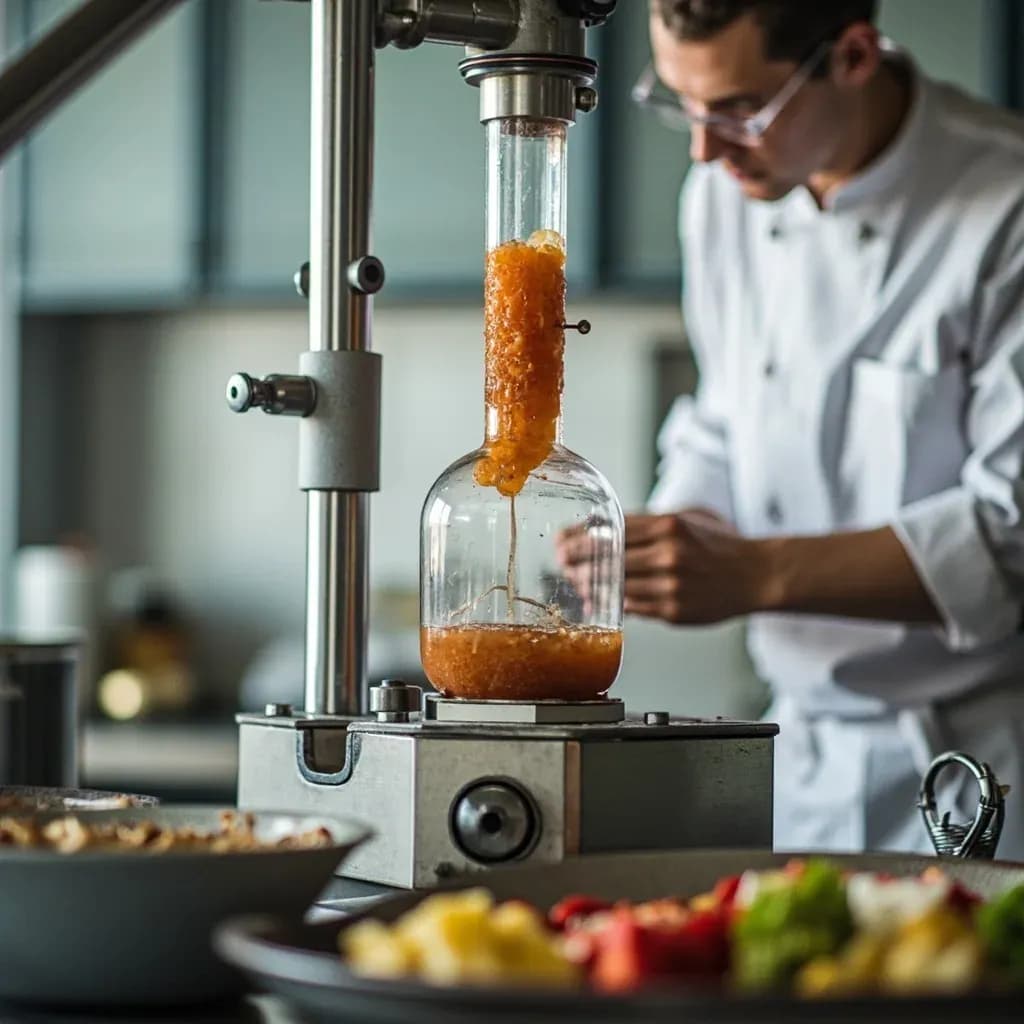
Rotary distillation uses a rotary evaporator (rotovap) to separate and capture volatile aromas under vacuum, which lowers the boiling point so distillation happens at gentle temperatures that preserve fragile flavors. Modernist kitchens and bars use it to make crystal-clear flavored spirits, hydrosols, and concentrated essences without cooking off the aromatics. The rotating flask spreads the liquid into a thin film to speed gentle, even evaporation.
Rotary distillation, almost always shortened to "rotovap" in the kitchen, is the culinary adaptation of a laboratory technique for separating volatile flavor compounds from a liquid at temperatures well below their normal boiling point. By pulling a vacuum inside a spinning flask partially submerged in a warm bath, the technique drops the boiling point of water and alcohol low enough that they evaporate at 30–50 °C rather than 100 °C, then recondense on a chilled coil. The result is a clean split between a distillate (the captured volatiles) and a retentate (everything too heavy to vaporize — sugars, acids, salts, pigments).
This matters in a kitchen because the brightest top notes of herbs, citrus, flowers, and fermented liquids — the compounds that smell like "fresh" — are exactly the ones that cook off first in a saucepan. A rotovap lets a chef capture basil oil without cooking the basil, strip the alcohol from a wine without boiling away its perfume, or concentrate a consommé without the color deepening and the flavor turning. It does not create new flavors; it redistributes existing ones, which is why cooks often pair the distillate from one ingredient with the retentate of another to recompose a dish in a new form.
Adopted into fine-dining kitchens in the early 2000s — Heston Blumenthal at The Fat Duck, and the elBulli team of Ferran and Albert Adrià with chemist Mark van Zijl, are the names most often cited — rotary distillation sits at the heart of the modern "molecular gastronomy" toolkit alongside the centrifuge and the ultrasonic bath. It is a serious investment ($4,000–$60,000 depending on scale) and a moderate-to-difficult skill, but for working with delicate aromas it has no real substitute.
- Difficulty
- Hard
Types & varieties
Water-based plant material is heated under vacuum; volatile aromatics carry over as a distillate while non-volatiles stay behind. Produces hydrosols and essential oils.
Alcohol- or oil-based infusions (herbs in neutral spirit, fat-washed liquors) are concentrated by evaporating the solvent under vacuum and recondensing it.
Juices, broths, vinegars, or wines are distilled at low temperature to capture the volatile fraction without cooking off delicate top notes.
Reducing a sauce, stock, or juice to concentrate flavor without the Maillard browning or thermal damage of open-pot reduction.
Removing ethanol from wine, beer, or spirits under low pressure while retaining aroma; widely used in the no- and low-alcohol beverage industry.
How to do it
- 1
Prepare the source material
Macerate, juice, or steep the ingredient in water, neutral spirit, or a fat/oil. Strain coarse solids through cheesecloth or a fine mesh; for aqueous plant material, chop finely and keep chilled until loading.
- 2
Set up the rotovap
Fill the heating bath with water (or food-grade glycol for work above 70 °C) and pre-heat to the target temperature, usually 30–45 °C. Switch on the recirculating chiller and set the condenser to 0 °C, or lower for very volatile compounds such as citrus oils or menthol.
- 3
Load the evaporation flask
Pour the prepared liquid into a clean evaporation flask, filling no more than one-third to one-half of its volume to prevent suck-back and bumping. Secure the flask to the vapor duct with a clip or ground-glass clamp.
- 4
Engage rotation and lower the flask
Set rotation to 80–150 rpm for most liquids; raise it past 200 rpm for low-surface-tension mixtures. Lower the flask into the bath until the liquid surface is fully submerged.
- 5
Apply vacuum gradually
Open the vacuum valve slowly and watch the boil. A steady, controlled stream of bubbles forming a single vortex is ideal. If the mixture bumps or foams, release vacuum immediately and reduce the rate. Target pressure depends on solvent: ~25–50 mbar for water, ~100–150 mbar for ethanol.
- 6
Collect the distillate
Vapors condense on the chilled coil and drip into the receiving flask. Continue until the desired volume is collected or evaporation slows. Record both the distillate and the retentate for later use.
- 7
Separate and store
If the distillate separates into an oily and an aqueous phase (typical for citrus or herbal runs), decant or use a separatory funnel. Store hydrosols refrigerated in dark glass and essential oils in amber glass with PTFE-lined caps.
- 8
Clean the system
Drain the retentate, rinse the flask, then run two cleaning cycles — warm water, then food-grade ethanol — into a waste flask. Wipe the vapor duct and condenser with a lint-free cloth before the next run to prevent cross-contamination of aromas.
Working with the distillate and retentate
A run on the rotovap produces two streams, and treating them as separate ingredients is the key to using the technique well. The distillate is mostly water, alcohol, or a mix of both, carrying the light, fragrant compounds — terpenes, esters, aldehydes, low-molecular-weight alcohols. It is often cloudy when fresh, can be oily on top (the essential-oil phase) and watery below (the hydrosol), and should be stored refrigerated in dark glass. Hydrosols keep for one to two weeks; separated essential oils, six months to a year in amber glass with a PTFE-lined cap.
The retentate is what stayed behind: the sugars, acids, tannins, salts, pigments, and heavier flavor molecules. Because the volatile fraction has been removed, the retentate tastes denser, rounder, and sometimes more bitter or savory than the original — it is essentially a flavor concentrate. Many chefs use the retentate as a base (a consommé, a syrup, a sauce backbone) and finish the dish with a few drops of the matching distillate to restore the lost top notes. Keeping the two streams labeled and refrigerated until service is non-negotiable; they look almost identical in the flask and cross-contamination ruins both.
Solvent selection
The choice of carrier liquid determines what comes off in the distillate and at what pressure.
- Water — ideal for hydrosols and capturing water-soluble volatiles; requires the strongest vacuum (~25–50 mbar) and the longest run times.
- Neutral grain spirit (40–60% ABV) — preferred for herbal, spice, and citrus distillations; ethanol carries a wider range of aroma compounds and evaporates at a higher pressure (~100–150 mbar), making runs faster and gentler.
- Fat- or oil-based infusions (clarified butter, neutral oil) — used when the target compounds are fat-soluble. A standard approach is to extract the aromatics into alcohol first, combine with the fat, then rotovap off the alcohol so the flavored fat remains concentrated in the retentate.
- Wine, beer, cider — distilled directly to capture or remove the alcohol fraction; pre-filter to remove yeast and proteins that foam and scorch.
Common uses
Tips & pitfalls
- Match vacuum to bath temperature: too much vacuum at high heat causes violent bumping; too little at low heat stalls evaporation altogether.
- Fill the evaporation flask no more than half full — one-third is safest for aqueous mixtures and anything likely to foam.
- Pre-chill the receiving flask and chiller for very volatile compounds (citrus oils, menthol, ethyl acetate) or you will lose them to the pump.
- Add a few drops of food-grade anti-foam (silicone-based) to foaming mixtures such as yeast starters, beer, and fruit purées, or fit a bump trap.
- Label every flask with the source material, date, and the vacuum/temperature settings — distillates all look the same once collected.
- Purging the system between runs with a neutral solvent (ethanol, then water) prevents one ingredient's aroma from haunting the next.
- The retentate will taste different from the distillate — vacuum removes volatiles, so the residue is denser, more savory, and sometimes more bitter.
- Avoid distilling high-sugar or high-protein liquids directly: they scorch in the bath and foam badly. Pre-filter, clarify, or dilute first.
Good to know
- Invented
- Laboratory rotary evaporator patented by Lyman C. Craig in 1950 (US Patent 2,651,586); first culinary adaptations appeared in experimental kitchens in the early 2000s.
- First culinary users
- Heston Blumenthal at The Fat Duck and the elBulli team (Ferran and Albert Adrià, with chemist Mark van Zijl) in the early-to-mid 2000s.
- Typical bath temperature
- 30–50 °C for most culinary applications; rarely above 55 °C.
- Typical vacuum range
- 10–150 mbar, adjusted to solvent (water ~25–50 mbar, ethanol ~100–150 mbar).
- Rotation speed
- 50–280 rpm; higher speeds increase surface area and evaporation rate.
- Condenser temperature
- 0 °C for aqueous work; –20 °C or lower (dry-ice/acetone or –40 °C chiller) for very volatile compounds like citrus terpenes.
- Concentration factor
- Finished distillates are typically 5–10× more concentrated than the source aroma; citrus-peel essential oils yield 0.5–3% by weight.
- Cost
- Entry-level culinary units run $4,000–$8,000 USD; new laboratory-grade Büchi systems run $20,000–$60,000+.
Also called
Rotovap Distillation · Vacuum Distillation
Related

Confit
Cook slowly submerged in fat for silky tenderness and keeping

Cure
Draw out moisture with salt and time to preserve and concentrate

Pickle
Steep in acidic brine for bright, tangy, crunchy preservation

Ferment
Let friendly microbes transform food into tangy, complex flavor

Marinate
Soak in a seasoned mix to flavor and tenderize before cooking

Brine
Soak in salt water so meat stays juicy and seasoned throughout

Dehydrate
Slowly dry out moisture to concentrate flavor and extend shelf life

Cold-Smoke
Perfume cured food with smoke without cooking it through