Transform & Preserve
Rotary Evaporation
Concentrating a liquid in a rotovap under vacuum to reduce it without heat damage.
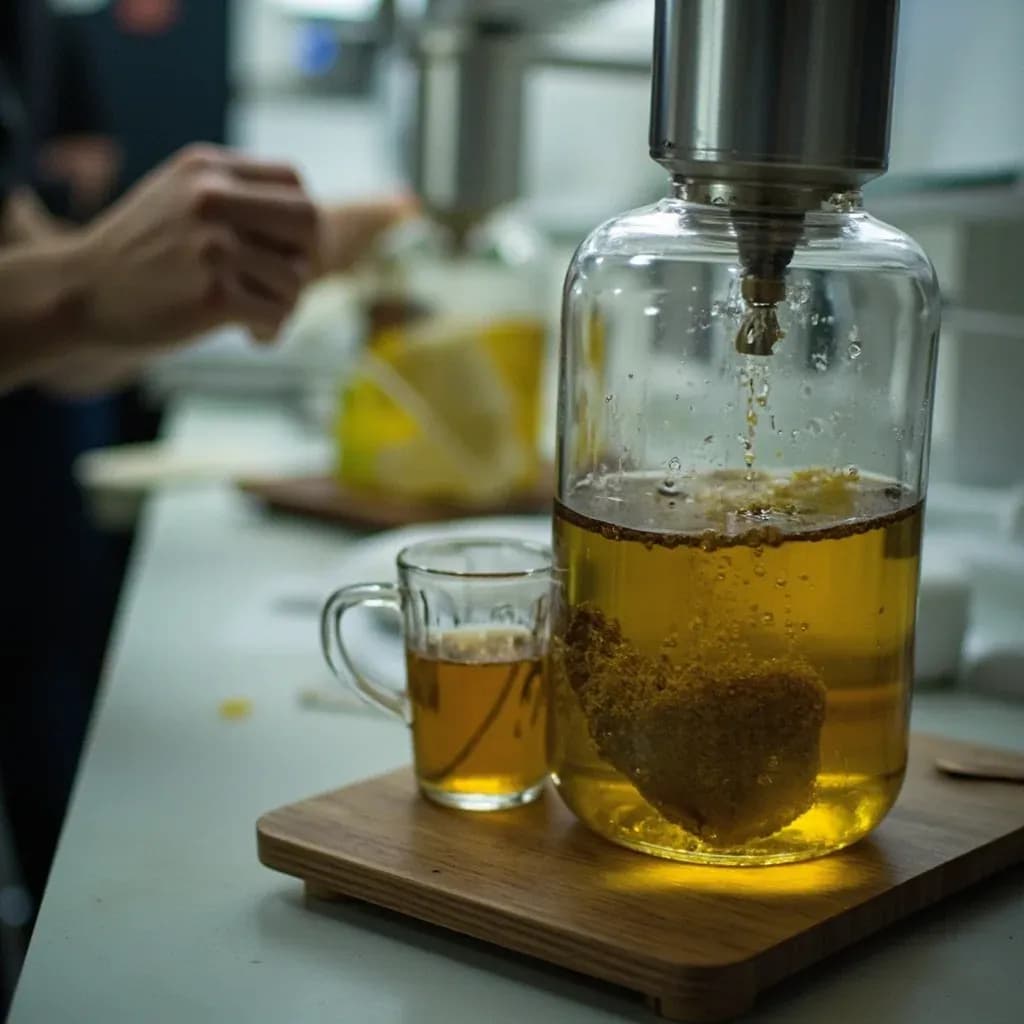
Rotary evaporation gently removes solvent or water from a liquid using a rotovap, where reduced pressure lets evaporation occur at low temperature while the spinning flask maximizes surface area. Cooks use it to concentrate juices, stocks, and flavorings into intense reductions while keeping fresh, uncooked character that boiling would destroy. The captured vapor can also be condensed and saved as a flavorful distillate.
Rotary evaporation is a technique borrowed almost unchanged from organic chemistry, in which a liquid is spun in a sealed, partially evacuated flask while sitting in a warm water bath. The rotation spreads the liquid into a thin film on the inside of the glass, multiplying surface area, and the partial vacuum drops the boiling point of the solvent dramatically — water boils at roughly 10 °C under 10 mbar, and a typical kitchen run at 30–50 mbar sees water boiling somewhere between 25 and 32 °C even when the bath itself is at 50 °C. The evaporated vapor travels into a chilled condenser, where it returns to liquid form and drips into a separate receiving flask, leaving the non-volatile components (sugars, acids, salts, color, body) concentrated in the original flask.
For cooks, the technique is valued for two things traditional stovetop reduction cannot do: it concentrates at or near room temperature, and it captures volatile top notes in the condenser rather than boiling them into the kitchen air. The output of a rotovap is rarely a syrupy, cooked-down glaze; it is a clear, intensely aromatic liquid that smells startlingly like the raw ingredient — fresh strawberry juice that still smells like strawberries, a dashi with the lift of just-steeped kombu, a tomato water that has the perfume of vine-ripened fruit in August. It is best understood as a flavor-clarification and -concentration tool, not a thickener.
A benchtop rotovap is a meaningful capital investment — used Büchi, Heidolph, or IKA systems with a vacuum pump and recirculating chiller typically run US $5,000–$15,000, and new lab-grade systems start around US $20,000 — which is why the technique is found mostly in modernist restaurants, pastry kitchens doing intensive flavor work, and the production kitchens of cookbook authors and consulting chefs. Once installed, the apparatus is forgiving and highly reproducible, with each run documented by bath temperature, vacuum, rpm, and start/end volume.
- Difficulty
- Hard
Types & varieties
The classic batch setup: load a flask, run to target volume, stop, and recover the concentrate.
A feed tube and metering valve drip liquid in continuously while the concentrate stays in the flask — well suited to larger volumes of juice, stock, or hydrosol.
A close cousin operating at very high vacuum (≤0.01 mbar) with an internal condenser; used for thermally fragile or high-boiling fractions such as clarified fats and isolated essential-oil fractions.
An industrial variant with a mechanical wiper that spreads the film; used in commercial flavor and pastry production rather than the kitchen.
Adds an in-line cold trap at −78 °C between the condenser and the pump to recover very volatile aromatics before they reach and contaminate the pump oil.
How to do it
- 1
Set up the apparatus
Connect the vacuum pump, fill and pre-heat the water bath to target temperature (25–60 °C for most kitchen work), and set the recirculating chiller to about 0 °C (lower for highly volatile fractions). Confirm the receiving flask is empty, clean, and properly seated.
- 2
Prepare the liquid
Strain or coarse-filter the liquid to remove particulates. For foaming or delicate liquids, pre-freeze to a slush. For very dry or viscous material, dilute with a little water or food-grade ethanol so it tumbles in the flask.
- 3
Charge the evaporation flask
Pour the liquid into a pear-shaped flask, filling no more than 40–50% of its volume. Apply a thin film of high-vacuum grease to the joint (or use a PTFE sleeve) and attach a clean bump trap.
- 4
Lock it in
Connect the flask-and-bump-trap assembly to the condenser duct and secure with a Keck clip. Attach a clean receiving flask on the other side and confirm every joint is fully seated.
- 5
Begin rotation and heat
Lower the rotating assembly into the bath and start rotation at 50–150 rpm depending on viscosity. The liquid should coat the inner wall in a thin, even film; if it pools in the bottom, raise the rpm or lower the flask deeper.
- 6
Ramp the vacuum gradually
Open the stopcock to the pump slowly, over 30–90 seconds. Watch for steady, controlled boiling in the flask; if it bumps, back off the vacuum. Adjust until you see a steady stream of condensate dripping into the receiving flask.
- 7
Run to target
Hold bath temperature, vacuum, and rotation steady. When the volume in the flask is at the desired reduction (often 10–50% of starting volume) and the concentrate tastes and smells right, stop.
- 8
Vent slowly
Close the vacuum line first, then bleed air — or nitrogen, for aromatic work — back into the system gradually. Rapid venting will splash concentrate around the flask and can oxidize hot product.
- 9
Recover and clean
Stop the motor, raise the flask out of the bath, remove the Keck clip, and decant or pipette the concentrate into a storage container. Clean the flask immediately; concentrated sugar and protein films are difficult to remove once dry.
Why the vacuum, not the bath, does the work
The single most important conceptual point for a cook using a rotovap is that the vacuum controls what temperature the liquid is actually boiling at, not the bath. Set 30 mbar and 50 °C and the water in your flask is boiling at roughly 25 °C; the bath is just a heat source to keep evaporation brisk. This is exactly why the technique preserves top notes: the aromatics that traditional reduction loses to the air are the ones the rotovap sends straight into the condenser as vapor. It is also why ramping the vacuum slowly matters — the moment the pressure drops faster than the liquid can shed heat, it bumps, and bumping is the number-one way batches are lost.
- At 10 mbar, water boils near 10 °C — true room-temperature concentration.
- At 50 mbar, water boils near 32 °C — a comfortable working range for most juices.
- Higher mbar (weaker vacuum) means higher boiling point and faster throughput, but more heat exposure to the product.
Dialing in a run
Most kitchen work converges on a small set of starting parameters that you then adjust by smell, by sight in the receiving flask, and by the volume remaining in the pot flask. The variables are bath temperature, vacuum, and rotation speed, and they trade off against each other in predictable ways.
- Thin, watery liquids (clear juices, hydrosols): 40–50 °C bath, ~50 mbar, 120–150 rpm.
- Foamy or fermentation-based liquids: lower rpm, gentler vacuum ramp, a bump trap, sometimes pre-frozen slush.
- Viscous concentrates near the end of a run: drop to 50–80 rpm so the film does not climb out of the bath.
Equipment you will actually need
The rotovap itself is only part of the system. A serious kitchen setup also needs a vacuum pump capable of pulling down to at least 5 mbar ultimate vacuum (a rotary-vane or dry-diaphragm pump, not the cheap single-stage units sold for HVAC service), a recirculating chiller to hold the condenser near 0 °C, high-vac grease or PTFE sleeves for the ground-glass joints, Keck clips, a bump trap, and a set of pear-shaped flasks. A nitrogen cylinder for venting at the end of a run is strongly recommended for any aromatic product.
- Tap water through the condenser is acceptable for ethanol work but is too warm for most volatile aromatics.
- A bump trap is not optional for any foaming liquid; it is the difference between a clean run and a contaminated condenser.
- Keck clips are cheap insurance — a flask flying off a spinning rotovap is a genuine safety hazard.
Common uses
Tips & pitfalls
- Ramp the vacuum down slowly. Slamming it open is the single most common cause of bumping and lost batches.
- Use a bump trap for anything that foams — juices, fermentations, stocks — it catches the splashes that would otherwise contaminate the condenser.
- A recirculating chiller set around 0 °C is worth the cost. Tap water through the condenser is fine for ethanol but too warm for most volatile aromatics, and you will smell the difference at the pump.
- Stop short of bone-dry. The last 5–10% of a run concentrates salts, acids, and off-notes; pull the flask when the desired intensity is reached, not when the flask is empty.
- Vacuum grease or PTFE sleeves on every ground-glass joint — without a seal, the system will not hold vacuum and the run will be very slow.
- Pre-freeze delicate or foamy liquids into a slushy before charging the flask. It delays bumping on the first pass and protects volatiles.
- Vent with nitrogen rather than air for any aromatic concentrate; hot product in contact with oxygen picks up off-notes fast.
- Match rotation to viscosity: thin liquids around 100–150 rpm, syrups around 50–80 rpm, otherwise the film climbs out of the bath.
- The rotovap is mechanically capable of producing potable-strength alcohol, and distilling spirits through one may still require distillery licensing in many jurisdictions even when alcohol recovery is incidental to flavor work.
Good to know
- Invented
- Lyman C. Craig, 1950, for organic chemistry; adopted in restaurant kitchens from the mid-2000s
- Core principle
- Vacuum lowers the solvent's boiling point; rotation spreads a thin film for fast, gentle evaporation
- Bath temperature
- Typically 25–60 °C in food work; up to ~80 °C for very water-rich liquids
- Boiling point of water under typical vacuum
- ~10 °C at 10 mbar; ~25 °C at 30 mbar; ~32 °C at 50 mbar
- Rotation speed
- 20–280 rpm available; kitchen work usually runs 50–150 rpm
- Condenser temperature
- ~0 °C from a recirculating chiller for most work; −20 to −78 °C for very volatile aromatics
- Flask size & fill
- 1, 2, or 3 L pear-shaped flasks; never fill above 40–50% of volume
- Pioneering chefs
- Heston Blumenthal, Wylie Dufresne (wd~50), and Ferran Adrià (elBulli) brought it into restaurant kitchens
- Common brands
- Büchi (the original — "RotoVap" is a Büchi trademark now used generically), Heidolph, IKA, Lab Society, PolyScience (chillers), Pope Scientific
Also called
Rotovap · Vacuum Evaporation · Low-Temperature Reduction
Related

Confit
Cook slowly submerged in fat for silky tenderness and keeping

Cure
Draw out moisture with salt and time to preserve and concentrate

Pickle
Steep in acidic brine for bright, tangy, crunchy preservation

Ferment
Let friendly microbes transform food into tangy, complex flavor

Marinate
Soak in a seasoned mix to flavor and tenderize before cooking

Brine
Soak in salt water so meat stays juicy and seasoned throughout

Dehydrate
Slowly dry out moisture to concentrate flavor and extend shelf life

Cold-Smoke
Perfume cured food with smoke without cooking it through