Heat & Fire
Salt-Crust Baking
Encasing fish or meat in a thick salt shell that bakes into a sealed oven for moist, even cooking.
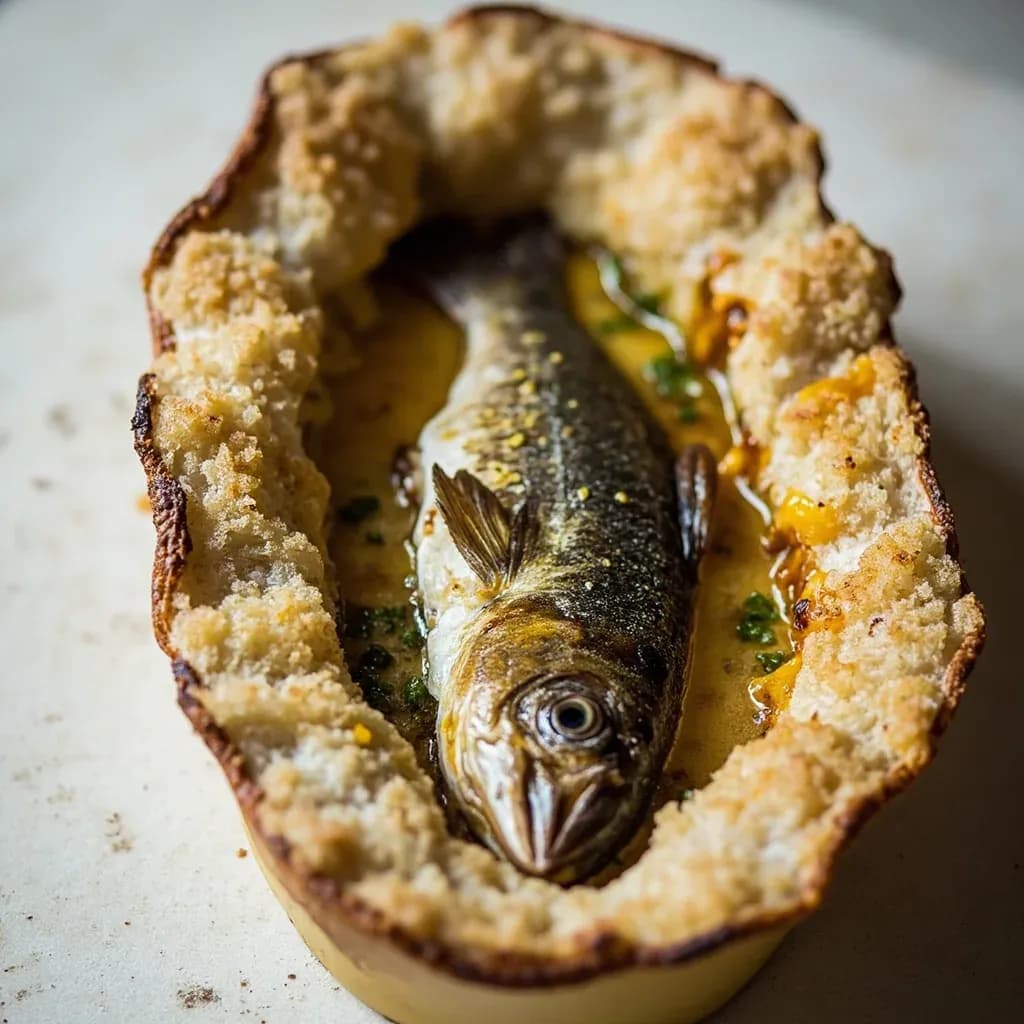
Salt-crust baking packs a whole fish, joint of meat, or root vegetable in a thick paste of coarse salt and egg white, which hardens in the oven into a sealed shell. The crust insulates and gently steams the food in its own juices, producing extremely moist, evenly cooked flesh that is surprisingly not overly salty because the shell barely penetrates. The dramatic crust is cracked open tableside before serving.
Salt-crust baking is a centuries-old Mediterranean technique in which a whole fish, bird, or roast is encased in a thick shell of damp coarse salt and baked. The crust is not a seasoning device — it is a vessel. Once sealed, the food's own juices turn to steam inside a mineral shell, and that trapped steam does the actual cooking. The result is exceptionally moist, evenly cooked flesh with clean, pure flavor, because the food is essentially steaming in its own trapped juices rather than losing moisture to dry oven air.
The method has been documented in Italian and Spanish coastal kitchens since at least the Renaissance, and earlier salt-curing precedents stretch back further. Its appeal is partly practical — it forgives the imprecisions of a wood-fired oven and makes a whole fish far easier to cook evenly than open roasting — and partly theatrical. The crack of the salt dome at the table, releasing a cloud of steam, is one of the most satisfying reveals in the kitchen. The one persistent myth worth retiring is that the salt seasons the food: it does not, as long as the skin is intact. The crust blocks direct contact, and the food emerges tasting of itself, not of the sea.
- Difficulty
- Medium
Types & varieties
Whites bind the salt into a hard, plaster-like shell; produces the cleanest seal and the most dramatic table-side crack.
Coarse salt moistened with water only; looser and crumbly but cooks identically and is faster to mix.
Crushed peppercorns, rosemary, thyme, fennel seed, bay, or citrus zest stirred into the salt to perfume the escaping steam.
Branzino, sea bass, snapper, or trout, often stuffed with lemon and herbs.
Chicken, poussin, or small game birds; longer bake time, internal temp checked through the crust.
Large red-meat roasts, sometimes finished uncovered for browning after the crust is removed.
Beets, potatoes, or celeriac buried in salt in a covered Dutch oven for concentrated, clean flavor.
Protein wrapped first, then buried in salt; reduces contact and eases unwrapping, though some chefs consider it less traditional.
How to do it
- 1
Weigh and prepare the protein
Scale the fish, bird, or roast on a kitchen scale — weight drives both salt quantity and timing. Scale, gut, and pat dry whole fish; truss poultry; tie roasts. Brush lightly with olive oil or a thin layer of beaten egg white if you want the crust to grip tightly.
- 2
Season the cavity or interior
Fill cavities with aromatics such as lemon slices, fennel fronds, thyme, rosemary, garlic, or cracked pepper. Do not salt the interior; the crust supplies more than enough seasoning once cracked.
- 3
Mix the salt
In a large bowl, combine coarse salt with enough egg whites (traditional) or water to reach the consistency of damp sand that holds its shape when squeezed. Stir in peppercorns, herbs, or citrus zest here if using.
- 4
Build a base layer
Spread a 1–2 cm (½–¾ in) bed of the salt mixture in a parchment- or foil-lined roasting pan, slightly larger than the protein.
- 5
Encase the protein
Seat the protein on the bed. Mound more salt over and around it, packing firmly with your hands until the food is encased in an unbroken layer at least 1–2 cm thick on every side. Smooth the surface and press out any obvious air pockets.
- 6
Bake
Transfer to a 200–230 °C / 400–450 °F oven. Allow roughly 25–35 minutes for a 1–1.5 kg whole fish, 60–90 minutes for a 1.5–2 kg chicken, and 15–20 minutes per 450 g for red-meat roasts. Insert an instant-read thermometer through the crust to read the true interior temperature.
- 7
Rest before cracking
Pull the dish at the target internal temperature and rest 10–15 minutes. Carryover heat will gently finish the cook and the crust will firm up slightly, making for a cleaner break.
- 8
Crack and serve
Strike the crust with the back of a heavy knife or a small mallet to break it open away from your face. Lift away the salt shell; on fish, the skin usually comes away with it. Brush off any clinging crystals before plating, and serve the natural juices pooled in the cavity as a sauce.
How the crust actually cooks
The thick salt wall does two things at once. It holds heat like masonry, smoothing out hot spots in an uneven oven, and it seals in the moisture that the food releases as it heats. That steam, unable to escape easily, builds pressure around the protein and conducts heat much more efficiently than dry air. A whole branzino emerges flaky and translucent because the steam has gently poached it inside its own shell. A whole chicken stays juicy because the breast and thigh finish in the same moist environment rather than racing the dry oven air.
- Salt penetration is minimal; the food is seasoned by its own juices, not by the shell.
- The shell acts as insulation, evening out oven hot spots — useful in older or non-convection ovens.
- Because the food is steamed rather than roasted, browning does not occur inside the crust; any Maillard sear must be done after the shell is removed.
Why the technique has endured
Salt is heavy, cheap, and available to coastal villages throughout the Mediterranean. A salt crust turns a piece of whole fish — historically the trickiest thing to cook evenly — into a forgiving project that even a less experienced cook can execute. It also solved a real problem with wood-fired ovens, where radiant heat at the hearth or flue could scorch a fish in minutes. The crust turned the fish into its own little oven, decoupled from the fire.
Common uses
Tips & pitfalls
- Use coarse kosher or sea salt only; iodized table salt tastes metallic and can discolor the crust.
- Weigh the protein and weigh the salt — an underbuilt crust is the single most common failure.
- Dampen the salt until it holds its shape when squeezed like a snowball: wet enough to pack, not soupy.
- For whole fish, leave the skin on; it lifts away with the crust and shields the flesh from any direct salt contact.
- An instant-read probe is essential: crust color and feel tell you nothing about the food inside.
- Crack the crust away from your face — the escaping steam is genuinely hot.
- Let the protein rest 10–15 minutes after cracking; carryover heat continues to raise the internal temperature.
- Reserve dried, broken-off salt for bath soaks or de-icing; do not reuse it to season food.
Good to know
- Technique type
- Moist-heat, indirect roasting inside a sealed salt enclosure
- Also called
- Salt-baking; salt-roasting; Italian pesce in crosta di sale; Spanish pescado a la sal
- Origin
- Mediterranean, documented since at least the Renaissance; tied to Italian Adriatic and Spanish coastal cooking
- Core mechanism
- A thick damp salt shell acts as a pressure-resistant oven, trapping steam from the food's own moisture
- Salt-to-protein ratio
- Roughly 2–3 kg coarse salt per 1–1.5 kg whole fish; 3–5 kg for a whole chicken
- Preferred salt
- Coarse kosher salt or coarse sea salt; never iodized table salt
- Oven temperature
- 200–230 °C / 400–450 °F
- Internal target temperatures
- Fish 54–60 °C / 130–140 °F; poultry 74 °C / 165 °F; red meat 54–63 °C / 130–145 °F
- Salt penetration
- Negligible; the crust blocks direct salt contact, especially when skin is left on
- Rest after cracking
- 10–15 minutes
Also called
salt-baking · salt-baked · baking in salt crust
Related

Sear
Blast the surface hot for a deep-browned, savory crust

Sauté
Cook quickly in a little fat over lively heat, tossing as you go

Stir-Fry
Toss bite-sized pieces over roaring heat for fast, smoky cooking

Pan-Fry
Crisp food in a shallow layer of hot fat, turning once or twice

Deep-Fry
Submerge in hot oil for an all-over crackling crust

Roast
Cook uncovered in dry oven heat for browned edges and tender centers

Bake
Cook with steady, surrounding oven heat — the soul of bread and pastry

Broil
Hit food from directly above with fierce overhead heat