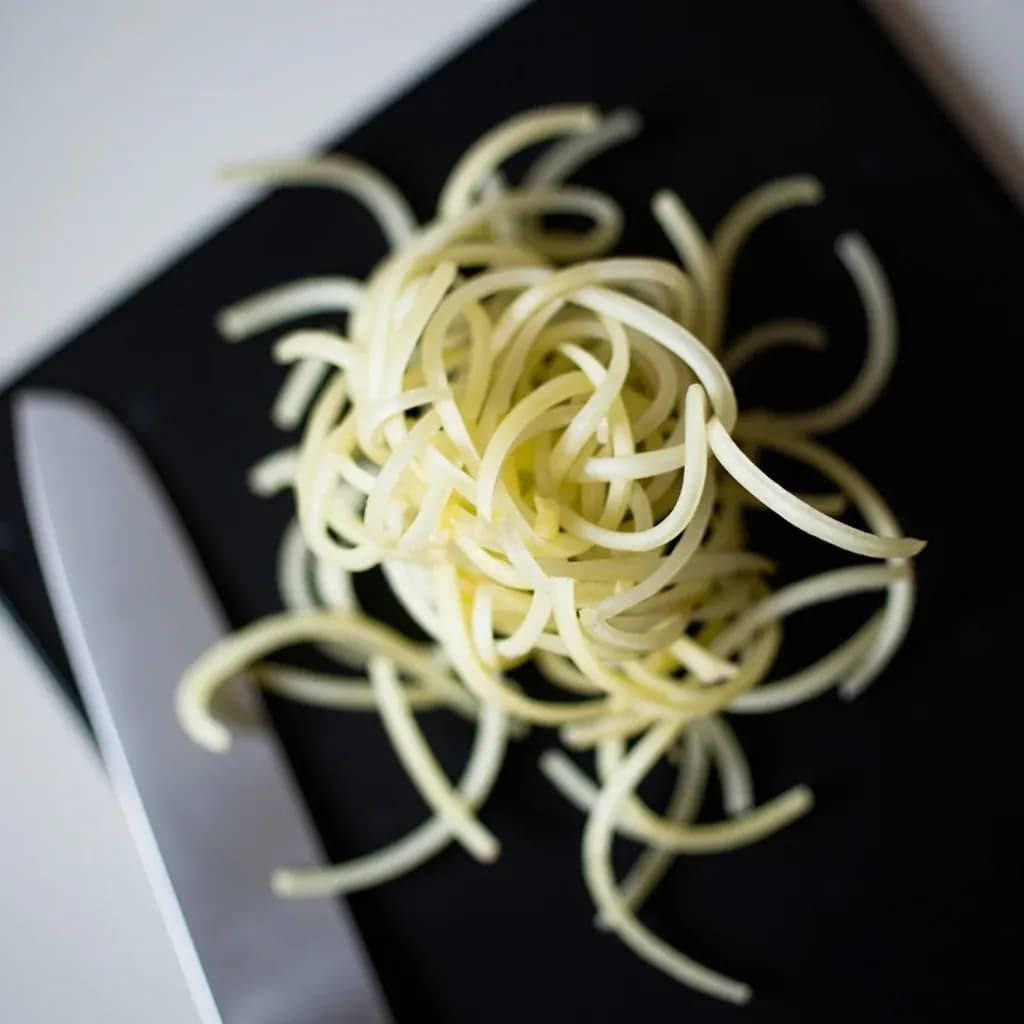
Knife Skills
Sasagaki
Japanese shaving cut that whittles a vegetable into thin slivers resembling bamboo leaves or pencil shavings.
Sasagaki is a Japanese knife technique that rotates a vegetable, most often burdock root or carrot, while shaving thin slivers off the end with the blade, much like sharpening a pencil. The resulting bamboo-leaf-shaped shreds cook quickly and absorb seasoning well, making them ideal for kinpira and soups. The vegetable is usually turned slowly with one hand while the knife shaves toward you with the other.
Sasagaki (笹掻き, literally "bamboo-leaf shaving") is a Japanese knife cut that turns a firm, cylindrical vegetable into thin, pointed slivers that curl slightly and resemble sasa bamboo leaves or fresh pencil shavings. It belongs to the classical katsuramuki family of shaving techniques taught in Japanese culinary training, distinguished from its relatives by the way the cook rotates the vegetable a quarter-turn between strokes, producing a sliver that tapers to a point at both ends rather than a continuous sheet, a flat baton, or a simple coin.
The cut serves three overlapping purposes in a finished dish. Visually, the leaf-shaped slivers catch light and dressing in ways a flat slice never does, which is why they appear on sashimi platters, chirashi bowls, and kaiseki plates where presentation carries as much weight as flavor. Texturally, the thin shaving preserves the vegetable's snap and water content, holding its crispness through brief cooking where thicker batons would soften and lose definition. Practically, the high surface-to-volume ratio lets salt, vinegar, or sugar penetrate almost instantly, making the cut ideal for quick pickles (asazuke) and lightly dressed salads (sunomono).
The motion is a controlled draw of the blade toward the cook, never a push, with the non-dominant thumb acting as a moving backstop rather than a guide. That single mechanical detail is what separates a clean, translucent leaf from a ragged, bruised ribbon, and it is where most home cooks stall out. A yanagiba or usuba is the traditional tool, but any very sharp, narrow blade long enough to clear the width of the vegetable in one stroke will do.
- Difficulty
- Medium
Types & varieties
Very thin, almost translucent shavings cut with a near-horizontal blade angle (15–25°); used as delicate garnish for sashimi, tofu, and clear soups.
Thicker, broader shavings cut with a steeper blade angle (30–45°); holds up to dressing in kinpira and sunomono-style salads.
Burdock shaved diagonally then soaked in vinegar water; a milder, more decorative alternative to the usual matchstick cut in kinpira gobo.
Briefly salted and squeezed to soften, then plated as a cooling garnish alongside grilled fish or tempura.
How to do it
- 1
Select and prep the vegetable
Choose a straight, uniformly thick vegetable — carrot, daikon, peeled gobo, or deseeded cucumber. Square off both ends. If the vegetable will roll, slice a thin flat along one side to stabilize it. Pat the surface dry so the slivers release cleanly.
- 2
Set up grip and stance
Hold the vegetable in your non-dominant hand, fingers curled inward with the thumb extended along the surface and well behind the path the blade will travel. Grip the knife in your dominant hand as if peeling — index finger and thumb pinching the heel of the blade for fine control.
- 3
Set the blade angle
Rest the blade against the vegetable with the edge facing toward you. Tilt the spine up so the edge contacts the flesh at a shallow angle — about 15–25° for fine, translucent shavings, closer to 30–40° for thicker, heartier ones. The tip of the blade should extend past the far side of the vegetable.
- 4
Make the shaving stroke
Draw the blade toward your body in a smooth, short pulling motion, letting the edge slice off a thin sliver. The thumb of your holding hand acts as a backstop and pivot. Do not press down; let the sharpness and angle do the work.
- 5
Rotate and repeat
After each stroke, rotate the vegetable a quarter- to half-turn so the next shaving starts from a fresh face. This is what gives each sliver its pointed, leaf-like shape at both ends. Keep the angle and pressure consistent.
- 6
Stop at the core
When the remaining piece becomes too narrow, seedy, fibrous, or hard to grip, stop. Reserve the core for stocks, stir-fries, or another preparation.
- 7
Finish the slivers
Drop the shavings immediately into a bowl of ice water for 2–3 minutes to crisp them and set the curl. Drain on a clean towel before plating or dressing.
Sasagaki and its cousins in the katsuramuki family
Sasagaki sits inside a broader family of Japanese shaving cuts that share the same short, pulling stroke but differ in what the cook does with the vegetable between strokes. Understanding the differences helps you pick the right cut for the right dish.
- Katsuramuki: the vegetable is rotated continuously against a stationary blade to produce one long, unbroken sheet — used for daikon sheets draped over sashimi or for translucent wraps.
- Tategiri: the blade is drawn straight along the length of the vegetable to produce flat, rectangular planks, often the starting shape for further julienning or for laying across fish.
- Sasagaki: the defining move is a quarter- to half-turn of the vegetable after each stroke, so every sliver is pointed at both ends and reads as a discrete leaf rather than part of a sheet.
Choosing and prepping the vegetable
Not every vegetable will shave cleanly. The best candidates share three traits: a straight, uniform diameter; dense, low-moisture flesh; and a pith or core that can be removed before it interferes with the stroke.
- Trim a flat edge along one side of long, rounded vegetables (carrot, parsnip, peeled gobo) so the cylinder sits still on the board.
- For cucumber, slice in half lengthwise and scrape out the seedy core with a spoon before shaving; the wet center will otherwise tear.
- Chill firm vegetables 20–30 minutes in the fridge — colder flesh shaves cleaner and the slivers hold their shape longer on the plate.
- Stop cutting as soon as the remaining piece becomes narrow, fibrous, or hard to grip; reserve that core for stock, stir-fry aromatics, or a quick pickle.
Common uses
Tips & pitfalls
- Sharpen the blade right before cutting. A yanagiba or usuba that is merely "sharp enough" will crush cell walls and produce ragged, translucent ribbons rather than clean leaves.
- Keep the blade angle shallow (15–25°) for fine, sashimi-grade garnish; raise to 30–45° when the slivers need to stand up to dressing or brief cooking.
- Pull the knife, never push. The blade travels toward your body and your thumb; pushing forward tears the flesh and curls the sliver unpredictably.
- Use only the thumb as a backstop. Letting the index finger creep onto the vegetable to "guide" the cut is the fastest route to a nick and an uneven sliver.
- Work in short, rhythmic strokes, not one long continuous strip. Rotating a quarter-turn between strokes is what creates the signature two-pointed leaf shape.
- Ice-bath the finished shavings for 2–3 minutes. The cold water crisps the flesh and sets a gentle curl that holds through plating.
- Common mistake: shaving a warm or freshly washed vegetable. Moisture and softness both drag the edge; a chilled, dry surface lets the blade glide.
- Common mistake: trying to shave the entire vegetable. The seedy, pithy, or fibrous core will not shave cleanly — stop early and put it to work elsewhere.
Good to know
- Japanese name
- 笹掻き (sasagaki)
- Literal meaning
- "Bamboo-leaf shaving"; sasa refers to bamboo grass whose leaves the slivers resemble
- Category
- Japanese knife technique in the katsuramuki (shaving) family
- Typical blade
- Yanagiba or usuba; a very sharp petty or santoku substitutes at home
- Best vegetables
- Carrot, daikon, cucumber (seeded), gobo, parsnip, celery heart, kohlrabi, asparagus
- Thickness range
- Under 1 mm for fine garnish; 2–3 mm for salads and cooked dishes
- Yield
- One medium carrot produces roughly 20–30 usable slivers before reaching the core
- Difficulty
- Intermediate — demands a freshly sharpened blade and confident thumb-as-backstop control
Also called
Sasagaki (Shaving/Whittling Cut) · Shaving Cut · Whittling Cut
Related

Chop
Cut into rough, irregular pieces — the everyday workhorse cut

Dice
Cut into uniform cubes for even cooking and a tidy look

Mince
Cut as fine as possible so flavor melts evenly into the dish

Slice
Cut into even, flat pieces for consistent cooking and presentation

Julienne
Cut into thin matchsticks for fast cooking and elegant garnish

Brunoise
Cut into tiny, precise cubes — the finest dice in the kitchen

Chiffonade
Roll and slice leafy greens into delicate ribbons

Batonnet
Cut into tidy sticks, thicker than julienne — think classic fries