Water & Steam
Soft-Boiling Eggs
Boiling eggs briefly so the white sets while the yolk stays runny or jammy.
Soft-boiling cooks eggs in simmering water just long enough to set the white while leaving the yolk liquid or jammy, typically around six to seven minutes depending on size and starting temperature. Precise timing and an ice-water plunge to stop the cooking are what separate a runny yolk from an overcooked one. The result is served in the shell with toast soldiers or peeled for ramen and salads.
Soft-boiling is the simplest shell-egg technique and the most unforgiving if you treat it casually. You are cooking an egg in near-boiling water just long enough for the albumen to set while the yolk stops somewhere between liquid and custardy. The window is small: the white begins coagulating near 62°C and is fully firm around 73°C, while the yolk thickens at 65°C and is solid by roughly 70°C. Because those ranges overlap, the difference between a dippy egg with a glossy yolk and a rubbery near-hard-boiled one is often less than a minute.
Two reliable methods produce good results. The first is a timed stovetop boil followed by an ice bath, which is what most home cooks use. The second is a low-temperature water bath — either sous-vide at 65°C for 45–60 minutes, or the Japanese onsen-tamago approach of holding eggs in 65–70°C water for 30–40 minutes — which gives a more repeatable, custardy white without any rubbery layer next to the yolk. Altitude matters on the stovetop because water boils cooler as you climb, so above about 1,500 m the sous-vide method becomes the more dependable choice.
The two things that separate a confident cook from a frustrated one are the timer and the ice bath. Pull the eggs when the timer says to, and drop them into cold water for at least two minutes; that single step stops carryover cooking and is also what lets you peel a soft egg without tearing the white to ribbons. From there, soft-boiled eggs become a building block — for soldiers at breakfast, for ramen and rice bowls, for salads and compound butters, and for the French oeuf mollet and the soy-mirin ajitsuke tamago of Japanese noodle shops.
- Difficulty
- Easy
Types & varieties
Hot start, 5 minutes; white just set and tender, yolk completely liquid — the classic dippy egg for soldiers.
White set but still yielding, yolk thickly runny and glossy.
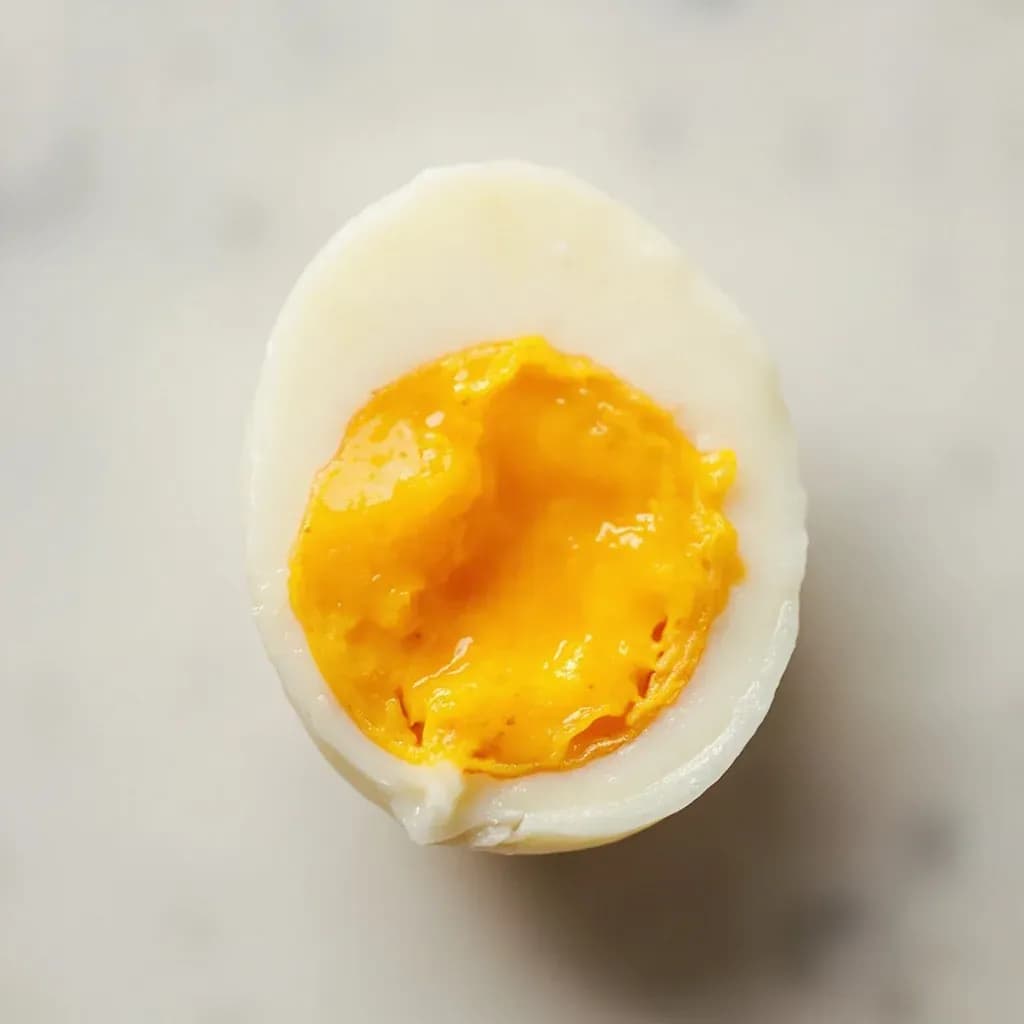
Industry-standard ramen doneness: white set, yolk jammy with a thin liquid core.
Yolk mostly set with a faint creamy center; approaching hard-boiled.
French preparation, ~6 minutes; whites fully set, yolk just barely flowing, often peeled, breaded, and fried or set in aspic.
Japanese style cooked low-and-slow in 65–70°C water for 30–40 minutes; white custardy, yolk just set.
Soft-boiled egg (usually the 7-minute stage) marinated 4–12 hours in soy, mirin, and dashi.
Eggs lowered into cold water, brought to a boil, heat cut, covered, and rested 6–8 minutes — gentler and more forgiving timing.
Cooked in a covered steamer basket over boiling water for 9–12 minutes; similar result with less risk of cracked shells.
65°C for 45–60 minutes in a circulating water bath; repeatable jammy texture; whites slightly under-set, so usually peeled only after the yolk firms.
How to do it
- 1
Set up
Fill a saucepan with 5–7 cm of water and bring to a full boil, then reduce to a steady gentle boil with small bubbles. Set a bowl of ice water next to the stove and a slotted spoon within reach.
- 2
Prep the eggs
Use large eggs straight from the refrigerator for the most predictable timing. Optionally pin-prick the wider end of each shell with a clean needle to vent the air cell and prevent cracking.
- 3
Lower and time
Lower the eggs into the water one at a time with the slotted spoon. Start the timer the moment each egg touches the water: 5 minutes for a runny yolk, 6:30 for jammy with a liquid core, 7:30 for fully jammy, 8:30 for soft-set.
- 4
Hold the temperature
Keep the water at a gentle boil — small bubbles, not a rolling churn — so the whites set evenly without becoming rubbery and the shells do not bang against each other.
- 5
Ice bath
At the timer, lift the eggs straight into the ice water. Leave them for at least 2 minutes. This halts carryover cooking and contracts the white away from the membrane, which is what makes peeling clean.
- 6
Crack and peel (optional)
Tap the shell all over to create a fine crack network, then peel under cool running water or in the ice bath, starting at the wider end where the air pocket sits.
- 7
Serve
Serve in an egg cup with the top sliced off and a side of buttered toast soldiers, or peel and slice in half to show the yolk. Finish with flaky salt and freshly ground black pepper.
- 8
Cold-start variation
For a more forgiving method, place the eggs in cold water, bring to a boil, cut the heat immediately, cover, and rest 6–8 minutes depending on desired doneness. Transfer to the ice bath as above.
The physics of a soft egg
What you are really doing is chasing a temperature gradient between the white and the yolk. The white sets first because its proteins begin coagulating around 62°C and are fully firm near 73°C; the yolk thickens at 65°C and is set by about 70°C. In a hot-start boil, the white reaches setting temperature within a minute or two while the yolk climbs more slowly through the thermal mass of the white and its own fat. That lag is the entire game. Pull too early and the white is still translucent and slimy; pull too late and the yolk has crossed from jammy to chalky.
- White begins to set at ~62°C and firms near 73°C.
- Yolk thickens at ~65°C and is fully set by ~70°C.
- At sea level, a rolling 100°C water bath drives the yolk from liquid to jammy to firm in roughly three to four minutes — the reason the timer matters more than the recipe.
Choosing your method
Hot-start stovetop is the default: fastest, simplest, and the only one most home cooks need. Cold-start is more forgiving because the egg heats gradually and is less likely to crack, but it gives a slightly less even white. Steaming is a nice middle ground that protects shells and produces a tender white. Sous-vide and onsen-style low-temperature baths are the gold standard for repeatability and for cooking at altitude, where the lower boiling point makes stovetop timing unpredictable.
- Stovetop, hot start: 5–8 minutes for a jammy yolk at sea level.
- Stovetop, cold start: bring to a boil, cut heat, cover 6–8 minutes — gentler on shells.
- Steaming: 9–12 minutes over boiling water in a covered basket.
- Sous-vide / onsen: 65°C for 30–60 minutes; best for altitude or large batches.
How to tell doneness
The color and gloss of the yolk are the honest indicators. A liquid yolk is bright golden-orange and runs freely when you cut the egg. A jammy yolk is a deeper amber, holds its shape on the cut face, and oozes slowly when pressed. A soft-set yolk is matte orange and only slightly yielding in the center. If you are cooking for service or photography, sacrifice one egg to check — crack it onto a plate after the ice bath and look at the cross-section; the time you need to adjust is rarely more than thirty seconds.
- Liquid yolk: bright, glossy, runs immediately when cut.
- Jammy yolk: deep amber, holds shape, oozes slowly.
- Soft-set yolk: matte orange, mostly firm with a faint creamy core.
Common uses
Tips & pitfalls
- Use a timer — the gap between jammy and overcooked is roughly sixty seconds, and guessing by feel is unreliable.
- Pin-prick the wider end of the shell before cooking to vent the air cell; without that, expanding air cracks the shell against the pot wall.
- Lower eggs into the water with a spoon rather than dropping them; thermal shock cracks shells and you lose the egg to a leaky white.
- Keep the water at a gentle boil, not a rolling one; a hard boil toughens the outer white and bounces eggs into each other.
- The ice bath is not optional — residual heat will carry the yolk one or two stages past your target after you pull them, and a cold shock is what makes the white release from the membrane for clean peeling.
- Use eggs that are 4–10 days old for the cleanest peel; very fresh eggs bond to the inner membrane and tear when you try to strip them.
- To peel a soft egg without tearing, crack the shell all over first, then work the shell off under cool running water or back in the ice bath.
- At altitude, switch to a 65°C sous-vide bath or extend stovetop time by a minute or two, since water boils below 100°C and timing curves shift.
Good to know
- Technique type
- Moist-heat shell cooking in water at or near boiling
- Water temperature
- 95–100°C / 203–212°F (gentle boil to full boil)
- Standard timing (large egg, hot start)
- 5–8 minutes; 6:30 is the jammy sweet spot
- Egg-size adjustment
- Small/medium finish 30–60 s sooner; extra-large need 30–60 s longer
- Altitude effect
- Boiling point drops ~1°C per 285 m; add ~1 min or switch to sous-vide
- Sous-vide alternative
- 65°C / 149°F for 45–60 minutes for consistent jammy yolks
- Post-cook
- Ice bath 1–2 minutes to halt carryover and firm the white
- Peelability
- Eggs 4–10 days old peel most cleanly; very fresh eggs cling to the membrane
Also called
soft-boil · soft-boiled eggs · jammy eggs
Dishes that rely on it
Related

Boil
Cook in vigorously bubbling liquid at full rolling heat

Simmer
Hold liquid at a gentle shimmer for tender, unhurried cooking

Poach
Cook gently in barely-trembling liquid for silky, tender results

Steam
Cook in rising vapor to keep color, nutrients, and shape intact

Blanch
Plunge briefly in boiling water, then shock cold to lock color

Braise
Sear, then cook slow in a little liquid until fall-apart tender

Stew
Simmer bite-sized pieces fully submerged into a rich, unified pot

Sous-Vide
Seal and cook in precise warm water for edge-to-edge doneness