Knife Skills
Spiralizing
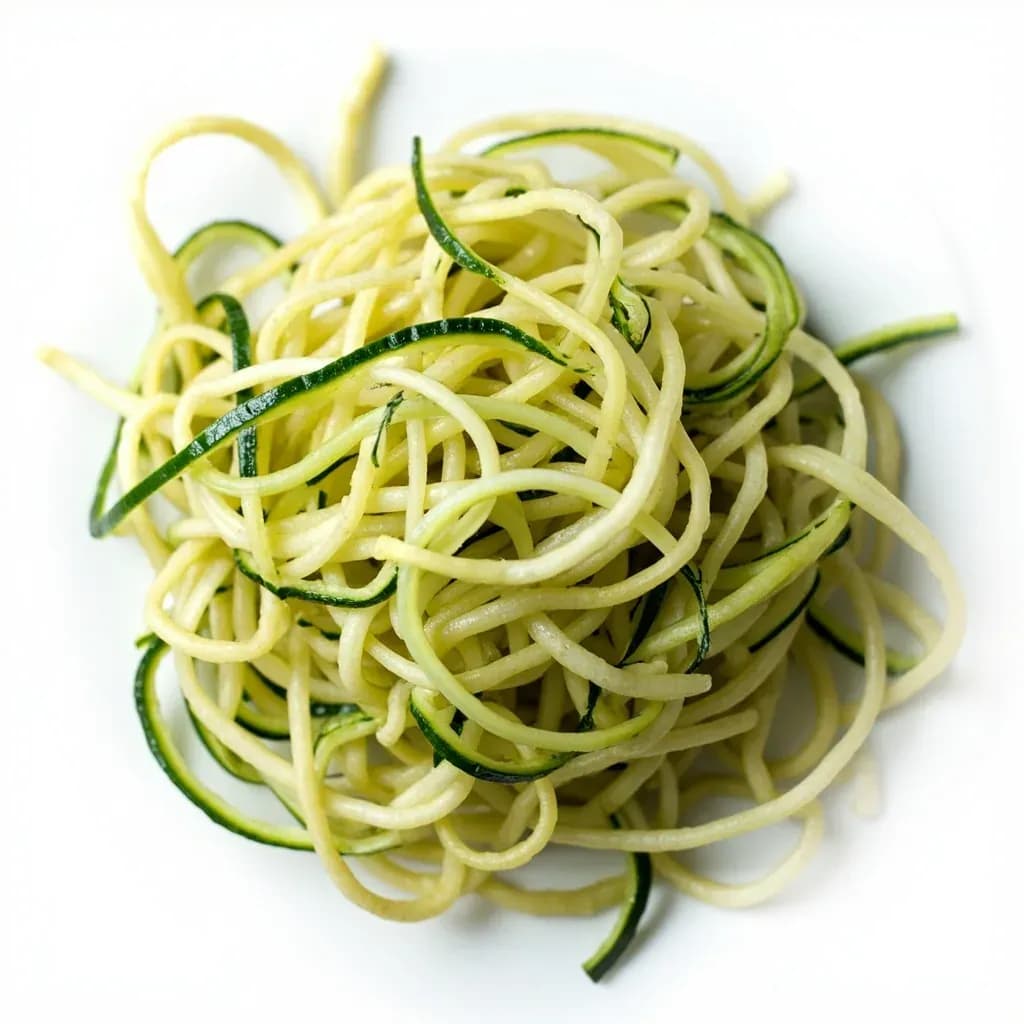
Turning firm vegetables into long curly noodle-like strands with a spiralizer.
Spiralizing feeds a firm vegetable, such as zucchini, carrot, or beet, through a bladed spiralizer to produce long, springy ribbons or noodle-like strands. It's used to make low-carb vegetable noodles, garnishes, and salads with a fun texture. Firm, straight, evenly thick vegetables spiralize best, while soft or hollow ones tend to shred apart.
Spiralizing is a mechanical cutting technique that turns firm, cylindrical vegetables into long, continuous, noodle-like strands using a hand-crank or electric spiralizer. The tool holds the vegetable on a central prong while a rotating blade shears it into ribbons or round strings — essentially a standardized form of julienne that produces unbroken lengths of vegetable "noodle" with very little knife skill. The strands behave differently from wheat pasta: most spiralized vegetables are far wetter and more delicate, so they need brief cooking, aggressive drying, or treatment as a raw ingredient rather than a simmered one.
The technique matters because it lets a cook swap a refined carbohydrate for a whole vegetable without sacrificing the visual and textural pleasure of long, twirlable strands. A medium zucchini becomes roughly 1.5 to 2 cups of noodles in under a minute, a sweet potato yields a sturdy, heat-tolerant ribbon, and a beet produces a vivid, plate-staining strand that holds a vinaigrette beautifully. It is, in practical terms, the easiest way to put a vegetable where pasta used to be — and once you understand which vegetables hold up to heat and which ones weep water onto the plate, it becomes a reliable weeknight tool rather than a novelty.
A spiralizer is not the only way to get there. A julienne peeler produces thin matchsticks, a vegetable peeler makes wide flat ribbons, and a box grater gives a short, rice-like texture. None of these, however, makes the long, curly strand that defines the technique — for that, you need the rotating blade and prong assembly of a true spiralizer.
- Difficulty
- Easy
Types & varieties
Thin, round, spaghetti-like strands; the default setting on most spiralizers and the cut most associated with 'zoodles'
Flat ribbons roughly 2–3 mm wide; sturdier than the spaghetti cut and noticeably better at holding up to heat and sauce
Wide, flat, pappardelle-like strips produced by a separate blade insert; can be approximated with a vegetable peeler for a lower-cost option
How to do it
- 1
Choose a suitable vegetable
Pick a firm, straight, cylindrical vegetable at least 1.5 inches (4 cm) in diameter. Zucchini, yellow squash, carrots, cucumbers, daikon, sweet potato, beet, parsnip, broccoli stems, and the neck end of butternut squash all work. Avoid soft, seedy, or hollow vegetables — they crush or jam the blade.
- 2
Wash and trim
Rinse the vegetable under cool water and scrub lightly. Slice off the top and bottom so both ends sit flat. If the vegetable tapers (a carrot, the bulb of a beet, the body of a butternut), square off the thickest part with a knife so it seats flush on the prongs.
- 3
Mount the vegetable
Press the flat-cut end firmly onto the prongs of the spiralizer, pushing all the way in so the central spike is centered. Off-center mounting gives short, uneven strands and is the most common beginner mistake.
- 4
Select the blade and cut
Insert the desired blade (spaghetti, linguine, or ribbon). Hold the handle, apply firm even pressure toward the blade, and turn the crank at a steady pace — not so fast that the motor or your hand stalls, not so slow that the vegetable slips. The strands emerge from the opposite side and fall into a bowl or onto a sheet pan.
- 5
Separate and inspect
Lift the noodles gently and shake them apart with your fingers. The nub left on the prongs is too short to spiralize; slice it off with a paring knife and dice it for stocks, stir-fries, or omelets.
- 6
Dry if cooking
For watery vegetables (zucchini, cucumber, summer squash), spread the noodles on a clean kitchen towel, roll up, and press firmly. For longer cooking or saucy applications, salt lightly first, rest 10–15 minutes, then squeeze again. Beet, carrot, and sweet-potato noodles need little or no drying.
- 7
Cook briefly or serve raw
For cooked applications, sauté in a hot pan with a little oil for 1–2 minutes, or blanch in boiling water for 30–60 seconds and shock in cold water. For raw applications, chill the cut noodles for 10–15 minutes (they firm up and sauce clings better) and dress just before serving.
Which vegetables work — and which don't
The geometry of a spiralizer rewards vegetables that are firm, dense, and roughly the same diameter from end to end. Anything too soft crushes against the blade instead of cutting cleanly; anything hollow or seedy (eggplant flesh, large tomatoes, bell peppers) jams or collapses into wet shreds. The sweet spot is a vegetable you can hold upright on a prong and push steadily against steel.
A short history
Vegetable 'noodles' long predate the spiralizer. Julienned daikon appears in Japanese oden, shoestring carrots thread through Korean japchae, and cold cucumber salads in Sichuan cooking rely on the same long-strand logic. The tool itself is essentially a powered julienne: a rotating blade does what a knife hand does, only faster and more uniformly. The modern wave, from roughly 2013 onward, was driven by gluten-free and low-carb eating, when home cooks needed convincing pasta substitutes and the zucchini — abundant, mild, and quick to cook — became the workhorse.
Drying is the real skill
The single most important technique in spiralizing is not the cutting — it is what you do after. Zucchini, cucumber, and summer squash are roughly 95% water; their strands will weep that water into any sauce, soup, or hot pan within minutes. Salting and resting, then pressing in a clean kitchen towel, removes enough moisture to let a sauce cling instead of pool. Beet and sweet-potato noodles are drier by nature and need no pre-treatment. Carrots sit in the middle: a brief towel-pat improves them but they will not punish you if you skip it.
Common uses
Tips & pitfalls
- Pat or squeeze zucchini noodles dry in a clean kitchen towel before saucing; one medium zucchini can hold a third of its weight in water and will pool a sauce within minutes if you skip this.
- Salt zucchini noodles lightly, let sit 10–15 minutes, then drain and pat dry for any cooked application — the salt draws out water the towel can't reach on its own.
- Cook spiralized vegetables over high heat for the shortest possible time. Steam or sauté, never boil, and treat one minute as the upper limit for zucchini.
- Cut the vegetable so it is straight and long enough to clear the blade fully — short or crooked pieces produce broken, stubby strands.
- For hard squash like butternut, microwave the neck end whole for 1–2 minutes to soften the skin just enough for the blade to bite without splintering.
- Center the vegetable on the prongs. Off-center placement is the single most common cause of short, ragged, or jammed strands.
- Chill raw noodles 10–15 minutes after cutting. Cold strands are firmer, less weepy, and hold sauce better than room-temperature ones.
- Dress raw spiralized salads at the last moment. Salt in any dressing begins pulling water out of the strands within minutes, so a dressed salad needs to be served, not held.
Good to know
- Technique type
- Mechanical vegetable cutting — produces long, continuous strands using a rotating blade and prong assembly
- Primary tool
- Countertop hand-crank spiralizer (Paderno-style); also electric spiralizers, stand-mixer attachments, and handheld pencil-style spiralizers
- Blade types
- Typically three — spaghetti (thin round strands), linguine/fettuccine (flat ribbons ~2–3 mm wide), and ribbon/sheet (wide flat strips)
- Most common vegetable
- Zucchini, which produces the ubiquitous 'zoodles'
- Best vegetable texture
- Firm, dense, and roughly cylindrical — soft, seedy, or hollow vegetables collapse or jam the blade
- Skill level
- Beginner — minimal knife work required once the tool is loaded and centered
- Time per vegetable
- Under 1 minute after washing and trimming
- Cook time for zucchini
- 1–2 minutes maximum; longer and the strands turn watery and limp
- Popularization
- Went mainstream in the U.S. around 2013–2014; Ali Maffucci's cookbook Inspiralized (2015) helped drive adoption
- Yield
- One medium zucchini (~200 g) yields roughly 1.5–2 cups of noodles
Also called
Vegetable Noodling · Making Veggie Noodles
Related

Chop
Cut into rough, irregular pieces — the everyday workhorse cut

Dice
Cut into uniform cubes for even cooking and a tidy look

Mince
Cut as fine as possible so flavor melts evenly into the dish

Slice
Cut into even, flat pieces for consistent cooking and presentation

Julienne
Cut into thin matchsticks for fast cooking and elegant garnish

Brunoise
Cut into tiny, precise cubes — the finest dice in the kitchen

Chiffonade
Roll and slice leafy greens into delicate ribbons

Batonnet
Cut into tidy sticks, thicker than julienne — think classic fries