Water & Steam
Steaming Sticky Rice (Nueng Khao Niao)
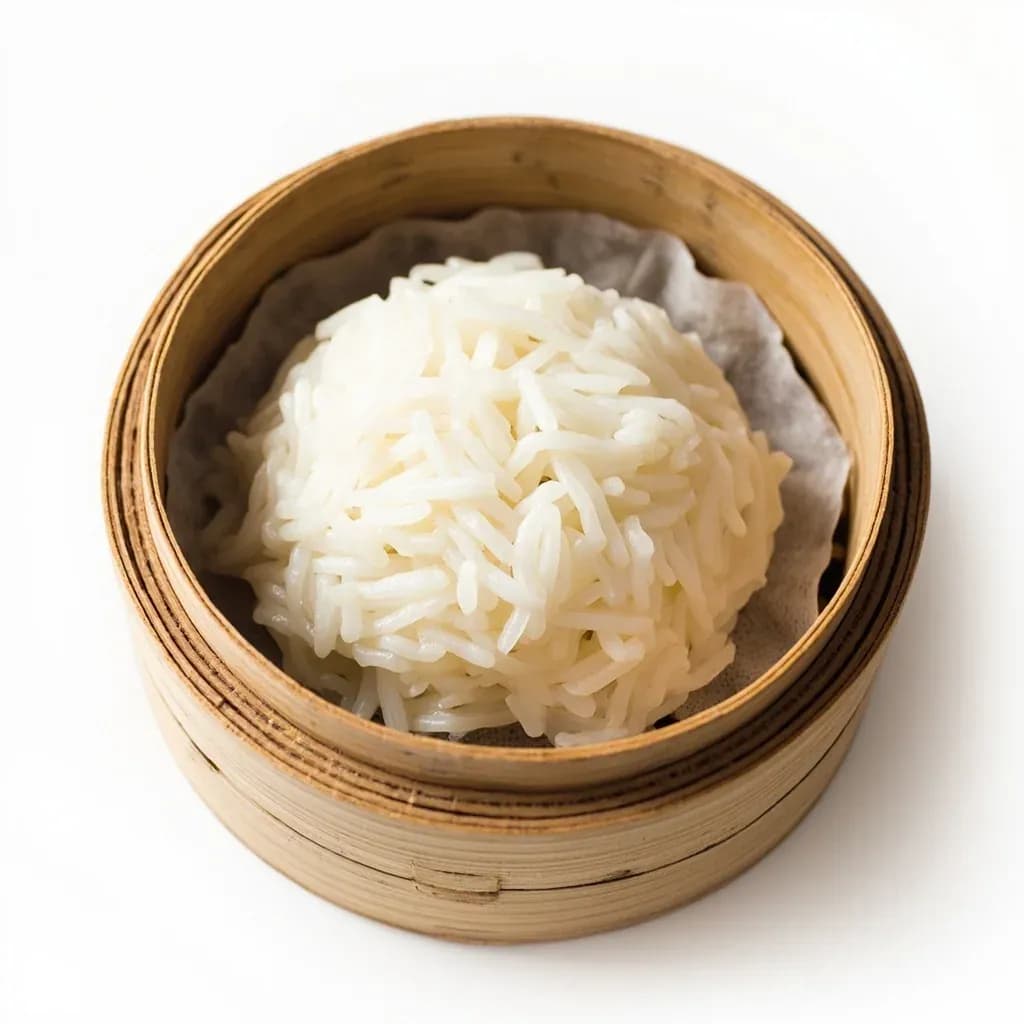
Soaking and steaming glutinous rice over a bambo basket so grains stay separate and chewy.
This Lao and Thai technique steams pre-soaked glutinous (sticky) rice rather than boiling it, traditionally in a conical bamboo basket set over a pot of water. Soaking for several hours lets the grains hydrate, and the steam cooks them into a tender, chewy mass that holds together for hand-rolling. The rice is often flipped midway so it cooks evenly without becoming gummy.
Steaming sticky rice — nueng khao niao in Thai, khao niao in Lao — is the everyday method across Laos and Isan (Northeast Thailand) and the foundation of the region's foodways. The principle is simple: soak the rice, then cook it with steam, never in standing water. A short- to medium-grain glutinous rice, almost entirely amylopectin, is hydrated for hours until the grains soften, drained, and suspended in a bamboo basket (huat in Thai, saiung in Lao) over a rolling boil. The result is sticky rice as it is meant to be — each grain tender, translucent, and chewy, with enough grip to be pinched into a small ball with the fingers, the traditional way of eating it.
The bamboo basket is the heart of the technique. Its woven walls let steam rise through the rice bed and wick away any moisture that would otherwise turn the grains to paste, while a cloth-wrapped lid catches condensation so drops fall onto the towel instead of back onto the rice. Restaurants keep a stack of baskets on simmering water all day, so a new batch is always a few minutes from done. The grains hold their heat and chew for an hour or two, then firm up as they cool — which is why sticky rice is meant to be eaten soon after steaming, ideally from the basket it was cooked in.
The payoff is a texture no rice cooker or saucepan can replicate. When glutinous rice sits in water, its amylopectin swells into the surrounding liquid and the grains collapse into a dense, gummy mass. Steam applies heat to the outside of each grain while the surface starches gelatinize in place, so the rice cooks through without dissolving. A properly steamed batch is sticky enough to hold together as a ball, loose enough to feel like individual grains under the teeth, and faintly sweet and vanilla-like on the nose.
- Difficulty
- Easy
Types & varieties
Workhorse of Isan and Laos; served with grilled meats, som tam, larb, and jeow dipping sauces.
Purple-black heirloom; firmer, nuttier, and the traditional base for sweet coconut puddings.
Earthy and slightly sweet; used in ceremonial and northern Thai/Lao preparations.
Sold mainly in Thailand; yields slightly less sticky, more separated grains, and needs a longer soak.
How to do it
- 1
Measure and rinse
Measure 1 cup of glutinous rice per 2 servings. Rinse in cool water, swishing gently, until the water runs mostly clear, then drain.
- 2
Soak
Submerge the rice in a large bowl of cool water for 4–6 hours at room temperature, or overnight in the refrigerator. The grains should swell and crush easily between thumbnail and finger.
- 3
Set up the steamer
Fill a pot or wok with water to about 2.5–5 cm (1–2 in) below the bamboo basket; the water must not touch the basket. Bring to a rolling boil.
- 4
Drain the rice
Drain the soaked rice in a colander and shake off excess water. Let it sit 1–2 minutes so surface moisture drips away.
- 5
Load the basket
Line the bamboo basket with cheesecloth or a piece of banana leaf. Spread the drained rice in an even layer no deeper than about 5 cm (2 in). Wrap the pot lid in a clean kitchen towel and clamp it on so condensation drips onto the cloth rather than back onto the rice.
- 6
Steam, first pass
Steam over rapidly boiling water for 15–20 minutes (white rice) or 20–25 minutes (black or red rice). Lift the lid once at the halfway mark to turn or fluff the rice with chopsticks or a paddle so it cooks evenly.
- 7
Optional second steam
For the most tender, evenly cooked result, transfer the rice to a bowl, sprinkle with 2–3 tablespoons of water per cup of raw rice, toss, then return to the basket and steam another 5–10 minutes.
- 8
Test and rest
Bite a grain — the center should be fully translucent and tender with no chalkiness. Let the rice rest in the covered basket 5 minutes before serving.
- 9
Serve
Turn out onto a plate or keep warm in the basket. Serve with accompaniments, or eat by hand, pinching off a small ball, dipping, and using it to scoop food.
Why soak before steaming?
Glutinous rice carries almost no amylose, the straight-chain starch that makes long-grain rice cook up into separate, fluffy grains. Its starch is nearly all amylopectin, which swells and bursts readily in water. A long soak — 4 to 6 hours at room temperature, or overnight in the refrigerator — gives the amylopectin time to absorb water gradually, so the grains are already soft when the steam hits them. Skip or shorten the soak and the outside of each grain will gelatinize and harden before the inside catches up, leaving a chalky core no amount of steaming will fix. The thumbnail test is the most reliable: a properly soaked grain crushes to a soft paste with no resistance.
The bamboo basket (huat / saiung)
The woven bamboo basket is the tool that gives nueng khao niao its character. Steam rises through the gaps in the weave and reaches the rice from below and from the sides, while the basket itself allows moisture to escape rather than pooling around the grains. A tight-fitting metal or plastic steamer works in a pinch, but condensation collects on solid walls and drips back onto the rice, so the towel-under-the-lid trick is even more important. A banana leaf or cheesecloth liner keeps the rice from falling through the weave and adds a faint vegetal note to the finished rice. In Laos and Isan, baskets of sticky rice are kept stacked over simmering water all day; each new portion is ready in 15–20 minutes, and the rest stays warm and pliable for hours.
Common uses
Tips & pitfalls
- Soak in plenty of cool water until the grains crush easily between thumbnail and finger; under-soaked rice will never finish tender in the basket.
- Do not cook sticky rice in a rice cooker or saucepan of standing water — the drained-then-steamed method is what keeps grains separate and chewy.
- Drain the soaked rice thoroughly; excess surface water turns the basket into a soggy steamer and the grains turn gummy.
- Line the basket with cheesecloth or banana leaf, pre-warm it over the steam for a minute, and wrap the pot lid in a clean kitchen towel so condensation drips onto the cloth instead of back onto the rice.
- Flip or stir the rice once at the halfway mark so the top and bottom cook evenly; a few cooks splash 2–3 tbsp of water over the rice at the flip.
- Test doneness by biting a grain — it should be tender all the way through with no chalky core.
- Do not crowd the basket; steam in shallow batches no deeper than about 5 cm (2 in), or the bottom layer stays raw.
- Serve immediately. To hold, keep the rice covered in the basket over barely simmering water and re-steam 5 minutes to refresh.
Good to know
- Origin
- Laos and Isan (Northeast Thailand); central to Lao and Isan foodways
- Thai name
- Nueng Khao Niao (หนึ่งข้าวเหนียว)
- Lao name
- Khao Niao (ເຂົ້າໜຽວ); saiung refers to the steaming basket
- Primary equipment
- Bamboo steaming basket (huat in Thai, saiung in Lao) over a pot of boiling water
- Rice used
- Glutinous (sticky) rice — short- to medium-grain, opaque, high in amylopectin
- Soak time
- 4–6 hours at room temperature, or overnight refrigerated
- Steaming time
- 20–30 minutes for white rice; up to 45 minutes for black or red
- Yield
- About 2 cups cooked per 1 cup raw rice
- Texture goal
- Individual, tender, chewy grains that hold when pinched but are not gummy
- Serving temp
- Eaten hot or warm; stiffens significantly once fully cooled
- Shelf life (cooked)
- Best within a few hours; re-steam leftovers, do not microwave alone
- Difficulty
- Low in steps, but technique-sensitive — soaking and basket steaming are non-negotiable
Also called
Nueng Khao Niao · Steamed Glutinous Rice · Sticky Rice Steaming
Related

Boil
Cook in vigorously bubbling liquid at full rolling heat

Simmer
Hold liquid at a gentle shimmer for tender, unhurried cooking

Poach
Cook gently in barely-trembling liquid for silky, tender results

Steam
Cook in rising vapor to keep color, nutrients, and shape intact

Blanch
Plunge briefly in boiling water, then shock cold to lock color

Braise
Sear, then cook slow in a little liquid until fall-apart tender

Stew
Simmer bite-sized pieces fully submerged into a rich, unified pot

Sous-Vide
Seal and cook in precise warm water for edge-to-edge doneness