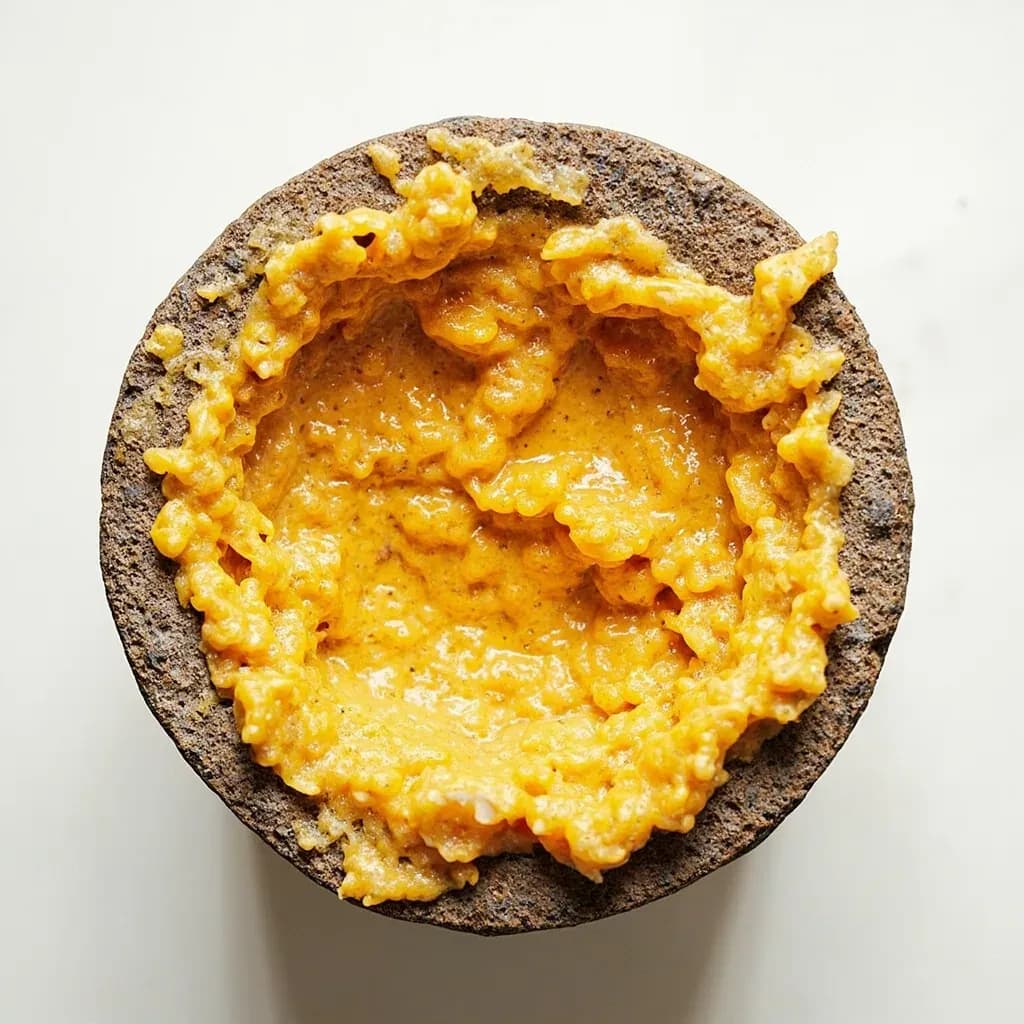
Prep & Assembly
Stone Grinding
Crushing grains, nuts, or masa between stones into meal or paste.
Stone grinding mills ingredients like nixtamalized corn, grains, nuts, and spices between two stones, such as a metate, batán, or molino. The slow, low-heat grind preserves flavor and oils that high-speed steel mills can scorch, and it gives masa and pastes their distinctive texture. The technique remains central to making tortilla masa and traditional nut and grain pastes.
Stone grinding is the reduction of grains, nixtamalized corn, nuts, cacao, or seeds between two stone surfaces using pressure and abrasion rather than blades or high-speed metal burrs. The defining quality is low heat: friction stays well below the temperatures of industrial milling, which preserves volatile oils, active enzymes, and the fragile lipids in the germ that give fresh-ground flours and pastes their distinctive aroma and nutrition. The process is slow, deliberate, and physical — closer to kneading dough than to running a machine.
The technique produces a particle profile that is coarser and more irregular than what comes out of a steel roller mill, and for whole grains it leaves the bran and germ largely intact. The result is more flavorful, more nutritious flour with a noticeably shorter shelf life. With nixtamal, wet stone grinding yields the soft, pliable, hydrated masa that gives fresh tortillas their characteristic chew — a texture that rehydrated masa harina imitates but does not equal.
Stone grinding is moderate to high in skill, and the equipment is regionally specific. Stones are porous and become seasoned with use; treated like cast iron and never washed with soap, they develop a working patina that actually improves performance over time.
- Difficulty
- Hard
Types & varieties
Mesoamerican: a large sloped or three-legged slab worked with a cylindrical hand-stone in figure-eight or sweeping strokes. The classic tool for masa.
Mexican basin-and-pestle of volcanic rock; smaller and vertical, used for salsas, moles, and small-batch grinding.
Earliest European and African style: a lower saddled stone rubbed with an upper 'rubber' stone; slow but effective for grains.
Later European evolution with a turning upper stone; the ancestor of the modern stone-burr grain mill.
South Asian stone mill of two horizontal circular stones, traditionally used for atta (whole-wheat flour) and spice pastes.
Japanese stone mortar paired with a wooden kine (mallet); a vertical pounding rather than rotary grind, used for mochi and certain bean pastes.
Modern granite or stone rollers turning in a stone trough over hours or days, used in craft chocolate to refine cacao nibs with sugar into liquid chocolate.
A well-used metate whose surface has been ground into a smooth concavity; prized by experienced tortilleras for how it breaks the corn.
How to do it
- 1
Prepare the stone
Settle the metate on a stable, knee-height surface. Tilt it a few degrees toward you so paste or meal collects at the lower edge. If the stone is new, season it by grinding a slurry of dried corn, water, and a spoonful of cal for 10–15 minutes per day over several days until the surface smooths.
- 2
Hydrate the nixtamal (for masa)
Rinse cooked nixtamal and let it rest covered with a thin layer of water for at least 30 minutes; the grains should be tender and the skins slip off easily when rubbed. Drain off excess water but keep the corn damp.
- 3
First grind
Place a small handful of nixtamal (about 60–80 g) in the upper third of the metate. Wet the mano. Press the mano down and forward with body weight, sweeping in long arcs across the surface to crush the kernels.
- 4
Add water as you go
Splash a small amount of water (a tablespoon or two) onto the stone as grinding progresses. The masa should form a soft, damp paste — not soupy, not dry. Work it back up the slope with the mano for a second pass.
- 5
Refine the texture
After 8–10 minutes per batch, the masa should be uniformly fine. Do the thumb-press test: a small ball should hold its shape with a clean, slightly tacky edge, and no visible grits when broken in half.
- 6
Collect and repeat
Sweep the finished masa to the lower edge of the metate or into a bowl, then reload with fresh nixtamal. Keep a damp cloth over finished masa so it does not dry out before pressing or forming.
- 7
Clean the stone
Rinse with warm water and scrub with a stiff plastic or natural-bristle brush. Avoid soap. Stand the stone on edge to air-dry fully, or cover with a clean cloth between uses.
The seasoned stone
A stone grinder is not a passive slab — it is a living surface that improves with use. The first handfuls of corn on a new metate feel like sanding the stone, and you will produce a lot of dust and frustration before the surface smooths. Cooks traditionally break in a fresh metate by grinding a slurry of dried corn, water, and a spoonful of cal (slaked lime) for ten or fifteen minutes a day over several days. This both polishes the working face and embeds a thin alkaline patina into the pores, which is what seasoned tortilleras call a curvada. Once developed, that patina helps the stone 'release' the masa cleanly instead of letting it gum up. A curvada metate is often passed down within a family or a tortillería for exactly this reason.
- Expect the first 5–10 batches on a new metate to feel slow and gritty; production speeds up dramatically once the working curve develops.
- Never wash a grinding stone with soap or detergent — both are absorbed into the porous surface and will flavor everything you grind afterward.
- Store the stone dry between uses, but in arid kitchens a lightly damp cloth laid over the surface prevents cracking.
- Stand the stone on edge after cleaning so water drains and both faces air-dry fully.
Knowing your equipment
Stone-grinding tools look similar at a glance but are not interchangeable. A metate is a slab, worked horizontally with a rolling stone; a molcajete is a basin, worked vertically with a pestle. A chakki is a pair of horizontal millstones for dry grain; a melanger is a slowly turning granite trough designed for wet chocolate. Using the wrong tool is the most common reason home cooks give up on stone grinding — they are trying to make masa on a molcajete, or chocolate on a chakki. Match the tool to the job, and the work is far easier than the reputation suggests.
- Metate and mano: nixtamal masa, large-batch wet grinding.
- Molcajete and tejolote: salsas, moles, spice pastes, small-batch work.
- Saddle and rotary querns: dry grain into flour or meal.
- Chakki: South Asian whole-wheat atta and spice grinding.
- Stone melanger: cacao and sugar refined into chocolate over many hours.
Common uses
Tips & pitfalls
- Always start with nixtamal (corn treated with cal or wood ash), never raw or plain dried corn, if you want real tortilla masa — hydration and pectin release depend on the alkaline cook.
- Add corn and water in small increments; too much at once stalls the grind and leaves gritty pockets.
- Use the long side of the mano for broad sweeps and the rounded tip for the edges and corners of the stone.
- Test masa by pressing a small ball between thumb and fingers — it should hold together without sticking or crumbling at the edges (the maíz de prueba).
- Common mistake: substituting pre-ground masa harina for fresh nixtamal on a metate. The alkali treatment and moisture are already locked in, and you will not achieve the same fresh texture.
- For chocolate, the stone must run for 12–72 hours to develop a true conche; short grinds leave a gritty, undeveloped paste.
- If you do not own a metate, a hand-cranked stone-burr mill handles dry flours well and a high-power food processor handles wet pastes, but neither replicates a real stone-ground texture exactly.
Good to know
- Definition
- Reduction of grains, nixtamalized corn, nuts, cacao, or seeds between two stone surfaces into meal, flour, or paste, using pressure and abrasion rather than blades.
- Origin
- Among the oldest food-prep techniques; Mesoamerican metate-and-mano tradition dates to the Preclassic period, while quern stones appear across Neolithic Europe, North Africa, and South Asia.
- Common stone materials
- Volcanic basalt (most metates and molcajetes), granite, sandstone, soapstone, and andesite.
- Heat generated
- Low — friction stays well below the temperatures of high-speed steel burrs, preserving volatile oils, enzymes, and germ lipids.
- Wet vs. dry
- Dry grinding for grain flours; wet grinding (with water added during the work) for masa, nut pastes, and chocolate.
- New-stone break-in
- A fresh metate is seasoned by grinding a slurry of corn, water, and lime over several days to smooth the surface and embed a working patina (called curvada in Mexico).
- Particle size
- Coarser and more irregular than industrial milling; stone-ground flour retains bran and germ, giving higher nutrient density but shorter shelf life.
- Masa yield
- Roughly 1.5 kg fresh masa from 1 kg dried nixtamalized maize, depending on moisture and grind fineness.
Also called
Stone Grinding (Pisne) · Grinding on the Batán · Grinding on Stone (Moler) · Masa Grinding (Moler Masa)
Dishes that rely on it
Related

Whisk
Beat ingredients smooth and aerated with a looping wire motion

Sift
Pass dry ingredients through mesh to aerate and remove lumps

Strain
Pour through mesh to separate solids from liquid for a smooth result

Filter
Pass liquid through fine material to clarify out the smallest particles

Rice
Press cooked potatoes through small holes for fluffy, lump-free texture

Mash
Crush soft cooked food into a rustic, creamy purée

Grind
Crush food into a coarse to fine texture, from spices to meat

Grate
Shred food into fine bits against a sharp-toothed surface