Prep & Assembly
Tamping
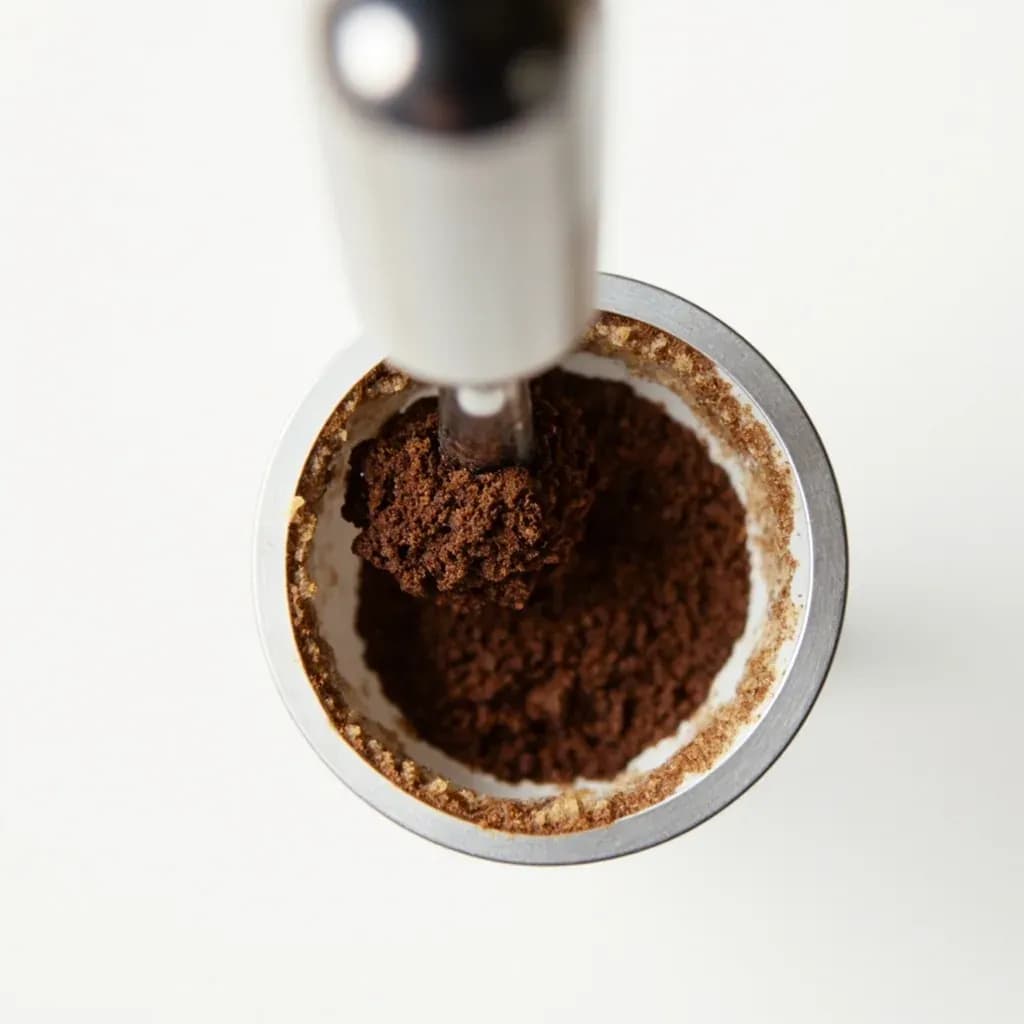
Compressing ground coffee evenly into a portafilter for balanced espresso extraction.
Tamping is pressing ground coffee firmly and level into the portafilter basket so water flows through the bed evenly under pressure. A consistent, flat tamp prevents channeling, where water rushes through weak spots and produces a sour, under-extracted shot. Baristas aim for steady downward pressure and a perfectly horizontal puck.
Tamping is the act of compressing a measured, ground dose of coffee into a firm, level puck inside an espresso portafilter basket. It is the final physical step between grinding and brewing, and the only moment where the barista directly controls the density of the bed through which pressurized water will flow. A well-tamped puck resists water evenly across its surface; a poorly tamped one creates channels — preferential paths where water rushes through, leaving the rest of the bed under-extracted and producing shots that taste sour, thin, or harshly bitter.
The mechanics are simple: a piston-shaped tamper is pressed straight down onto a leveled bed of grounds with roughly 30 pounds of force. What makes tamping deceptively difficult is that the puck's behavior during extraction depends less on the absolute pressure than on its uniformity. Levelness, perpendicularity, and consistency shot to shot matter far more than brute force. Because tamping sits at the end of a chain — dose, grind, distribution, leveling, then tamp — it cannot rescue upstream errors. It can only lock them in, or, with care, set the stage for a clean, balanced extraction.
Modern specialty practice treats tamping as one act within a broader workflow called puck prep. Distribution tools (WDT needles, dosing funnels, levelers) handle the work that baristas once tried to do with the tamper itself. A good barista today is judged less by how hard they tamp than by how repeatable their puck is from shot to shot.
- Difficulty
- Easy
Types & varieties
The industry standard and the choice of most competition baristas; produces a level, predictable puck surface that matches a flat basket floor.
Slightly domed base said to mirror the basket floor; popular in some specialty cafés, though most empirical testing finds flat tampers extract more evenly.
Built-in spring or pneumatic mechanism that clicks or stops at a preset pressure (typically 30 lb), removing guesswork for newer baristas.
Motorized or pneumatic press common in busy cafés; delivers identical pressure on every shot without operator variability.
Mechanical-advantage design that standardizes pressure with less wrist strain, useful for high-volume service.
How to do it
- 1
Dose the basket
Weigh the portafilter, dose the correct amount of ground coffee (typically 14–20 g for a single or double basket), then re-weigh to confirm. Weight is more reliable than volume.
- 2
Distribute the grounds
Use a WDT tool, dosing ring, or distribution tool to break up clumps and spread the bed evenly across the basket floor. Tamping a poorly distributed bed is the single most common cause of channeling.
- 3
Level the bed
Tap the portafilter gently on the bench or use a leveler so the surface of the grounds is flat before any pressure is applied. A mound guarantees an uneven puck.
- 4
Position the tamper
Place the tamper base flush on the leveled bed. Grip with the handle in the palm, fingers wrapped, wrist neutral and elbow at roughly 90°. The tamper should sit parallel to the basket floor.
- 5
Apply pressure
Drive straight down with the body until you reach about 30 lb of force (13–15 kg). The active pressing motion takes 1–2 seconds; resist the urge to lean extra weight into the handle.
- 6
Release cleanly
Lift the tamper straight up without twisting. If using a flat tamper, an optional quarter-turn polish can smooth the surface, but skip it if it visibly disturbs the bed.
- 7
Inspect the puck
The surface should look polished, level, and free of cracks or loose grounds around the rim. Brush or blow away any stray particles before locking in.
- 8
Lock in the portafilter
Insert the portafilter into the group head immediately so the puck does not dry out or shift. Start the shot within a few seconds of tamping.
Tamping as Part of Puck Prep
Tamping is the last step in a sequence, not a stand-alone action. The puck it produces is only as good as the dose, grind, and distribution that came before it. A common beginner mistake is to over-focus on tamping force while ignoring upstream variables.
- Dose weight sets the total mass of coffee and the basket volume it must fill.
- Grind size sets the resistance; a finer grind needs less tamp pressure to feel firm.
- Distribution (WDT, dosing ring, or finger work) breaks clumps and evens the bed.
- Leveling ensures the tamper meets a flat surface, not a mound or divot.
The Pressure Myth
The 30-pound figure is a useful benchmark, not a law of physics. What the extraction actually responds to is uniformity and reproducibility. A barista who tamps the same puck at 25 lb every time will pull better shots than one who varies between 20 and 45 lb trying to chase a number.
- Beyond roughly 30 lb, additional force compresses the puck minimally because the grounds are already near their packing limit.
- Excessive pressure can disturb the bed and contribute to channeling rather than eliminating it.
- Light, calibrated tampers reduce the cognitive load in busy service.
- For non-espresso methods — pour-over, French press, AeroPress — tamping as defined here is irrelevant; those brews use different bed-prep techniques like blooming, stirring, or inverted pressing.
Common uses
Tips & pitfalls
- Aim for ~30 lb of force — the working mantra is 'level, not hard.' Extra pressure does not improve extraction and often worsens it.
- Hold the tamper like a door handle with elbow at roughly 90° and wrist locked, so your body drives pressure rather than your wrist.
- Tamp on a flat, stable surface — a tamper mat or the edge of the bench — so you cannot tilt inadvertently.
- Always distribute and level before tamping; tamping a mound or uneven bed locks channeling into the puck permanently.
- Keep the tamper base clean and dry. Grounds stuck to the base will tilt the next tamp and leave a ridge in the puck.
- Use a tamper 0.5–1 mm smaller than the basket's inner wall to avoid pressing grounds up the sides and creating a 'wall effect' that resists water flow.
- Match tamper diameter to the basket brand; 58 mm baskets can differ by 0.2–0.5 mm between machines, and a sloppy fit shows up in the cup.
- Tamp straight down. Any lateral movement while pressing will tilt the puck and cause uneven extraction on one side of the bed.
- Polish with a quarter-turn only when using a flat tamper on a level bed; a heavy twist can spin fines and disturb the puck.
- Replace warped or chipped tamper bases — a flat, true base is non-negotiable.
Good to know
- Category
- Espresso preparation technique
- Primary tool
- Tamper (handheld, piston-shaped)
- Standard pressure
- 13–15 kg (≈30 lb) of force
- Typical tamper diameter
- 58 mm (also 53, 54, 57 mm depending on portafilter)
- Basket fit
- Tamper base should be 0.5–1 mm smaller than the basket's inner diameter
- Required prep
- Proper dosing, grinding, and distribution must precede tamping
- Time per tamp
- 2–4 seconds once the puck is level
- Difficulty
- Beginner-friendly to learn; takes months of practice to master consistency
- Origin
- Italy, alongside the development of lever espresso machines in the early 20th century
Also called
Coffee Tamping · Puck Tamping
Related

Whisk
Beat ingredients smooth and aerated with a looping wire motion

Sift
Pass dry ingredients through mesh to aerate and remove lumps

Strain
Pour through mesh to separate solids from liquid for a smooth result

Filter
Pass liquid through fine material to clarify out the smallest particles

Rice
Press cooked potatoes through small holes for fluffy, lump-free texture

Mash
Crush soft cooked food into a rustic, creamy purée

Grind
Crush food into a coarse to fine texture, from spices to meat

Grate
Shred food into fine bits against a sharp-toothed surface