Water & Steam
Pulling an Espresso Shot
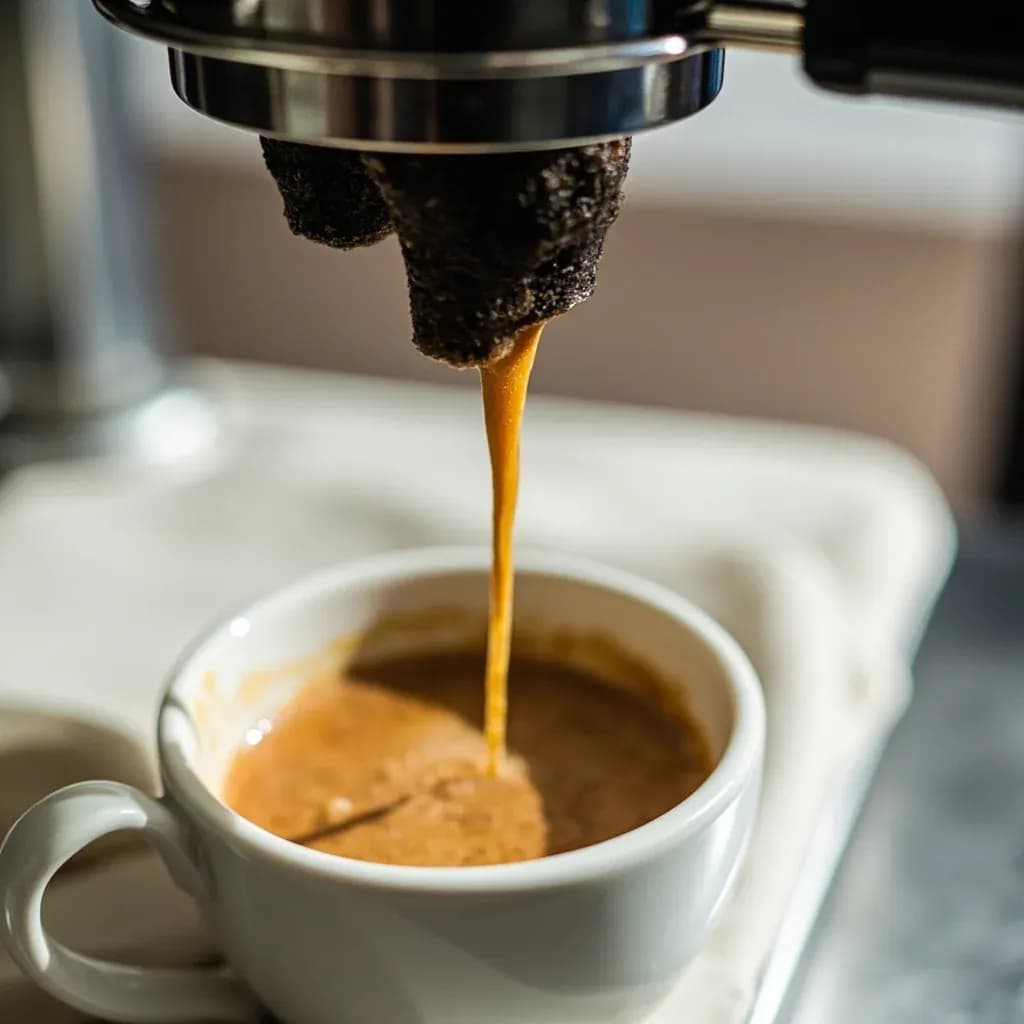
Forcing hot pressurized water through finely ground coffee to extract a concentrated espresso.
Pulling a shot drives water near 90 to 95 degrees Celsius through a tamped bed of fine coffee at around 9 bars of pressure. The brief, intense extraction yields a small concentrated coffee topped with crema, the golden emulsion of oils and gas. Baristas judge the shot by timing and yield, typically aiming for roughly 25 to 30 seconds to draw a balanced double from about 18 grams of grounds.
Pulling a shot of espresso is the act of forcing water heated to roughly 92–94 °C through a tamped puck of finely ground coffee at about 9 bar of pressure, yielding a small, concentrated, crema-capped serving. Developed in Italy in the early twentieth century — Bezzera's 1901 commercial machine and Gaggia's 1947 spring-piston lever gave it the crema-bearing form most cafés still serve — espresso is the only common brewing method in which the coffee bed itself is sealed and pressurized. That pressure, applied evenly to a level, well-distributed puck, is what produces the emulsified oils and dissolved CO₂ that become crema, and what makes espresso simultaneously the fastest brew method and the most finicky.
For the cook, espresso is less a beverage than a base ingredient: a 30–40 mL shot underwrites the cappuccino, the flat white, the affogato, the espresso martini, and the soak in a tiramisù. The actual motion of pulling one is short — dose, distribute, tamp, lock in, start, stop — but the variables that determine the result are tightly coupled. Grind size, dose weight, tamp pressure, water temperature, pump pressure, basket geometry, and roast style all push on one another, and a change in one demands a compensating change in another. Consistent espresso comes from understanding that web of relationships, not from any single rule.
The shop heuristic of "25 to 30 seconds from first drip to stop, yielding about a 1:2 ratio of coffee in to beverage out" is a useful starting point, not a law. Lighter, modern roasts generally want a slightly coarser grind and a longer pull to keep acidity in check; darker, traditional Italian roasts want a tighter pull and a sweeter, shorter ristretto-style extraction. Read the shot as much as you time it — color, flow pattern, and taste are the real feedback, and a bottomless portafilter shows all of them at a glance.
- Difficulty
- Medium
Types & varieties
The reference pull: ~25–30 s, roughly a 1:2 brew ratio, balanced sweetness, acidity, and body.
A restricted or short pull — the first 15–20 s of a normal shot, about 15–20 mL from a double dose. Sweeter, denser, more syrupy.
A long pull of ~45 s and roughly 1:3–1:4 ratio; lighter-bodied, often more bitter, with thinner crema.
A double dose (14–20 g) pulled through a double basket to about 60 mL; the standard working unit in most modern cafés.
A lungo-style volume served in a small cup; common in French café service, milder and more tea-like.
A 2–5 s bloom at 2–4 bar before full pump pressure, used on machines that support it to wet the puck evenly and reduce channeling.
How to do it
- 1
Prepare the machine and cup
Turn the machine on well before service so the boiler and group head reach stable brewing temperature. Place a demitasse or small cup under the portafilter spouts; prewarm it with a splash of hot water. Purge the group head with a brief flush to clear any cooled water sitting in the line.
- 2
Grind the dose fresh
Grind beans directly into the portafilter basket just before pulling. Aim for 7–9 g in a single basket, 14–18 g (often 18–20 g) in a double. The grind should be noticeably finer than table salt — gritty, almost powdery, and clumping slightly when pinched.
- 3
Distribute the grounds
Level the bed of coffee before tamping. Tap the side of the portafilter gently, sweep the surface with a finger or distribution tool, or use a dosing funnel. A flat, even bed is the prerequisite for an even extraction; clumps and mounds channel water and ruin the shot.
- 4
Tamp level
Set the portafilter on a flat surface or tamper mat. Press the tamper straight down with firm, even pressure — about 13–15 kg (30 lb) is a common guideline, though consistency matters more than force. Finish with a polish so the surface is mirror-flat and level with the basket rim, then wipe any loose grounds from the rim.
- 5
Lock in the portafilter
Insert the portafilter into the group head and twist to lock it firmly. Start the shot immediately — leaving the puck sitting in the hot group head for more than a few seconds scorches the surface and shifts the flavor toward bitterness.
- 6
Start the pump and watch the first drops
Engage the pump. The first drop of espresso should fall 7–10 seconds after the pump starts. If it drips right away, the grind is too coarse; if nothing appears for 15 seconds or more, the grind is too fine or the dose is too tight.
- 7
Pull to target weight or volume
Run the shot until it reaches your target yield — commonly a 1:2 ratio (for example, 36 g out from an 18 g dose) in roughly 25–30 seconds. Use a scale under the cup for precision, or work from a timed stop. The color should start as dark honey, hold through the middle, and end as it turns pale blond.
- 8
Stop, taste, and adjust
Stop the pump. The shot should look like dark, viscous liquid flowing under a layer of tiger-striped hazelnut crema. Taste: sour, thin, or bright → grind finer or pull longer; bitter, ashy, or hollow → grind coarser or pull shorter. Adjust the grinder one small step at a time and re-pull until the shot is balanced.
Reading a shot
The most useful skill in espresso is reading the pour. A well-extracted shot streams from a bottomless portafilter in dark, viscous ribbons that knit together beneath a tiger-striped crema; the liquid starts as dark honey, holds a deep brown through the middle of the pour, and lightens to pale blond as the shot ends. A shot that gushes from one side of the basket, or that sprays in pale, fast threads, is channeling — water is finding the path of least resistance through an uneven puck. A shot that drips lazily in a thin, watery stream is over-extracted; one that arrives in a dark, syrupy trickle that never loosens is under-extracted. Taste confirms what the eye suggests: sour or thin means under, bitter or ashy means over, and balance is the target.
- First drops should fall 7–10 s after the pump starts.
- The pour should darken to honey, hold, and then lighten to pale blond as it ends — stop on the blond, not on a clock.
- A bottomless (naked) portafilter is the cheapest diagnostic tool in espresso: the flow pattern reveals channeling immediately.
- Crema should be a thin, even, hazelnut-tan layer; pale, thin crema often points to stale coffee or under-extraction; very dark, heavy, blotchy crema can point to over-extraction or a stale grinder burr smear.
Dialing in
Dialing in is the loop of pulling, tasting, and adjusting that gets a new bag of coffee to a balanced shot. Lock the dose first — pick a basket, weigh the dose you intend to use, and keep it constant — then adjust grind until the shot hits the 25–30 s window. Change the grinder one small step at a time, pull a fresh shot, and re-evaluate. Temperature, distribution, and tamp consistency are dialed in the same iterative way.
- Start with a known dose for the basket: 8–9 g for a single, 18 g for a double is a safe modern default.
- Aim for 25–30 s from first drip to target yield; if it runs fast, grind finer; if it runs slow, grind coarser.
- If grind and time look right but the shot tastes off, adjust the yield: shorten for sour shots, extend slightly for bitter ones.
- Let the machine warm for 20–30 minutes before dialing — boilers and group heads drift in their first hour of service.
Common uses
Tips & pitfalls
- Grind only what you will use in the next few minutes — pre-ground espresso stales in minutes because of the high surface area.
- Match grind to dose: a coarser grind compensates for a larger dose and vice versa; lock the dose first, then dial the grind to hit 25–30 s.
- Tamp level rather than hard. Pressure matters less than an even, level surface; a tilted or uneven tamp is the usual cause of channeling.
- Purge the group head for a second before locking in the portafilter so temperature is stable and any cooled water in the line is cleared.
- The first drop should land 7–10 s after the pump starts; if it gushes immediately, grind finer; if it drips slowly or never appears, grind coarser.
- Stop the shot when it starts to blond — the color turning from dark brown to pale, washed-out tan — not strictly by time.
- Wipe the rim of the portafilter before locking it in; stray grounds break the seal, cause sprays, and produce inconsistent pressure.
- Backflush the group head with water and (periodically) espresso machine cleaner to keep the screen and dispersion block clear of coffee fines.
- Use freshly roasted beans — a roast date within the last 2–4 weeks, rested 7–14 days past roast for most blends — and reseal the bag between pulls.
- A bottomless (naked) portafilter is the cheapest diagnostic tool you can buy: the pattern of the pour reveals channeling instantly.
- Pull the shot into a prewarmed cup; cold ceramic drops the surface temperature by several degrees and dulls the crema.
- Don't try to dial in by tasting the original dose — pull a couple of test shots, weigh them, adjust, and re-pull rather than tasting the first, under-developed attempt.
Good to know
- Origin
- Italy, early 20th century; Luigi Bezzera patented the first commercial espresso machine in 1901, and Achille Gaggia's 1947 piston-lever design produced the first true crema.
- Pressure
- Roughly 9 bar (130 psi) at the pump; modern spec is 8–9 bar at the group head.
- Water temperature
- 90–96 °C (195–205 °F) at the group head; most machines brew at 92–94 °C.
- Brew ratio
- A 1:2 ratio (coffee in : beverage out) is the modern baseline; 1:1 for ristretto, 1:3–1:4 for lungo.
- Time
- 25–30 seconds from first drip to stop; first drops should appear at 7–10 s.
- Dose
- 7–9 g for a single basket; 14–18 g (often 18–20 g) for a double.
- Yield
- About 30–45 mL from a single, 50–75 mL from a double, in 25–32 s.
- Crema
- Thin layer of foam from emulsified oils and CO₂; a useful sign of fresh roast, correct grind, and even extraction.
Also called
espresso extraction
Related

Boil
Cook in vigorously bubbling liquid at full rolling heat

Simmer
Hold liquid at a gentle shimmer for tender, unhurried cooking

Poach
Cook gently in barely-trembling liquid for silky, tender results

Steam
Cook in rising vapor to keep color, nutrients, and shape intact

Blanch
Plunge briefly in boiling water, then shock cold to lock color

Braise
Sear, then cook slow in a little liquid until fall-apart tender

Stew
Simmer bite-sized pieces fully submerged into a rich, unified pot

Sous-Vide
Seal and cook in precise warm water for edge-to-edge doneness