Heat & Fire
Tempura Deep-Frying
Japanese deep-frying of seafood and vegetables in a light, barely-mixed cold batter for a lacy crust.
Tempura frying coats seafood and vegetables in a thin, deliberately lumpy batter of cold water and flour, then fries them quickly in hot oil for a crisp, lacy crust. Keeping the batter cold and barely mixed limits gluten development, so the coating stays light rather than bready. The result is delicate and shatteringly crisp, served immediately while hot.
Tempura deep-frying is the Japanese technique of coating seafood and vegetables in a barely-mixed, ice-cold batter and lowering them into hot oil for a brief, controlled fry. What distinguishes it from Western deep-frying is not the temperature or the oil but the batter itself: a thin slurry of low-protein wheat flour and ice water, stirred only enough to combine and full of lumps that survive the mixing. The result is a delicate, lacy crust that shatters cleanly under the teeth while the interior stays juicy and almost untouched by heat. That textural contrast — crackle against tenderness, golden shell against pale, steamy flesh — is the entire point of the technique, and it depends on keeping every element cold and every motion brief.
The method arrived in Japan with Portuguese missionaries and traders during the Nanban trade period of the 16th century, where it likely began as a meatless Lenten preparation, and was refined through the street stalls of Edo (Tokyo) during the 18th and 19th centuries. From there it migrated into the formal counter-seated tempura-ya, where a master fryer cooks each piece individually to order, and into countless home kitchens that treat it as a quick weeknight meal. Two regional styles coexist today: Edo-style, fried to a deeper gold and eaten dipped in tentsuyu with grated daikon; and Kansai-style, fried paler and dressed simply with salt and lemon. Both share the same non-negotiable principles — cold batter, hot oil, dry ingredients, and minimal handling — and both punish the cook who overmixes, overheats the batter, or crowds the pan.
- Difficulty
- Medium
Types & varieties
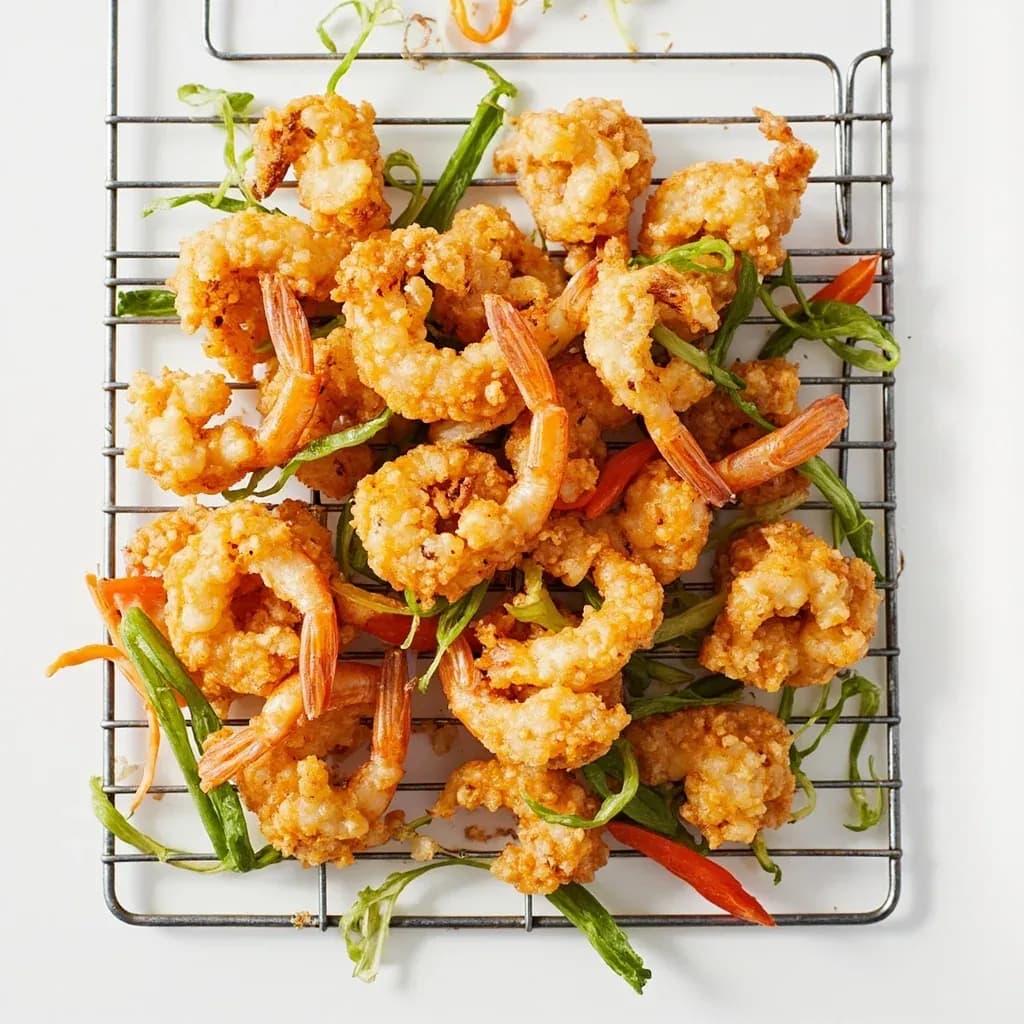
Whole shrimp, butterflied and stretched straight, the most iconic tempura item and a benchmark for any fryer.
Shredded vegetables (often burdock, carrot, scallion) or small seafood bound in a loose batter disc and fried as a single nest.
Saltwater eel, lightly battered, prized at high-end tempura-ya for its tender, fatty flesh.
Whiting, often fried whole with the tail standing up; a classic Edo specialty.
Perilla leaf, sometimes wrapped around a slice of ume plum or a prawn, fried crisp in seconds.
Japanese pumpkin sliced thin, fried until the edges crisp and the centre stays creamy.
Japanese eggplant, often slit and flattened for even cooking and quick oil absorption.
Tempura served over a bowl of rice with a sweetened soy-based sauce poured over.
Tempura arranged on a bamboo mat alongside chilled soba and a small dish of tentsuyu.
Tempura pieces (most often shrimp) wrapped in nori and sushi rice, the base of countless sushi rolls.
A home-style variant: ingredients dredged in seasoned flour, dipped briefly in thinner batter, and fried in small batches.
Tokyo tradition: fried to a deeper gold, eaten dipped in tentsuyu with grated daikon, often served as a casual meal.
Osaka/Kyoto tradition: fried paler, served without sauce and seasoned at the table with salt and a squeeze of lemon.
How to do it
- 1
Prepare the station
Set up three zones in a row: a tray of cut ingredients patted thoroughly dry, a shallow bowl of plain flour for pre-dusting, and the batter bowl nested inside a larger bowl filled with ice. Position a wire rack over a sheet pan for draining, never a paper-towel-lined plate. Heat about 5 cm of neutral oil to 170 °C / 338 °F for vegetables and 180 °C / 356 °F for seafood, using a thermometer rather than guessing.
- 2
Make the batter
For roughly four generous servings, combine 1 large egg with 200 ml ice water in the chilled bowl (or omit the egg entirely for a more traditional, lighter crust and use 250 ml ice water per 200 g flour). Sift 200 g low-protein Japanese flour or cake flour over the liquid at the last moment and stir with chopsticks for 8–10 strokes only — count them. Visible lumps are correct. Return the bowl to the ice bath and stop stirring; the batter should never be smooth.
- 3
Pre-dust the ingredients
Lightly coat each piece in plain flour, shaking off the excess so only a whisper of dry flour remains. This thin dry layer gives the wet batter something to grip and produces a more textured, lacy crust than batter alone would. Work in small batches so the floured pieces do not sit and absorb moisture.
- 4
Dip and coat
Hold each piece by a dry edge, lower it into the batter, and lift it with a slow, deliberate motion so a thin, even film clings to the surface. Do not let the piece soak. Some cooks drag the wet piece briefly across the surface of the batter to pick up stray strands that fry into the signature 'snowflake' texture.
- 5
Fry in small batches
Lower each battered piece into the oil away from you, sliding it just beneath the surface with long chopsticks or a wire skimmer to prevent splashing. Fry 2–4 pieces at a time with at least 1 cm between them. Most vegetables need 2–3 minutes; shrimp 2.5–3 minutes; thicker fish fillets 3–4 minutes. Fry vegetables before seafood so residual seafood flavour does not transfer.
- 6
Drain and finish
Lift each piece out with the wire skimmer and hold it above the oil for 2–3 seconds to drip back. Rest on the wire rack so air circulates on all sides; trapped steam softens the crust within seconds. Do not salt until the piece is plated — salt draws out moisture and ruins the shatter. Aim for pale honey-gold (Kansai-style) or a deeper gold (Edo-style), never brown.
- 7
Serve immediately
Plate on a paper-lined tempura basket or a flat dish with a small mound of grated daikon and a touch of grated ginger. Pour tentsuyu (1 part dashi, 1 part mirin, 1 part soy sauce, plus 1 teaspoon of sugar, simmered briefly) into a small individual cup. Tempura should reach the table within a minute of leaving the oil; it loses crispness rapidly under sauce.
The science of the lacy crust
Tempura's signature texture is a piece of cold-engineered physics. Ice-cold batter hits 170 °C oil, and the water in the batter flash-vaporises into steam before the flour proteins can fully set. Those expanding steam pockets push the batter outward in thin, brittle sheets rather than letting it settle into a uniform shell. The lumps in the batter matter too: they hold pockets of dry flour that hydrate unevenly and fry into irregular, crackly ridges. If the batter warms up or is stirred smooth, the water no longer flashes as cleanly and the result is the soft, oil-logged coating that beginners blame on the oil. Keeping the batter near freezing is the single most useful thing a home cook can do.
- Ice-cold batter produces steam-puffed, brittle sheets instead of a sealed shell.
- Visible lumps are dry flour pockets that fry into crackly ridges — they are intentional, not a mistake.
- Low-protein flour limits gluten development so the batter stays tender rather than chewy.
- Oil that is too cool lets batter absorb oil; oil that is too hot browns the crust before the interior cooks.
Edo versus Kansai
The same technique produces noticeably different food across Japan. Edo-style tempura evolved from street-stall snacks fried in sesame oil cut with vegetable oil, served standing up at counters with tentsuyu for dipping and grated daikon to cut the richness. Kansai-style tempura, refined in the lighter culinary culture of Kyoto and Osaka, is fried in pure cottonseed or canola oil, taken paler, and brought to the table without sauce so the diner can season each piece with salt and lemon. Neither is more correct; they simply express different relationships between batter and condiment, and many Japanese cooks keep both in their repertoire and switch by season and ingredient.
- Edo: sesame-oil blend, 175–180 °C, deeper gold, dipped in tentsuyu with grated daikon.
- Kansai: neutral oil, 160–170 °C, pale gold, seasoned at the table with salt and lemon.
- Tempura-ya service in Tokyo is typically counter-seated, one piece cooked to order and presented immediately.
- Kake-age is the home-cook adaptation: pre-dredged in seasoned flour, dipped in thinner batter, fried quickly in smaller batches.
Common uses
Tips & pitfalls
- Keep every element cold — ice cubes floating in the batter bowl, chilled flour if possible, and ingredients that are dry but not warm — because cold batter flashing into steam is what creates the lacy crust.
- Mix the batter with chopsticks in only 8–10 strokes; visible lumps are correct. A smooth batter is overworked and produces the heavy, bready coating that defines bad tempura.
- Test oil temperature with a small drop of batter: it should sink halfway down, then float and sizzle immediately. If it sinks and stays, the oil is too cool; if it browns on contact, the oil is too hot.
- Pat ingredients bone-dry before dipping. Wet surfaces cause the batter to slide off and the oil to spatter dangerously.
- For shrimp, butterfly along the back, remove the vein, and make 3–4 small slits across the belly so the piece cooks flat instead of curling into a ball.
- Never crowd the pan — leave at least 1 cm between pieces so the oil temperature recovers between dips.
- Drain on a wire rack rather than paper towels; trapped steam under the crust turns it soft within a minute.
- For extra lacy 'snowflake' texture, sift a thin layer of dry flour over the batter surface just before dipping each piece.
- Eat shrimp tempura by the tail and never dip the tail in tentsuyu — it has absorbed residual oil that will cloud the sauce.
- Serve within two or three minutes of frying; tempura loses its defining crispness faster than almost any other fried food.
Good to know
- Origin
- Introduced to Japan by Portuguese missionaries and traders during the Nanban trade period, c. 1543–1614.
- Etymology
- Likely from Portuguese 'tempero' (seasoning) or the Latin 'tempora' referring to Ember Days, the Catholic meatless fasts during which batter-fried fish was eaten.
- Flour
- Low-protein Japanese soft wheat flour (hakurikiko) or cake flour at roughly 7–8% protein; higher-gluten flours produce a chewy, bready crust.
- Batter temperature
- Ice-cold, 0–5 °C / 32–41 °F; ice cubes are often floated directly in the batter bowl to keep it chilled throughout service.
- Oil temperature
- 160–180 °C / 320–356 °F. Typically 170 °C for vegetables and 180 °C for seafood; thicker items finish slightly lower.
- Frying time
- 2–3 minutes for vegetables, 2.5–3 minutes for shrimp and thin fish, up to 4 minutes for thicker fillets.
- Defining texture
- Airy, lacy, almost translucent crust that shatters cleanly when bitten, with a juicy, barely-cooked interior.
- Dipping sauce
- Tentsuyu: dashi, mirin, and soy sauce in roughly equal parts, briefly simmered, served with grated daikon and ginger on the side.
Also called
Tempura Deep-Frying · Tempura · Tempura Frying
Related

Sear
Blast the surface hot for a deep-browned, savory crust

Sauté
Cook quickly in a little fat over lively heat, tossing as you go

Stir-Fry
Toss bite-sized pieces over roaring heat for fast, smoky cooking

Pan-Fry
Crisp food in a shallow layer of hot fat, turning once or twice

Deep-Fry
Submerge in hot oil for an all-over crackling crust

Roast
Cook uncovered in dry oven heat for browned edges and tender centers

Bake
Cook with steady, surrounding oven heat — the soul of bread and pastry

Broil
Hit food from directly above with fierce overhead heat