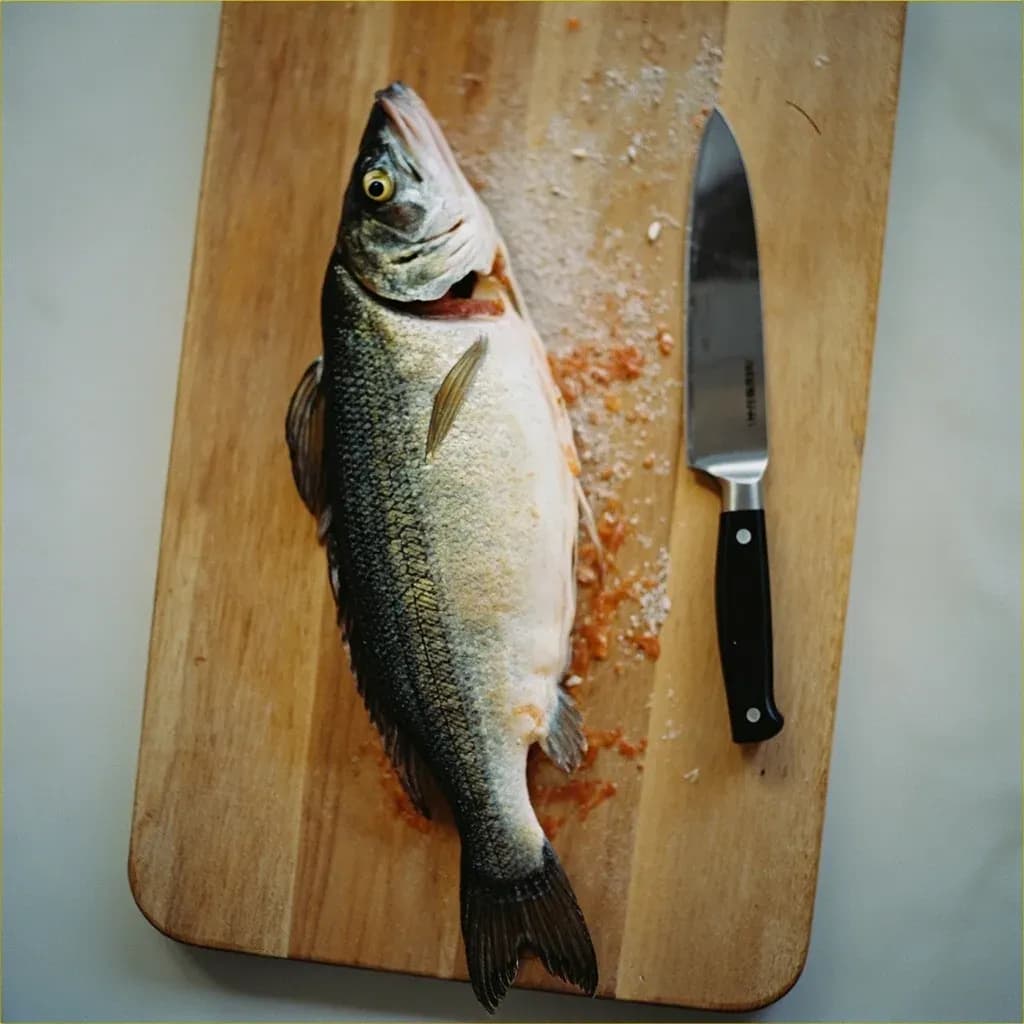
Knife Skills
Three-Piece Filleting (Sanmai Oroshi)
Japanese method that breaks a round fish into two boneless fillets plus the central bone-in section.
Sanmai oroshi is the foundational Japanese filleting technique that separates a whole round fish into three pieces: two clean fillets and the central spine still bearing the bones. The knife is run along the backbone from both sides, riding the bones to maximize yield while leaving the flesh intact. It is the starting point for sashimi, sushi, and most Japanese fish cookery, and is usually performed with a deba knife whose heavy heel can cut through the collar and ribs.
Sanmai-oroshi (三枚おろし) is the foundational breakdown of a round fish in Japanese cuisine — a single motion that separates a whole tai, hamachi, or sake into its three natural parts: two mirror-image side fillets and a central bone-in section containing the spine, belly flap, and usually the head and tail. The name is literal: sanmai means three flat pieces, oroshi means to take down. Mastering this cut is the gateway into uohiki, or fish butchery, because nearly every other Japanese fish cut — hira-zukuri, sogi-zukuri, usu-zukuri, katsuramuki — begins with the two clean fillets this method produces.
The technique is built around the geometry of the round-fish body and the weight of a single tool: the heavy, thick-spined deba bocho. Unlike a Western fillet knife that draws through flesh, the deba parts flesh by letting the spine of the blade do the work once the edge is laid flat against the backbone. The cut rewards patience and a sharp edge over force; in a practiced hand, two fillets come away with almost no meat left on the bones and a center section that is itself a valued ingredient, not scrap. In a well-run sushi or washoku kitchen, the ara, tai, or hone — the bones and collar — supply the rich brown meat and collagen that define ara-jiru, the smoky depth of shio-yaki ara, and a clean second dashi pull.
- Difficulty
- Hard
Types & varieties
Head-to-tail cut following the spine; produces two whole side fillets and a clean center bone.
Some chefs first split the fish belly-up along the backbone, then peel each side outward; used for larger fish like yellowtail and salmon.
For aji, sayori, and iwashi, the method is the same but with a smaller deba (105–120 mm) and a single careful pull rather than a long draw.
Pin bones are removed afterward with tweezers; the belly flap is often trimmed off the fillet for sushi (harasu side) or kept attached for grilling.
How to do it
- 1
Prepare the fish and station
Scale, gut, and rinse the fish unless the species is traditionally eaten unscaled (mackerel is a common example). Pat dry, wrap in a damp cloth, and chill in the refrigerator until firm. Lay a damp kitchen towel under a sturdy board so it cannot slide. Set out a sharp deba bocho (120–180 mm) and a small bowl of water for wiping the blade between strokes.
- 2
Position the fish
Lay the fish with its belly away from you and head to your dominant side (head to the right for a right-handed cutter). The back should face you. If the fish has been gutted, the open cavity faces down against the board so the belly wall stays intact and the cut is more controlled.
- 3
Make the gill cut (kama-kiri)
Just behind the pectoral fin and gill plate, angle the knife and cut down to the spine, severing the small rib bones. Stop the moment you feel the spine — do not cut through it. This cut defines where the head end of the fillet will release and prevents ragged flesh at the collar.
- 4
Turn the blade flat along the spine
Lay the blade nearly flat, edge angled slightly down toward the spine, and begin at the head end. The knife should be parallel to the backbone, not vertical; a vertical blade severs the spine and leaves bone shards in the fillet.
- 5
Draw the knife from head to tail
In one smooth pull, run the knife along the spine toward the tail. Let the blade's weight and the natural curve of the spine guide the cut. As the spine dips near the tail, ride the contour so the blade emerges through the tail without piercing the skin.
- 6
Release the first fillet
Lift the top fillet away with your free hand. Trim any pin bones with tweezers or the tip of a yanagiba. Set the fillet skin-side down if you plan to skin it later.
- 7
Flip and repeat on the second side
Turn the fish so the remaining intact side faces up. Repeat the gill cut, the flat-along-spine turn, and the head-to-tail draw. Release the second fillet.
- 8
Handle the center bone section (tai/ara)
The remaining piece contains the backbone, belly flap, tail, and (if left on) the head. Score the bone side in 2–3 places if you plan to grill it, or separate the head and tail pieces for dashi. Pick the brown meat from the bones for soup.
- 9
Skin and trim the fillets
Lay each fillet skin-side down, tail toward you. Slide the deba between flesh and skin at the tail end, angle the blade slightly down toward the skin, and pull the skin away from the blade with your other hand. Then trim away the bloodline (akazara) and any remaining pin bones.
The deba and why no other knife will do
The deba is built to break down bony round fish in a way no Western knife can. Its thick spine gives the blade enough weight to ride over the rib bones and push through the head joint without flexing; its short height keeps the heel on the board for control; and its single-bevel edge, ground on one side only, leaves a flat face on the fish that does not steer the cut into the meat. A gyuto or fillet knife will instead skate along the spine, leaving flesh behind, or snap when it meets a rib. Sharpness matters more here than with almost any other kitchen cut: a dull deba crushes the spine into bone shards, tears the flesh instead of parting it, and turns a two-minute breakdown into a salvage job. Most sushi chefs touch up the deba on a medium stone before each session and resharpen fully at the end of the day.
Why the center bone is not waste
In Western kitchens the frame left after filleting is often discarded or boiled for stock. In Japanese cooking, the tai, hone, or ara is treated as a separate ingredient with its own uses. The brown meat clinging to the bones is unusually rich in collagen and blood-myoglobin, giving ara-jiru (clear fish-bone soup) a silky body and a deeper flavor than any fillet can provide. The collar and head, scored and salt-grilled, become shio-yaki ara, a defining pub-style dish. The bones themselves, roasted briefly and simmered, give a second dashi with rounder, smokier notes than the delicate ichiban dashi from kelp and bonito flakes. A cook who has done a clean sanmai-oroshi can extract value from every gram of fish.
Common uses
Tips & pitfalls
- Chill the fish until firm — a near-frozen fish cuts cleaner and the spine comes away with very little flesh left behind.
- Sharpen the deba before starting. A dull deba crushes the spine and tears the flesh rather than parting it.
- Anchor a damp towel or nonslip mat under the cutting board; the board must not move while you press down on the fish.
- First incision: cut just behind the pectoral fin and gill plate at an angle, only down to the spine — do not sever the head or cut through the belly wall.
- Turn the blade flat against the spine and let the knife's weight plus a gentle pull do the work. Pushing down severs the spine and leaves bone shards.
- Follow the curve of the spine: the backbone arches up at the head and dips at the tail. Keep the blade in contact the entire length.
- On the second side, finish the first stroke near the tail so the fillet releases cleanly and the skin does not tear.
- After the fillet is off, trim the bloodline (akazara) — it carries strong iron and iodine flavor and will discolor sushi rice.
- Common mistakes: cutting through the belly wall and puncturing the gut; snapping the knife tip at the tail; leaving the belly flap on the fillet when skinning; twisting the knife and scooping meat off the bone instead of drawing along the spine.
Good to know
- Origin
- Japan; foundational technique of Japanese washoku fish butchery (uohiki)
- Japanese name
- Sanmai-oroshi (三枚おろし); sanmai = three flat pieces, oroshi = to take down
- Output
- Two boneless side fillets (sakami) plus one central bone-in section (tai/hone/ara)
- Primary knife
- Deba bocho, traditionally single-bevel, 120–180 mm for round fish
- Best fish
- Round, firm-fleshed fish: sea bream (tai), yellowtail (hamachi/buri), salmon (sake), horse mackerel (aji), mackerel (saba), striped jack (shima-aji)
- Typical yield
- Roughly 50–60% edible flesh on the two fillets; the remainder on the bone section is also used, not discarded
- Difficulty
- Intermediate; considered the entry point for professional Japanese fish breakdown
- Opposite technique
- Gomai-oroshi (five-piece) used for flatfish such as flounder (hirame) and sole (karei)
Also called
Three-Piece Filleting (Sanmai Oroshi) · Three-Piece Fish Filleting (Sanmai-oroshi) · Sanmai Oroshi · Three-Piece Fish Filleting
Related

Chop
Cut into rough, irregular pieces — the everyday workhorse cut

Dice
Cut into uniform cubes for even cooking and a tidy look

Mince
Cut as fine as possible so flavor melts evenly into the dish

Slice
Cut into even, flat pieces for consistent cooking and presentation

Julienne
Cut into thin matchsticks for fast cooking and elegant garnish

Brunoise
Cut into tiny, precise cubes — the finest dice in the kitchen

Chiffonade
Roll and slice leafy greens into delicate ribbons

Batonnet
Cut into tidy sticks, thicker than julienne — think classic fries