Knife Skills
Tournée
Classic French cut that shapes vegetables into seven-sided football-like barrels for even cooking and presentation.
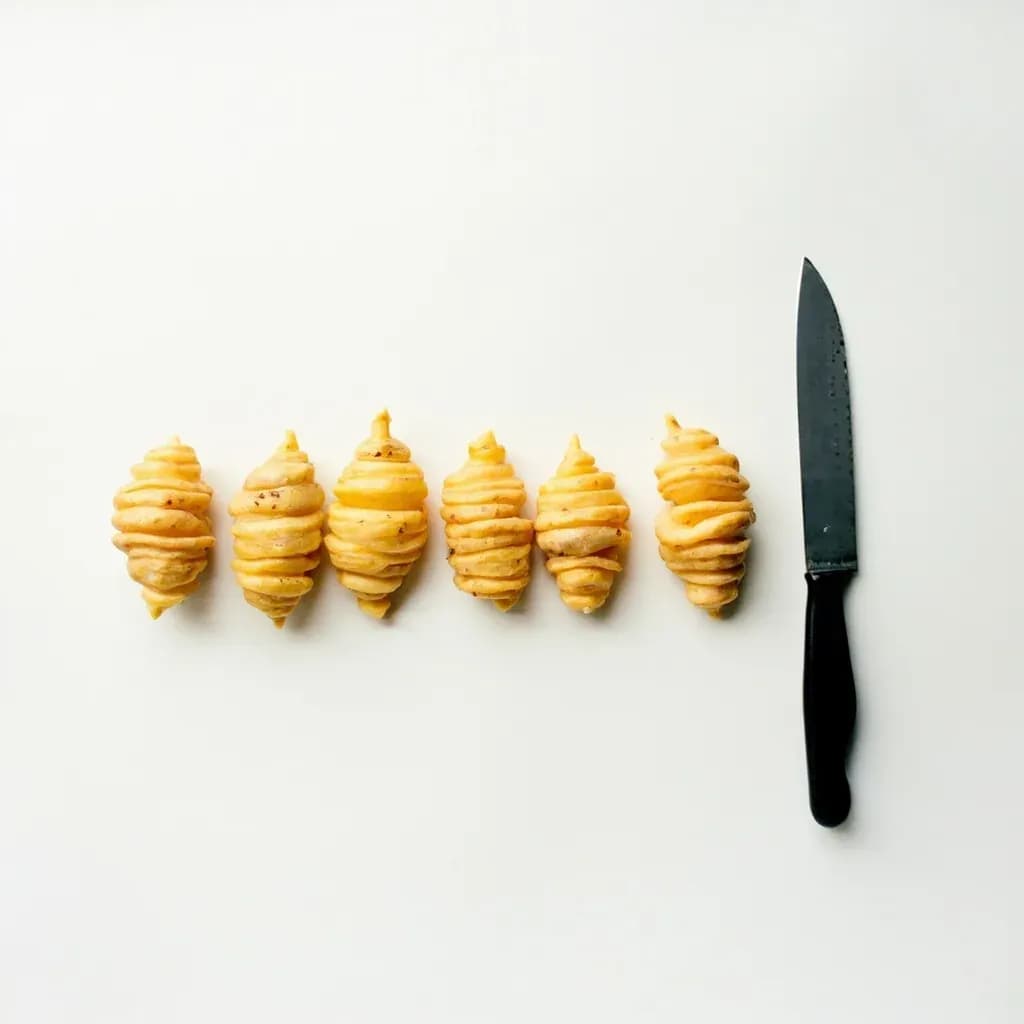
Tournée, or turning, carves firm vegetables such as potatoes, carrots, and turnips into uniform seven-sided ovals roughly two inches long. The shape cooks evenly and looks refined on the plate, and the technique is a traditional test of knife control in French kitchens. It is done with a small curved tourné (bird's beak) knife, rotating the vegetable against the blade in smooth arcs.
The tournée is a classical French cut that shapes a peeled vegetable into a small, seven-sided barrel with gently tapered, rounded ends — a form that resembles a miniature football or a hand-faceted gemstone. Carved by rotating the vegetable a quarter turn between each of seven long, curved slices, the shape is not decorative for its own sake: the symmetry guarantees that every piece in a batch is exactly the same thickness, so all of them cook in the same time, glaze in the same time, and finish at the same moment on the plate. That predictability is the entire point in classical service, where a side of glazed carrots or pommes château must arrive uniformly tender from the first forkful to the last.
The cut demands a short, inward-curving blade — a tourné or bird's-beak knife — and a steady claw grip that lets the blade ride against the thumb as a guide rail. It is famously slow and wasteful: expect 6 to 10 uniform pieces per minute once proficient, and 25 to 40 percent trim loss, because each face of the heptagon is cut away and discarded. In a modern professional kitchen those numbers usually disqualify the cut, which is why faster shapes like the oblique and bâtonnet have largely replaced it. It survives as a benchmark of knife discipline in culinary schools, a classical menu signature, and a competition standard.
When you do reach for a tourné knife, treat the technique as a building block rather than a finishing flourish. The same heptagonal logic scales down to a petite tournée for delicate garnishes, up to a château cut for potatoes, and sideways into uniform cups and barrels that can be stuffed or hollowed for composed garnishes.
- Difficulty
- Hard
Types & varieties
Large tournée, 5–6 cm long, almost always cut from a potato; the basis of pommes château, browned in butter.
Small tournée, 2.5–3 cm long, with a more pronounced egg shape; used as a vegetable garnish and in small sautés.
Half the size of a standard tournée, about 2.5 cm; favoured for delicate garnishes and composed vegetable medleys.
A related smooth, elongated oval shaped with the same knife; lacks the distinct facets of a true tournée, so it cuts more quickly and reads as a different shape on the plate.
How to do it
- 1
Select and prep the vegetable
Choose a firm, straight vegetable about 3–4 cm in diameter. Peel it completely, then trim the root and stem ends square so you have a clean cylinder to work with. Chill it if it has been sitting at room temperature.
- 2
Establish a working grip
Hold the vegetable in your non-dominant hand in a claw grip, fingertips curled back with the thumb acting as the guide rail. The tourné knife sits in the dominant hand, curved blade facing toward you, tip tucked against the thumb knuckle.
- 3
Cut the first facet
Slice off one long, slightly curved face from base to tip. The cut should run the full length of the piece, taper gently at each end, and remove only a thin sliver of flesh.
- 4
Rotate and facet six more times
Turn the vegetable roughly a quarter turn and make a second long facet identical to the first. Continue rotating and slicing until you have seven symmetrical flat faces running end to end, forming an elongated heptagon.
- 5
Round the ends
With the tip of the knife, shave small, curved cuts at each end to remove the sharp corners and create the characteristic rounded, football-like tips.
- 6
Trim to target length and check symmetry
Slice the finished piece into the desired length — 5 cm for a standard tournée, 2.5 cm for a petite. Stand each piece on a flat facet and check that all sides are even and the ends are uniformly rounded; rotate under the eye before setting it aside.
- 7
Hold or cook
Place finished tournées in cold acidulated water if prepping ahead, or proceed directly to glazing, blanching, or sautéing. Uniform geometry means the batch will cook in a single, predictable window.
Why the shape matters in the pan
The heptagonal barrel is a cooking tool as much as a visual one. Seven flat faces sit flush against the pan, giving more direct contact for browning and caramelisation than a round vegetable can offer, so a tournée browns more evenly and holds glaze more uniformly than an unshaped cylinder of the same weight. The rounded ends eliminate the sharp corners that would otherwise overcook or dry out during glazing, and they signal 'cooked correctly' to a classical palate trained on the shape. In a finished dish of glazed carrots or turnips, this is the difference between a side that looks intentional and one that looks rough.
- Flat facets sit flush against the pan, giving full contact for browning and caramelisation that a round cylinder cannot match.
- Rounded ends protect the tips from drying out or overcooking in long simmers like court-bouillon.
- Identical geometry means a single timer covers the whole batch — no fishing out the small ones while the large ones finish.
Selecting and prepping vegetables
Tournée is unforgiving of bad produce. A soft, irregular, or curved vegetable will fight the seven-facet geometry and force you to compensate with the knife, which is exactly when cuts go crooked and waste climbs. Pick the firmest, straightest examples you have, and chill them thoroughly before cutting so the cell walls resist the blade. Carrots, turnips, parsnips, salsify, beets, radishes, and small waxy potatoes are the classical choices; zucchini and cucumber also work but are softer, so they benefit from being cut slightly larger than the final target to give the facets room to hold their shape.
- Aim for a starting diameter of 3–4 cm — smaller pieces have no room for seven facets; larger pieces read as a different cut.
- Peel thoroughly and trim the root and stem ends flat so the vegetable sits stable in the hand.
- Keep cut pieces submerged in acidulated water (a squeeze of lemon or a splash of vinegar per litre) to prevent oxidation, especially for potatoes, turnips, and artichoke hearts.
Common uses
Tips & pitfalls
- Use a real tourné knife when you can: the inward curve lets you cut toward yourself and follow the contour of the facet in one motion, which is awkward to imitate with a straight paring blade.
- Start on carrots or turnips — they are firm, cheap, and forgiving enough to let you feel the geometry before moving to pricier vegetables.
- Cut a flat base first so the vegetable sits stably in the hand; trying to facet a round, rolling cylinder is the most common beginner mistake.
- Rotate a consistent amount between facets (about a quarter turn, or the angle between two adjacent flat faces) to keep the seven sides even and the piece symmetrical.
- Keep the knife tip tucked against your thumb knuckle and guide with the side of the blade; never let fingers extend past the cutting arc.
- If the work feels slow or ragged, peel the vegetable into a rough heptagonal cylinder with a paring knife first, then refine the facets and round the ends with the tourné.
- Common mistake: making the pieces too large. They will not cook in step with the smaller shapes on the plate, which defeats the entire purpose of the cut.
- Common mistake: leaving flat, square ends instead of rounded tips. The curve is what visually identifies a proper tournée and what prevents the tips from drying out in long cooks.
Good to know
- French name
- Tournée (past participle of 'tourner', 'to turn')
- Distinctive shape
- Seven flat facets running end to end, with rounded, tapered tips
- Standard length
- 5 cm (2 in) for a full tournée; 2.5 cm (1 in) for a petite tournée
- Knife used
- Tourné (bird's-beak) knife with a short, inward-curved blade; a small paring knife works as a substitute
- Origin
- Codified in 19th-century French cuisine; associated with Carême and Escoffier's brigade system
- Trim waste
- Typically 25–40% of the starting vegetable
- Speed
- Roughly 6–10 uniform pieces per minute once proficient
- Cooking behavior
- Maximises glazed surface area and ensures even heat penetration across a batch
Also called
Tournée (Turning) · Tournee (Turning) · Turning · Turned Vegetables
Dishes that rely on it
Related

Chop
Cut into rough, irregular pieces — the everyday workhorse cut

Dice
Cut into uniform cubes for even cooking and a tidy look

Mince
Cut as fine as possible so flavor melts evenly into the dish

Slice
Cut into even, flat pieces for consistent cooking and presentation

Julienne
Cut into thin matchsticks for fast cooking and elegant garnish

Brunoise
Cut into tiny, precise cubes — the finest dice in the kitchen

Chiffonade
Roll and slice leafy greens into delicate ribbons

Batonnet
Cut into tidy sticks, thicker than julienne — think classic fries