Transform & Preserve
Turning / Flipping Wheels
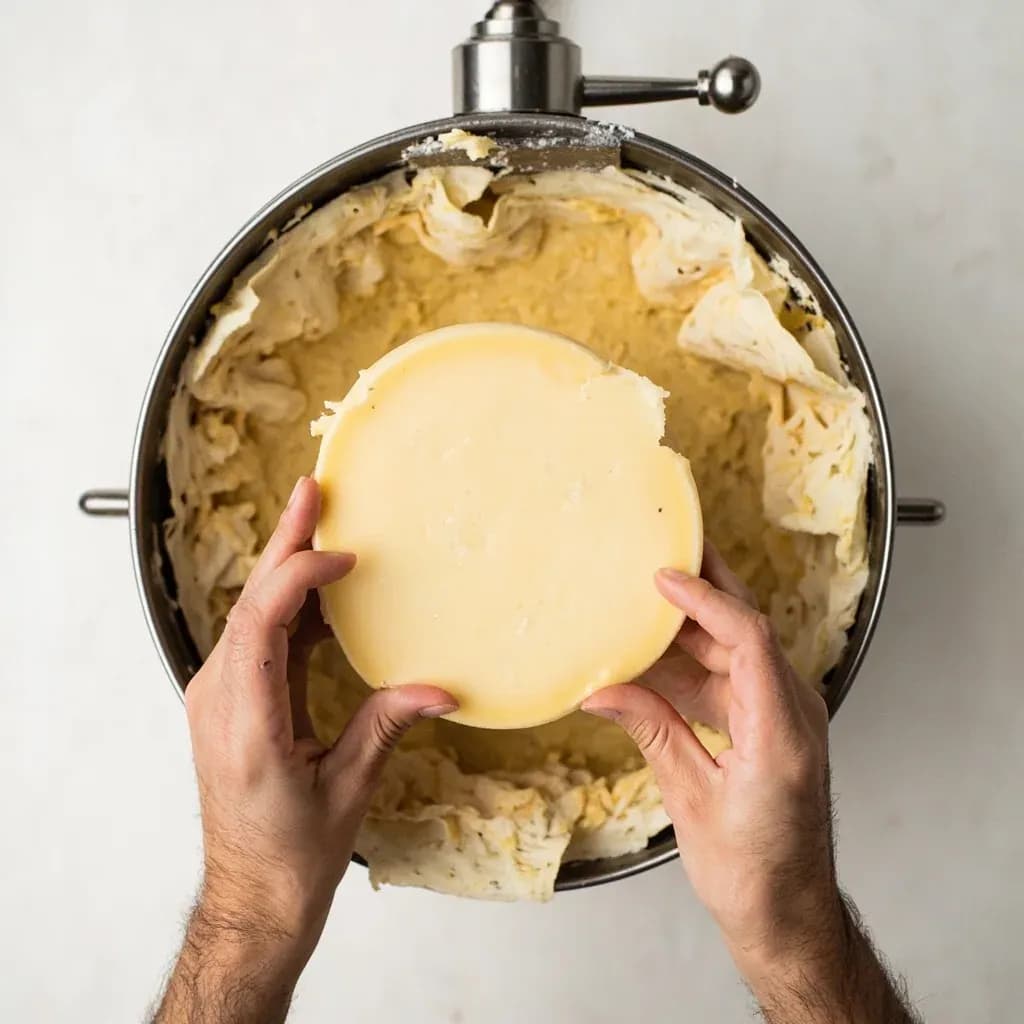
Flipping cheese wheels during pressing and aging for even shape, drainage, and rind.
Turning or flipping wheels is the repeated inversion of cheese during pressing and maturation so whey drains evenly and the wheel keeps a balanced shape and rind. Early flips help expel moisture and prevent a flat or lopsided form, while later flips during aging keep the rind consistent. It is hands-on work central to traditional wheel cheesemaking.
Turning, or retournement, is the regular flipping and repositioning of cheese wheels during the long, quiet months of affinage. It looks almost trivial — a hand lifts a wheel, sets it back down on its opposite face, and moves on — but the practice is the unglamorous backbone of every traditional aging cellar. A wheel that sits unmoved will sag under its own weight, pool moisture on its underside, and grow a rind that is thin and uniform on top but thick, sticky, and often ammoniated on the bottom. Regular turning equalizes all of that, letting gravity, airflow, and surface treatments act on every face in turn.
The rhythm and intensity of turning shifts with the cheese. A fresh wheel pulled from the press is mostly curd, soft and prone to slumping, so it needs frequent, gentle handling. As the rind dries, salt equilibrates through the paste, and the wheel loses perhaps a third of its weight in moisture, the interval between turns can lengthen without consequence. By the time a hard Alpine cheese is a year old, the rind is so rigid that the wheel will essentially hold its own shape, and turning becomes more an inspection routine than a structural necessity.
Beyond shape, every turn is also a quality-control pass. The affineur sees and smells every square centimeter of the wheel on a predictable schedule, so early signs of cracking, sliding rind, unwanted surface molds, or gas pockets are caught while they are still correctable. In PDO traditions like Parmigiano-Reggiano, Comté, and Gruyère, the turning schedule is codified by the consortium — a reminder that, in serious cheesemaking, this simple act is treated as a discipline on par with salting and pressing.
- Difficulty
- Easy
Types & varieties
Used for large hard wheels (Parmigiano-Reggiano, Grana Padano, Comté) during the first weeks to months when the rind is still forming and the wheel is heavy enough to deform under its own weight.
Standard for semi-hard wheels like Cheddar, Gouda, and Alpine-style cheeses once the rind is established and the wheel has firmed up.
Common for bloomy-rind cheeses (Brie, Camembert) and many tomme-style wheels during mid- to late-affinage, when the white mold is actively growing.
Specific technique for cloth- or leaf-wrapped wheels (Tomme de Savoie, Banon) where the wrapping is unwrapped, the rind wiped or re-treated, then rewrapped on a clean surface.
Cheeses like Époisses, Taleggio, and Limburger are turned before each rind wash to expose every face to the brine or alcohol wash and to keep the rind from sealing against the shelf.
Pricked wheels (Roquefort, Stilton, Gorgonzola) are turned regularly to keep air exposure even, though less frequently than bloomy cheeses because the rind is less active.
How to do it
- 1
Prepare the aging shelf
Sanitize wooden or stainless shelves, then line with food-grade parchment or a clean, dry board. Confirm humidity (85–95%) and temperature (10–13 °C / 50–55 °F) are stable in the cellar before the first flip.
- 2
Release the wheel from its pressing surface
After the final press, slide a flat turning board under the wheel or lift carefully with two hands. The rind at this stage is still soft and sticky; avoid prying with tools that can gouge the paste.
- 3
Flip and reposition
Place the wheel on a clean dry surface with the previously down-facing side now up. Press lightly with flat palms to confirm it sits level — any wobble indicates uneven pressing that will worsen if not corrected early.
- 4
Set the turning rhythm
Establish a schedule based on cheese type: daily for large hard wheels and washed-rind cheeses during active rind development; every two to three days for bloomy-rind and semi-hard wheels; reduce frequency as the rind hardens.
- 5
Combine with surface treatments
When a wash, oil, or salt rub is part of the recipe, apply it immediately after turning so the freshly exposed face receives the full treatment. For washed-rind cheeses, turn, wash, return to shelf; never wash the down-face while it sits on the wood.
- 6
Inspect every face at each turn
Look for cracks, ammonia smell (over-aged bloomy cheeses), wet spots, or unwanted colored molds. Address problems immediately — a defect caught on one face will spread across the wheel within days.
- 7
Adjust frequency as affinage progresses
As the rind thickens and the wheel loses moisture, it weighs less and is less prone to deformation. Extend intervals to once a week, then once every ten to fourteen days for long-aged hard cheeses, while continuing to inspect.
- 8
Record and rotate stock
Move older wheels to the front of the shelf so they are used first. Note each turn, wash, and inspection in an aging log — professional affineurs can track a single wheel across two or more years of regular handling.
Why turning shapes the finished cheese
Three forces act on a wheel during aging, and turning is the practice that keeps all three balanced. Gravity pulls moisture toward the bottom face; without flipping, that face stays wet, soft, and prone to unwanted bacterial growth while the top dries out. Rind cultures — geotrichum, penicillium, brevibacterium — colonize whatever surface is exposed to air; a wheel that never moves grows a rind only on its top. And surface treatments like salt rubs, brine washes, and oil or cocoa-butter coatings need to be redistributed or reapplied to a fresh face, or the wheel ends up with a rind that is seasoned on one side and raw on the other.
The practical consequence is that turning controls the geometry, the microbiology, and the chemistry of the rind all at once. A wheel that has been turned faithfully from the day it leaves the press will be round, evenly crusted, and uniformly colored. A wheel that has been neglected will tell the story in its silhouette: slumped shoulders, a flat or concave bottom, and a rind that ranges from crusty and golden on top to damp, sticky, and often pink or brown underneath.
- Gravity, airflow, and rind cultures all act asymmetrically on a stationary wheel; turning is the only way to make them even.
- A well-turned wheel is round, evenly crusted, and uniformly colored from face to face.
- A neglected wheel slumps, pools moisture underneath, and develops a thick, often ammoniated bottom rind.
- Every turn doubles as an inspection — cracks, sliding rind, gas pockets, and off-odors are visible before they spread.
Scheduling turning by cheese type
The right interval is set by three things: how heavy and soft the wheel is, how active the surface flora are, and how often the recipe calls for a wash or rub. Large hard wheels need the most attention early because their weight is the dominant problem. Washed-rind cheeses need frequent turning because each face must be washed in turn. Bloomy-rind cheeses need enough turning to keep the white mold uniform but not so much that the delicate rind tears. Blue cheeses need the least because their rind is comparatively passive once pricked.
- Large hard wheels (Parmigiano-Reggiano, Comté): daily for the first weeks, then taper.
- Semi-hard wheels (Gouda, Cheddar, Alpine-style): every other day once the rind is set.
- Bloomy-rind wheels (Brie, Camembert): two to three times per week during active mold growth.
- Washed-rind wheels (Époisses, Taleggio): turn before every wash, often daily.
- Blue wheels (Roquefort, Stilton, Gorgonzola): turn weekly; the rind is less active.
- Bandage-wrapped wheels: unwrap, inspect, rewrap, and turn at each interval.
Common uses
Tips & pitfalls
- Mark each wheel with a soft pencil or food-safe wax crayon on one face so you can confirm it has actually been rotated, not just lifted and replaced in the same orientation
- Always support the full diameter of the wheel when lifting; small wheels can be flipped by hand, but anything over two to three kilograms is safer on a flat board slid underneath
- Wipe or brush the aging shelf between turns to remove moisture drips and limit cross-contamination from unwanted molds
- For bloomy-rind cheeses, wait until the wheel releases cleanly from the shelf before flipping; forcing a stuck wheel tears the delicate rind and can deform the paste
- During the first twenty-four to forty-eight hours after pressing, handle gently — the rind is still fragile and the wheel is mostly curd
- Reduce frequency once the rind is firm and dry; over-turning a hard cheese wastes labor and can wear the rind prematurely
- Use separate boards for cheeses of different types to avoid transferring cultures or unwanted surface flora from one wheel to another
- Keep a log of turns, washes, and inspections; affineurs in traditional cellars track every movement on a chart pinned to the shelf
- The most common home-cheesemaker failure is simply forgetting — a single missed day on a young bloomy-rind wheel is enough to produce a lopsided final cheese with a thick, ammoniated bottom rind
Good to know
- Other names
- Retournement (French), cheese flipping, wheel rotation
- Primary purpose
- Maintain even shape, distribute moisture, promote uniform rind development, prevent deformation from gravity
- Typical frequency (early aging)
- Daily to every other day for most cheeses; large hard wheels like Parmigiano-Reggiano are turned daily for the first weeks
- Typical frequency (late aging)
- Reduced to one to two times per week once the rind is set
- Ideal cellar conditions
- 10–13 °C (50–55 °F) at 85–95% relative humidity
- Standard equipment
- Wooden or stainless aging shelves, smooth turning boards, brine or salt for surface treatment, clean cloths
- Duration of practice
- From the end of pressing through the entire affinage period, from a few weeks to several years
- Skill level
- Beginner-friendly with attention to schedule; critical for bloomy-rind, washed-rind, and aged hard cheeses
- Documented tradition
- Codified in PDO specifications for European cheeses including Parmigiano-Reggiano, Comté, and Gruyère
Also called
Flipping Wheels · Wheel Turning
Related

Confit
Cook slowly submerged in fat for silky tenderness and keeping

Cure
Draw out moisture with salt and time to preserve and concentrate

Pickle
Steep in acidic brine for bright, tangy, crunchy preservation

Ferment
Let friendly microbes transform food into tangy, complex flavor

Marinate
Soak in a seasoned mix to flavor and tenderize before cooking

Brine
Soak in salt water so meat stays juicy and seasoned throughout

Dehydrate
Slowly dry out moisture to concentrate flavor and extend shelf life

Cold-Smoke
Perfume cured food with smoke without cooking it through