Cheese & Dairy Cuts
Cheese Board Portioning for Service
Also: cheese plate portioning, fromage board cuts, cheese course geometry, plateau de fromages
The discipline of cutting each cheese on a multi-cheese service board into the correct geometric format — wedge, slice, chunk, or quenelle — using a dedicated knife per variety, to honour the paste, present the rind line, and allow guests to continue cutting equitably.
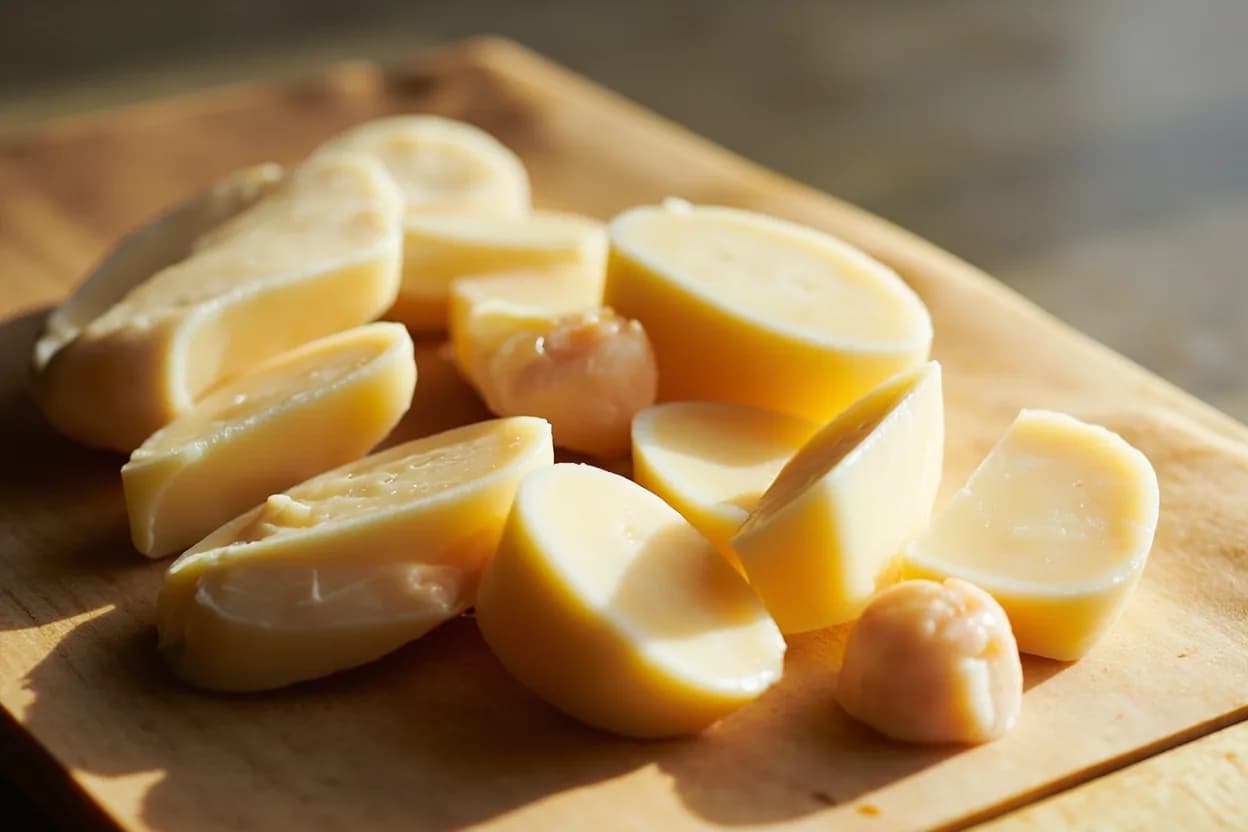
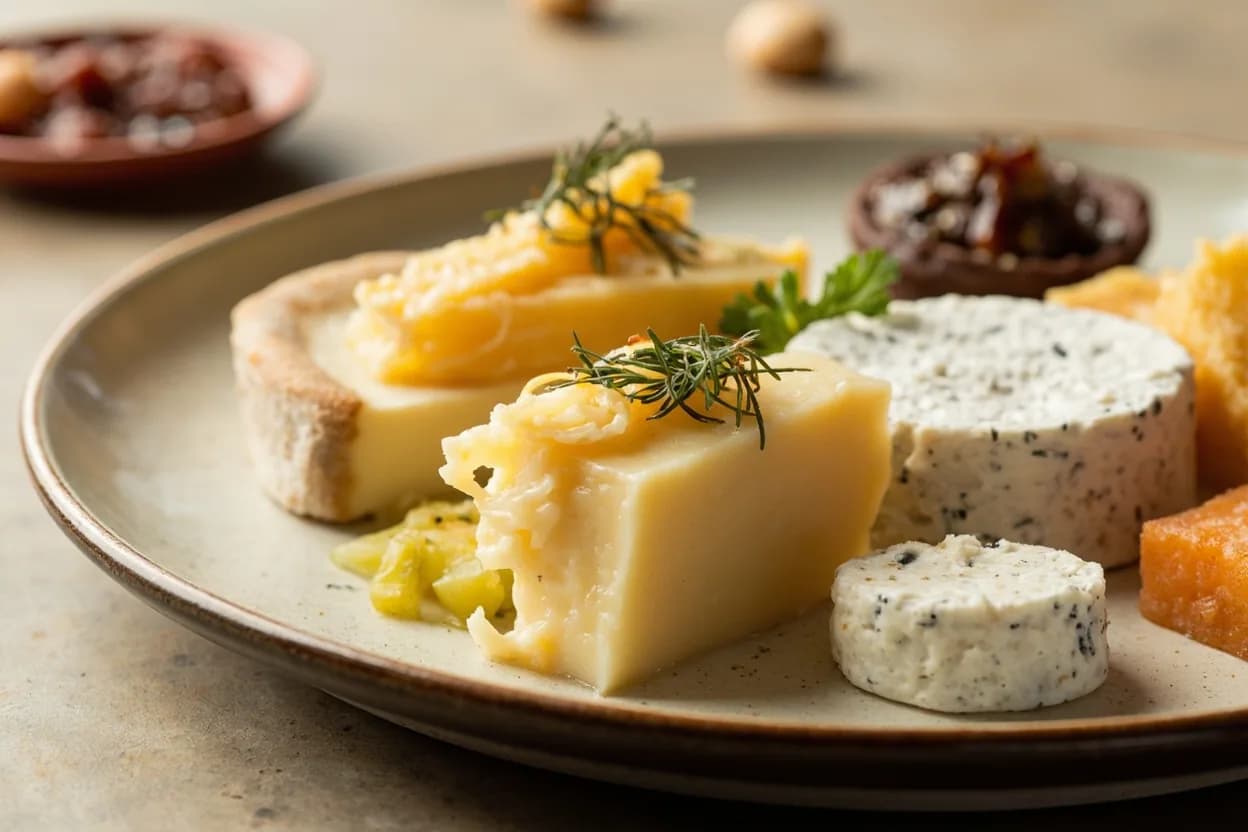
Cheese board portioning for service is the art and craft of transforming a selection of whole, half, or pre-cut cheeses into the correct pre-service geometry for a cheese course, cheeseboard, or fromage plateau. Each cheese type demands a specific cut geometry: wheels are always portioned radially (like a pie) so every piece carries the same ratio of rind-edge to heart; logs are sliced transversally into discs or half-moons; pyramids are quartered vertically from apex to base; bricks are sliced crosswise into rectangular slabs. The core discipline is also social: no one piece should contain all of one 'best' zone (such as the runny centre of a ripe Camembert), and pre-cut placement on the board must permit guests to continue cutting without awkwardness — the cheesemonger's job is to set geometry, not to exhaust it.
In photos
Where it comes from
Not an animal cut. Applies across all cheese formats: cylindrical wheels (Brie, Comté, Manchego), small discs (Valençay base, Crottin de Chavignol), logs (Sainte-Maure de Touraine, Selles-sur-Cher), pyramids (Pouligny-Saint-Pierre), bricks (Stilton quarter, Époisses), and irregular chunks (Parmigiano-Reggiano spade-broken pieces).
Best for
How to cook it
- 1Bring all cheeses to room temperature before service: 30–45 minutes for hard and semi-hard varieties; 15–20 minutes for soft and washed-rind (no more — a warm Camembert collapses)
- 2Arrange the board from mildest (top-left) to most assertive (bottom-right) following the standard French sequence: fresh/bloomy → washed-rind → semi-hard → hard → blue
- 3Wheels (Brie, Camembert, Manchego, aged Gouda): cut radially from the centre, like a pie, ensuring each wedge has a rind arc. For a 250 g wheel of Brie, cut into 6–8 equal wedges; leave one wedge slightly displaced to show the paste interior
- 4Logs (Sainte-Maure, Bucheron): slice transversally at 1.5–2 cm intervals into discs; lay the first 3 discs overlapping on the board to show the white exterior and ivory interior
- 5Pyramids (Pouligny-Saint-Pierre, Valençay): quarter vertically from apex to base — each quarter has rind on two faces and exposed paste on two
- 6Bricks (quarter Stilton, Époisses in box): for firm bricks, cut transversally into rectangular slabs 1–1.5 cm thick. For runny washed-rind bricks in their box, serve whole with a small spoon or small spatula
- 7Hard granular cheeses (Parmigiano, aged Pecorino Romano): use a short-bladed, drop-point spade to break into irregular lumps; the uneven surface is intentional and maximises aromatic release
- 8Place one dedicated knife per cheese on the board; knives with holes in the blade (Boska-style) prevent soft paste from sticking
Prep & butchery
- Label each cheese with a small flag or slate tile if serving guests unfamiliar with the selection — name, milk type, origin, and a single tasting note
- Have a small bowl of warm water and a clean cloth for wiping the blade between each cheese — never skip this step even at home
- For maximum visual impact, stagger the pre-cut portions: do not cut all cheeses into the same number of pieces — a large Manchego wheel with 3 wedges cut looks more generous and inviting than the same wheel with 8 wedges pre-cut
- If one cheese is noticeably more pungent (Époisses, Munster), position it downwind on the board — furthest from the most delicate cheese (fresh chèvre, young Brie) — so aromas do not migrate across the board during service
Substitutes
- Letting guests cut at table (French style)
Traditional restaurant service; entire wheel or half-wheel presented on a trolley; fromager cuts to order — no pre-cut geometry needed
- Cubed cheese service (cocktail format)
1.5–2 cm cubes of hard and semi-hard cheeses on cocktail picks; loses rind presentation but allows one-bite consumption without cutlery
Related cuts
The upstream wheel-to-wedge breakdown that produces the board-ready portions for alpine hard cheeses
Rind decisions (leave, trim, remove) are made at the board-portioning stage for each cheese
Blues and aged chèvre on a board may be pre-crumbled into a small pile rather than pre-sliced, depending on service format
Appears in
References
- 1.Mastering Cheese — Max McCalman & David Gibbons (Clarkson Potter, 2009)
- 2.The Cheese Plate — Max McCalman (Clarkson Potter, 2002)
- 3.Cheese: A Connoisseur's Guide to the World's Best — Steven Jenkins (Workman, 2008)
- 4.The Oxford Companion to Cheese — ed. Catherine Donnelly (Oxford University Press, 2016)
- 5.Larousse Gastronomique (Hamlyn, 2009 English edition) — 'Fromage' entry
Confidence: high
Notes
The geometric equity principle
The guiding principle of all pre-service cheese cutting is geometric equity: every guest portion must offer the same ratio of rind, sous-croûte, and interior paste. For wheel cheeses, this is automatically achieved by radial cuts from the centre. Violating this principle — cutting cross-sections (parallel slabs from a wheel) — creates an 'edge piece' (all rind, dry and bitter) and a 'centre piece' (all runny paste, no rind structure). The French fromager's term for this error is 'couper le nez du fromage' — 'cutting the nose off the cheese' — and it is considered a serious breach of cheesemonger etiquette.
One knife per cheese
The one-knife-per-cheese rule is both hygienic and flavour-protective. Penicillium roqueforti spores from a blue cheese transferred to a bloomy-rind Brie will colonise and alter the Brie's flavour within hours. The washed-rind bacteria of an Époisses will contaminate a fresh chèvre. In a restaurant setting, knives are rinsed in warm water and dried between cheeses on the same board. At home, having three or four dedicated cheese knives (soft-cheese spreader, lyre wire, hard-cheese cleaver, and blue-cheese fork) is a genuine functional requirement, not kitchenware affectation.
Pre-cutting vs guest-cutting
French tradition holds that guests cut their own portions at table, which maintains paste integrity until the moment of eating and allows each person to choose their preferred ratio of rind to paste. The cheesemonger pre-cuts one wedge only to reveal the paste and demonstrate ripeness. Anglo-American service tends toward fully pre-portioned boards, especially in restaurants, to control portion size and pace the course. Neither approach is wrong; they reflect different cultural attitudes toward the cheese course as personal exploration versus curated sequence.