Fish — Fabrication & Breakdown
Tronçon (Bone-In Flat Fish Steak)
Also: tronçon, troncon, flat fish steak, bone-in turbot steak, turbot tronçon
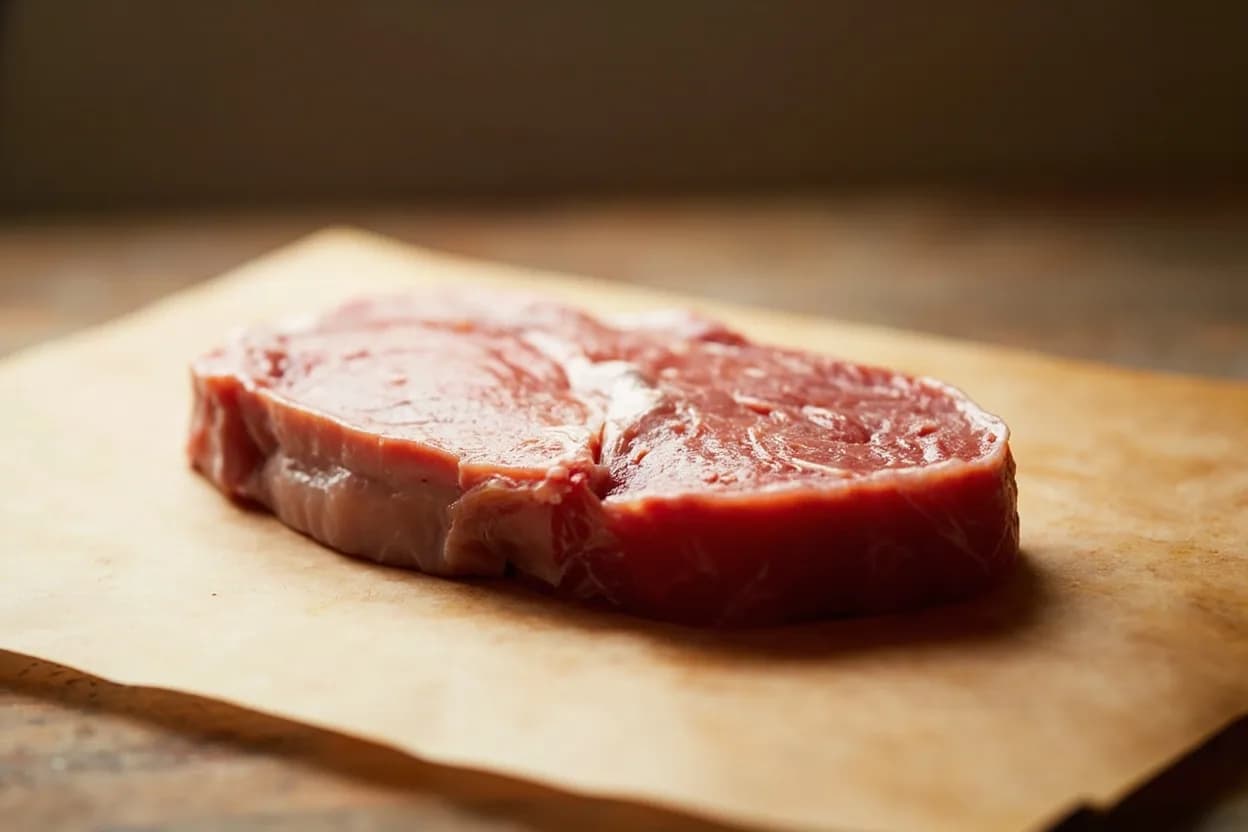
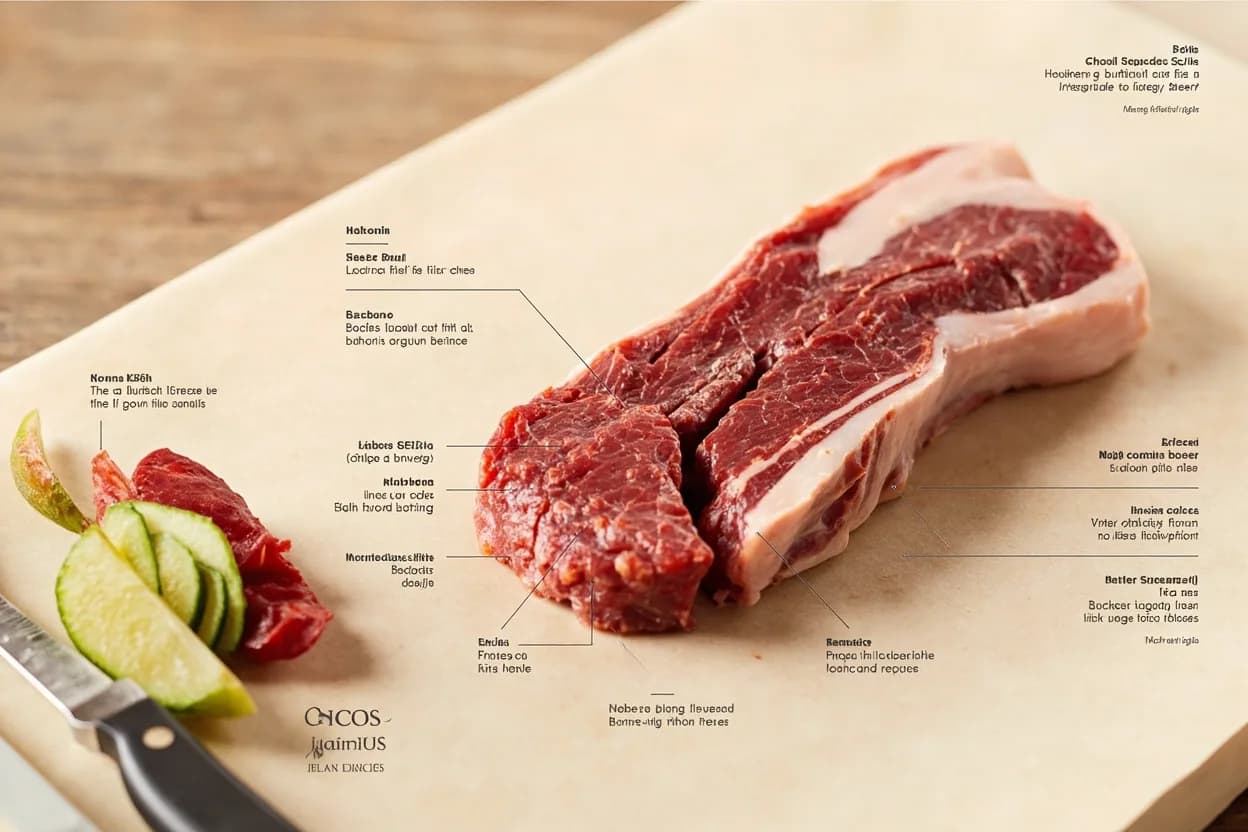
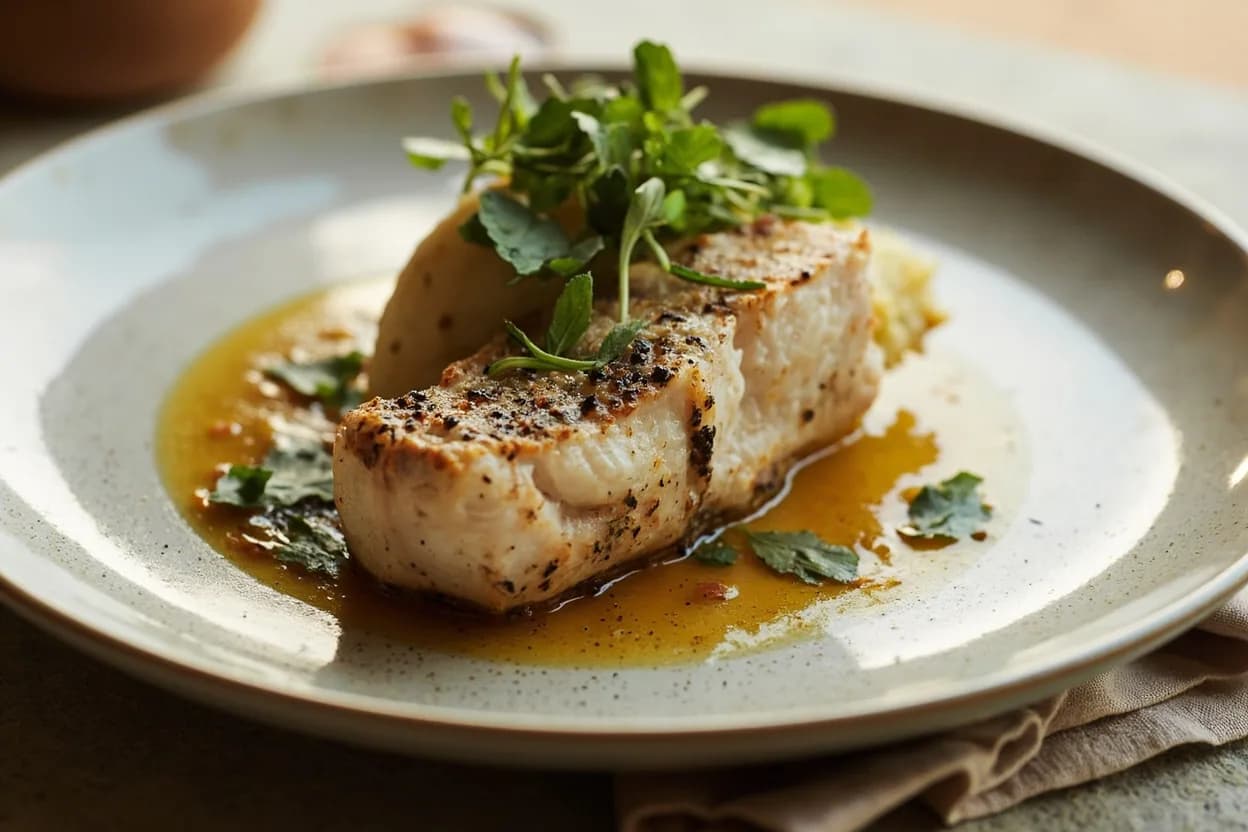
A cross-cut steak taken through a whole flat fish — turbot, brill, or sole — retaining spine, lateral bones, skin, and the four muscle pads in a single thick portion.
A tronçon is the flat-fish equivalent of a darne: the whole dressed flat fish is sliced perpendicularly to its spine in sections 3–5 cm thick, producing a bone-in steak containing portions of all four muscle lobes (two white/upper, two white/lower), the central spine, and lateral intermusculars. Unlike a darne from a round fish, the tronçon is wide and flat rather than oval, reflecting the compressed morphology of flatfish. It is considered one of the most prestigious fish portions in classical French cuisine, particularly from large turbot (the 'pheasant of the sea').
In photos
Where it comes from
Cut from the middle sections of a large flat fish — turbot (Scophthalmus maximus), brill (Scophthalmus rhombus), halibut (Hippoglossus hippoglossus), or large sole. The head and tail are removed first; the head section ('collet') is sometimes sold separately as a prized cheek cut. A 4 kg turbot yields 4–6 tronçons from the center, with collar and tail pieces sold separately.
Best for
How to cook it
- 1Season the tronçon generously on both sides; the bone mass requires bold seasoning. A marinade of olive oil, lemon, and herbs applied 30 minutes ahead penetrates effectively.
- 2For roasting in a turbotière (the traditional diamond-shaped flat-fish roasting pan): place in seasoned court-bouillon or white wine-butter mixture, bring to a simmer on the stovetop, then transfer to a 180°C oven for 15–20 minutes per 3 cm of thickness.
- 3For pan-roasting: sear the dark-skin side first in clarified butter over high heat until golden (2–3 minutes), flip, add thyme, garlic, and whole butter, and baste continuously for 2 minutes before transferring to a 200°C oven for 8–12 minutes.
- 4For braising: place tronçons in a buttered, shallot-lined baking dish, add white wine and fish stock to half-depth, cover with buttered parchment, and bake at 180°C for 12–18 minutes. Reduce the braising liquid with cream for sauce.
- 5The tronçon is done when the flesh pulls cleanly from the lateral bones and registers 58–62°C at the thickest point.
- 6Rest uncovered 2–3 minutes; serve with the bones intact — carve at table or let diners remove them.
Prep & butchery
- Remove the head by cutting behind the pectoral fin with a heavy chef's knife; gut and rinse the cavity thoroughly.
- Trim the fins with scissors before cutting (they are sharp and can complicate even portioning).
- Cut the tronçons with a single heavy downward stroke of a chef's knife through the flesh, using a mallet or bench scraper as a press on the spine if the bone resists.
- For very large turbot, a serrated knife or small saw may be needed for the spine; the goal is a clean, perpendicular cut face.
- Aim for uniform thickness of 3.5–4.5 cm for restaurant service; thinner than 3 cm is fragile, thicker than 5 cm requires very long oven time.
Substitutes
- Darnes (round-fish steak)
Same bone-in steak concept but from a round fish; cooking times and bone geometry differ; acceptable substitution in most braised preparations.
- Halibut steak
Large halibut can be cut into tronçon-style steaks; more available than turbot in North American markets; lean, so requires additional fat in cooking.
Boneless bias-cut portion — loses the gelatin contribution of the bones and the drama of the bone-in presentation, but far easier to eat.
Related cuts
The round-fish equivalent — same bone-in cross-cut concept applied to salmon, cod, or tuna.
Boneless bias-cut alternative from the same fish categories, preferred when ease of eating is paramount.
The French classification system that frames tronçon as the flat-fish variant of the darne category.
Appears in
References
- 1.Auguste Escoffier, 'Le Guide Culinaire,' Flammarion, 1903 — tronçon as canonical flat-fish cut
- 2.Joël Robuchon, 'Larousse Gastronomique,' Hamlyn, 2001 — fish cuts and preparations
- 3.Alan Davidson, 'North Atlantic Seafood,' Penguin, 1979 — turbot anatomy and cookery
- 4.The Culinary Institute of America, 'The Professional Chef,' 9th ed., Wiley, 2011
Confidence: high
Notes
The turbotière
The tronçon's prominence in French classical cuisine inspired the creation of a dedicated cooking vessel: the turbotière, a diamond-shaped roasting pan proportioned to hold a whole or halved large turbot. It is one of the few kitchen tools named for a single fish, reflecting how prestigious this cut was in 18th- and 19th-century bourgeois and grand-cuisine cooking.
Flat fish vs. round fish geometry
Because flat fish swim horizontally and have four muscle lobes (two upper, two lower, separated by the horizontal septum and the spine), a tronçon cross-section looks nothing like a darne. The tronçon is wide, shallow, and rectangular in profile; the darne is narrower and ovoid. This means the tronçon has two broad flat faces (dark skin and white skin) that brown easily, while the darne has only thin curved skin edges.