Cheeses
Blue Cheese
Also: bleu cheese, fromage bleu, mold-ripened cheese, Penicillium roqueforti cheese
Pungent, salty, and funky — the cheese that makes everything around it taste more intentional.
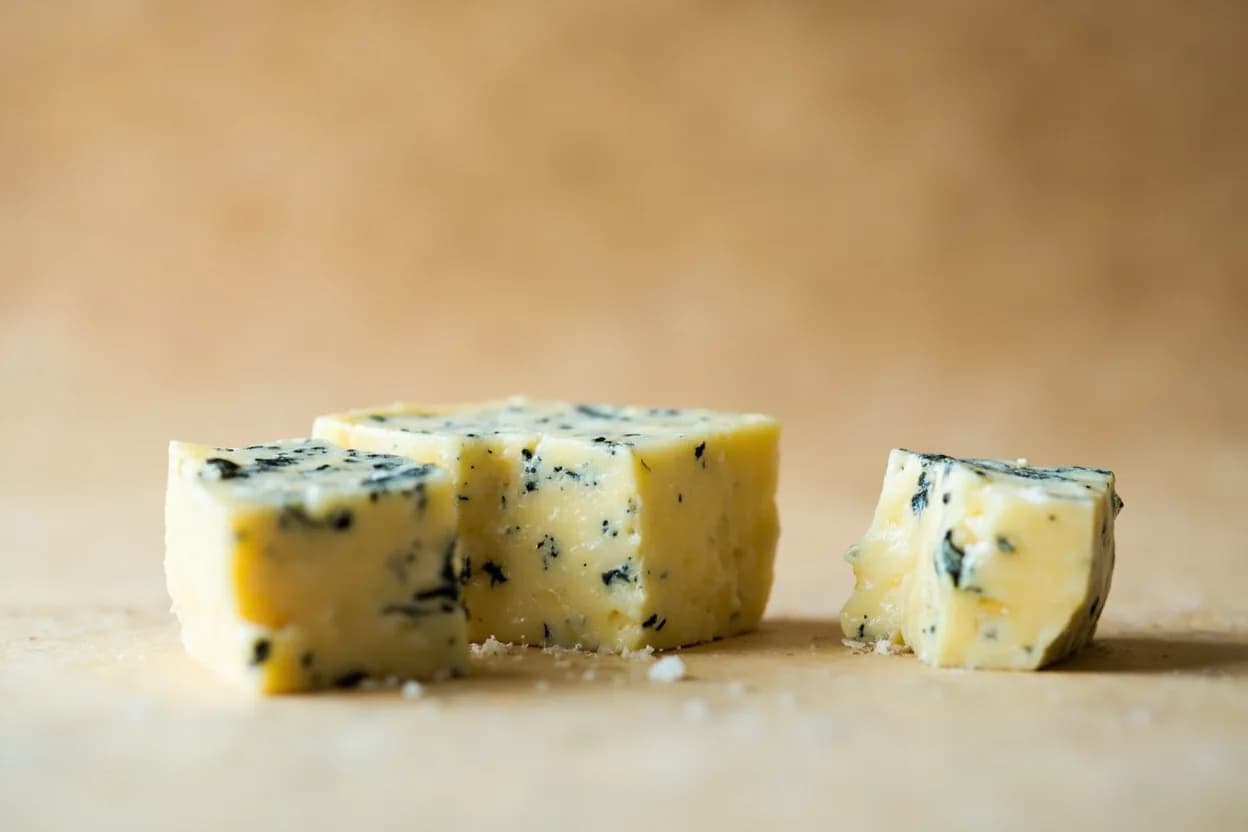
Blue cheese is any cow's, sheep's, or goat's milk cheese inoculated with Penicillium roqueforti or related molds and pierced with air needles to allow blue-green veins to develop throughout the paste. Proteolysis and lipolysis during ripening produce free fatty acids (butyric, caprylic) and complex ketones — primarily methyl ketones like 2-heptanone — that generate the signature piquant, barnyard, and ammonia-edged aroma. Style ranges from creamy and mild (Gorgonzola dolce) to dry and intensely sharp (Roquefort, Stilton).
In photos
Flavour profile
Classic pairings
- Tawny portBritish / Portuguese
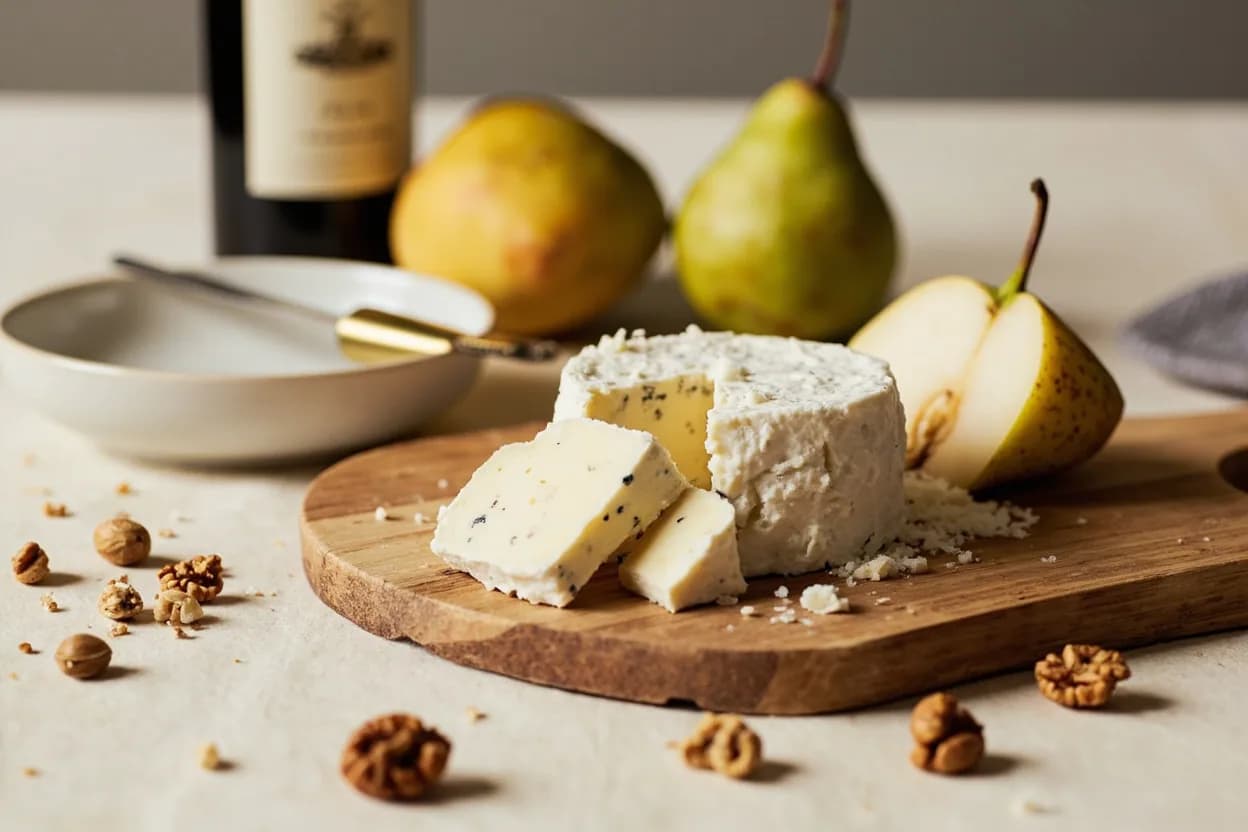
The Roquefort-Sauternes pairing is French, but the British Stilton-and-port tradition is equally canonical: oxidative walnut sweetness, dried fruit, and sugar buffer the cheese's aggressive salt and funk.
- WalnutsFrench / British
Bitter tannins and earthy oil in walnuts harmonize with blue cheese's piquancy; the textural contrast between crunch and creamy paste is structural to cheese boards from Auvergne to Shropshire.
- Pear (fresh or poached)European
The clean, juicy sweetness and subtle floral notes of ripe pear soothe the cheese's sharpness while the fruit's slight acidity cuts through its fat.
- Honey (raw, buckwheat, or wildflower)Italian / French
Sweet viscous honey draws the piquant edge into a savoury-sweet harmony; drizzled directly over Gorgonzola or Roquefort it is one of the simplest and most effective cheese-board moves.
- Dry-aged beef (steak)American / British
The deep umami and slight ferric tang of a dry-aged ribeye or sirloin is amplified and enriched by a blue-cheese compound butter or crust — especially with Roquefort or Stilton.
- Celery and celery saltAmerican
Cool, watery crunch of celery cleans the palate between bites of blue cheese, while celery's vegetal bitterness resonates with the cheese's own piquancy. The classic American Buffalo wing plate canonises this.
- Dried figsFrench / Italian
Concentrated jammy sweetness of dried figs functions like honey in providing sugar counterpoint; their seeds add textural interest against the creamy paste of Gorgonzola dolce or Bleu d'Auvergne.
Adventurous pairings
- Dark chocolate (85%+)
The bitterness and roasted tannins of very dark chocolate meet blue cheese's salt and funk in a surprisingly coherent pairing — both share fermentation-derived complexity.
- Mezcal
Smoky agave spirits cut through blue cheese fat with their phenolic smoke, and the spirit's earthy complexity (rather than oak-vanilla) doesn't compete with the cheese's funk.
- Caramelised onion jam
Long-cooked onions achieve a sweetness that tames even the sharpest Roquefort, while their umami depth aligns with rather than conflicts with the cheese's intensity.
- Ripe mango
The tropical, ester-rich sweetness of fresh Alphonso or Kent mango is a counterintuitive but effective foil for Gorgonzola piccante — sweet fruit cleanses the fat, acid lifts the funk.
- Bacon (thick-cut, smoked)
Smoky, salty pork reinforces the cheese's salt and funk while its rendered fat creates textural richness; a natural affinity in wedge salads, burgers, and crostini.
Tread carefully
- Delicate white fish and shellfishavoid
Blue cheese's methyl ketone funk overwhelms the subtle brininess of scallops, oysters, or sole — the dairy overtakes any trace of the sea.
- Light, aromatic white wines (Riesling Kabinett, Pinot Gris)avoid
Floral, off-dry whites are consumed by the cheese's pungency; if you want wine with blue cheese, go towards sweetness (Sauternes, late harvest) or oxidative styles (Amontillado, tawny port).
- Fresh citrus (lemon juice added directly)avoid
Raw lemon acid clashes with the ammonia and butyric notes of strong blue cheeses, exaggerating the pungency into an acrid sharpness rather than providing contrast.
How to use it
- Crumble at room temperature — cold blue cheese is muted; 30 minutes out of the fridge opens the aromatics dramatically
- Blend with butter and a splash of cream into a compound butter for finishing steaks, burgers, or grilled flatbreads
- Whip with crème fraîche or sour cream into a dressing — diluting the intensity makes it broadly accessible (classic Buffalo wing dip)
- Melt gently into cream sauces for pasta or gnocchi over low heat — high heat breaks the fat and makes the sauce grainy
- Layer into a gratin between par-cooked potato slices (Gratin Dauphinois variation) for umami depth without visible funk
- Press into hollow dates or wrap in bacon before roasting for a two-bite appetizer that balances all pairings simultaneously
Appears in
Related flavours
The archetype of French blues — sheep's milk, cave-aged, intensely salty and complex; the reference point for Sauternes pairing.
- Gorgonzola
Italian blue in two styles: dolce (young, creamy, mild) and piccante (aged, crumbly, sharp); dolce pairs more broadly with fruit and honey.
- Stilton
England's protected blue — firm, orange-brown rind, complex and nutty with a pronounced blue vein; the canonical port-and-cheese partner.
References
- 1.The Oxford Companion to Cheese — Catherine Donnelly (ed.)
- 2.Cheese and Culture — Paul Kindstedt
- 3.Wine and Food Pairing — Andrea Immer Robinson
- 4.The Flavor Bible — Karen Page & Andrew Dornenburg
Confidence: high
Notes
Style spectrum matters
The category 'blue cheese' spans from mild, buttery Gorgonzola dolce (which pairs with nearly anything sweet or fruity) to searing, crystalline Roquefort or very aged Stilton that demand assertive partners. When a recipe or pairing calls for blue cheese, specifying the style is not optional — the difference in intensity is larger than the difference between a mild Brie and a washed-rind Époisses.
The science of the funk
Penicillium roqueforti secretes lipases that break down milk fats into free fatty acids, which are then oxidized into methyl ketones (principally 2-pentanone and 2-heptanone). These carbonyl compounds are responsible for the characteristic 'blue' aroma. Proteolytic enzymes simultaneously produce free amino acids that contribute umami and sharpen the overall flavor. The balance of these two processes determines whether a blue reads as creamy-fruity or aggressively pungent.