Vinegars
Distilled White Vinegar
Sharp, colorless grain vinegar at ~5% acidity with a clean, neutral bite. The workhorse for pickling brines, deglazing, dough tenderizing, and cutting rich sauces.
Distilled white vinegar is the workhorse acid of the modern kitchen — clear, colorless, and deliberately stripped of everything except acetic acid and water. Unlike cider, wine, or rice vinegars, which carry the flavor of their source material, it is made by fermenting grain (overwhelmingly corn in the U.S.) into ethanol, oxidizing that ethanol into acetic acid with Acetobacter bacteria, and then distilling the liquid to remove color, aroma, and impurities. That distillation is what sets it apart from every other food vinegar and what gives it a clean, neutral bite.
That neutrality is the point. It is the vinegar you reach for when you want the function of acid — preserving, brightening, leavening, coagulating, emulsifying — without flavor commentary. A splash at the end of a braise perks up a flat dish; a cup in a pickle brine keeps cucumbers, onions, and peppers from taking on a muddy tint; a tablespoon in poaching water tightens egg whites into tidy shapes. In baking, it reacts with baking soda to release carbon dioxide, giving snickerdoodles, pancakes, and quick breads their tender, lofty crumb.
A few practical points govern how to use it well. Bottles labeled 5% are the safe assumption for virtually every published pickling and canning recipe — improvising with stronger cleaning vinegars is risky unless you have a way to test and dilute precisely. It is also effectively indestructible in the pantry: the acetic acid is its own preservative, so an unopened bottle keeps for years and an opened one keeps for years more as long as the cap is tight. Beyond the kitchen, it descales kettles, lifts mineral deposits from coffee makers, and washes produce — all jobs that exploit the same property: a stable, predictable acid that does one job with no surprises.
- Measured in
- ml
- Storage
- Pantry
Find it in
Suits
Types & varieties
The supermarket default and the safe choice for pickling, cooking, and dressings.
Slightly stronger; technically food-safe but punchier and not calibrated for canning recipes.
Sold as a horticultural or heavy-duty cleaning product; not formulated for cooking.
Industrial and agricultural strength (weed control); caustic and not a food product.
Made from certified-organic grain; functionally identical to conventional 5%.
A marketing label rather than a distinct grade — almost always 5% distilled white vinegar in a larger jug.
Often confused with grain white vinegar; made from rice wine, typically milder and slightly sweeter at 4–4.5% acidity.
How it's made and why that matters
The process is two biological steps plus one physical one, and understanding the order explains every cooking decision you will make with the bottle. First, yeast ferments a grain mash (corn, barley, or rice) into ethanol — the same fermentation that produces beer or sake. Second, Acetobacter bacteria oxidize that ethanol into acetic acid while the liquid rests in open tanks or slowly rotating generators. At this point the liquid is essentially a raw cider or wine vinegar, full of color, flavor compounds, and sediment. The third step, distillation, boils the vinegar and recondenses the vapor, leaving behind those non-volatile flavor and color compounds. The distillate is clear, nearly flavorless, and standardized to a target acidity by diluting with water.
- Distillation is what separates distilled white vinegar from cider, wine, and rice vinegars — the latter are bottled with their flavor compounds intact.
- Standardization to 5% is what makes published pickling recipes safe to follow: the acid calculation in the brine assumes that exact strength.
- In the U.S., the grain is almost always corn because of the corn-ethanol supply chain; in the U.K. and parts of Europe, malted barley is common, which is why some imported 'white' vinegars carry a faint malty note.
Acidity and food safety
Every reliable canning recipe — whether from the USDA, Ball, or a state extension service — is calibrated to 5% acetic acid. Going stronger is not inherently dangerous, but it changes the flavor and the texture of the produce; going weaker risks spoilage because the pH may not drop low enough to inhibit Clostridium botulinum in low-acid vegetables. This is the single most important rule in home pickling, and it is why you should never substitute a bottle of cleaning or horticultural vinegar into a canning recipe without testing and diluting it precisely.
- Use a pH meter or acid titration kit to verify strength if you are diluting a higher-acid vinegar; do not eyeball it.
- For refrigerator pickles (not water-bath canned), the stakes are lower, but the 5% assumption still gives the cleanest results.
- If a bottled 'pickling vinegar' lists an acidity other than 5%, treat the recipe you plan to use as needing recalculation.
Common uses
Tips & pitfalls
- Dilute before tasting — 5% reads harsh neat, but a teaspoon in a quart of braise disappears and just adds brightness.
- Reach for it (not apple cider or wine vinegar) when clarity matters: piccalilli, pale mustard, quick-pickled onions, or any brine you want to keep colorless.
- For poached eggs, add about 1 tablespoon per quart of water and keep it at a bare simmer — a rolling boil shreds the whites before the acid can do its work.
- In baking, do not swap it 1:1 for cream of tartar or lemon juice; it is stronger. Start at about half the amount called for and adjust to taste.
- Never pour full-strength vinegar on natural stone (marble, granite, travertine, limestone) — it etches the polish. Always dilute for counter cleaning.
- Avoid long cooking in bare cast iron; the acid can strip seasoning. Stainless steel or enameled cast iron is the safer vessel for acid-bearing braises.
- To descale a coffee maker or kettle, run a 1:1 vinegar-and-water cycle through the machine, then two full cycles of plain water to flush residue.
- Do not substitute malt vinegar 1:1 — malt is brewed, not distilled, and will add both color and a strong malty flavor that dominates delicate dishes.
Nutrition
Energy
75 kJ · per 100 g
Where the calories come from
Protein
0g
0% DV
Carbs
0g
0% DV
Fat
0g
0% DV
Fiber
0g
0% DV
Sugars
0g
of which
Sodium
2mg
0% DV
Source · USDA FoodData Central · approx. Vinegar, distilled
View on FDC →In the shops
Matched grocery products
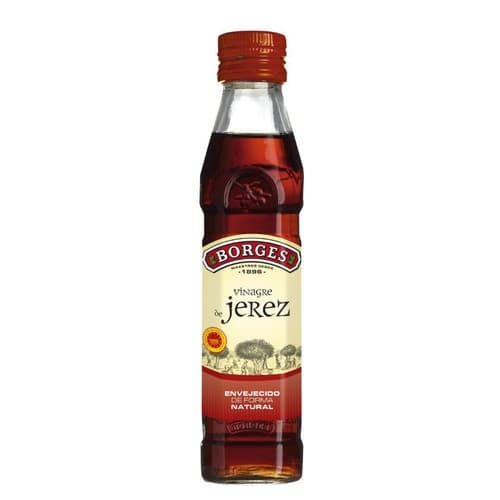 €1.99
€1.99BORGES Sherry Vinegar
BORGES · l · Bonpreu
 €1.49
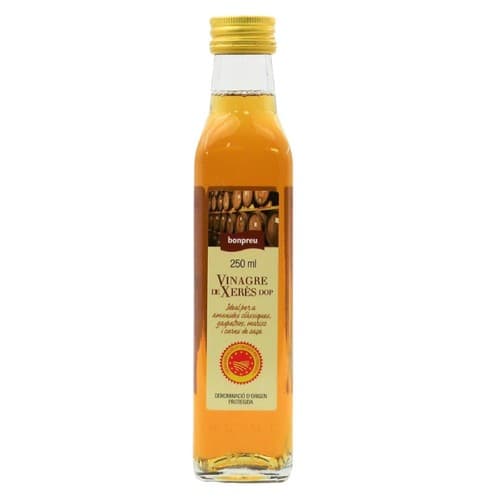
€1.49Sherry Vinegar
BONPREU · l · Bonpreu
 €1.35
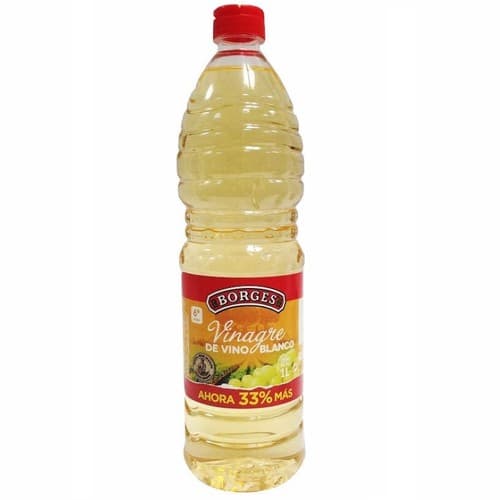
€1.35BORGES White Wine Vinegar
BORGES · l · Bonpreu
 €0.49
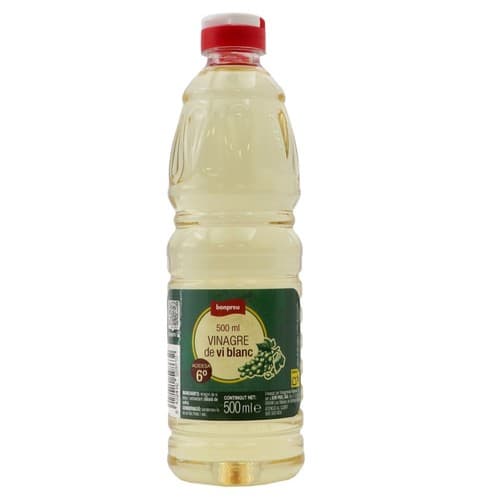
€0.49White Wine Vinegar
BONPREU · l · Bonpreu
 €0.65
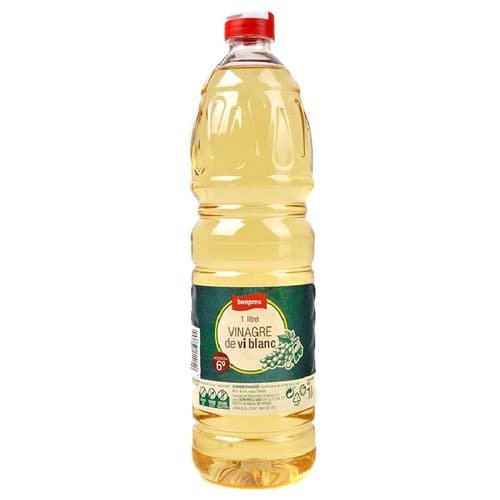
€0.65White Wine Vinegar
BONPREU · l · Bonpreu
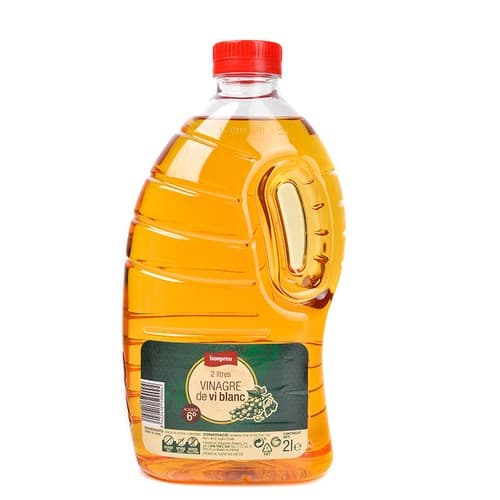 €1.24
€1.24White Wine Vinegar
BONPREU · l · Bonpreu
Good to know
- Type
- Distilled grain vinegar (typically corn in the U.S.)
- Typical acidity
- 5% acetic acid for food-grade; 6–8% for cleaning grades; 10% horticultural; up to 30% industrial/agricultural
- Source material
- Fermented and distilled grain alcohol — overwhelmingly corn domestically, sometimes malted barley or rice abroad
- Color and clarity
- Colorless and fully clear; will not tint brines, sauces, or baked goods
- Flavor profile
- Sharp, clean, neutral; no fruit, oak, or fermentation by-notes
- pH
- Roughly 2.4–3.0 at 5% acidity
- Caloric content
- About 3 kcal per tablespoon — effectively negligible
- Shelf life
- Practically indefinite if sealed; the acetic acid preserves the bottle itself
- Freezing point
- Around −2.2 °C / 28 °F — usually will not freeze solid in a home freezer
Substitutes
- Apple Cider Vinegar — The most common stand-in. Adds amber color and light fruity tang; fine in dressings, less good when you need crystal-clear brine.
- White Wine Vinegar — Softer and slightly fruity; reduce the amount by about 25% and add a pinch of sugar if the recipe needs extra punch.
- Champagne Vinegar — Delicate and floral; good in vinaigrettes but milder — use a bit more and expect a more refined finish.
- Unseasoned Rice Vinegar — Mildly sweet and lower acidity (around 4–4.5%); use roughly 1.25× the amount and add 1/4 teaspoon sugar per tablespoon if the recipe depends on sweetness.
- Lemon or Lime Juice — Citric rather than acetic, but the right flavor move in many sauces and salsas. Use about half the volume; it brightens differently.
- Sherry Vinegar — Deeper and nuttier; not a clean substitute when clarity matters, but an upgrade when you want the swap to add character.
- Diluted Higher-Strength Vinegar — If you only have 6–8%, dilute to 5% with water — but verify with a hydrometer or pH meter for canning, where precision matters.
Pairs with
Also called
white distilled vinegar · spirit vinegar