Proteins
Lamb Loin Chop
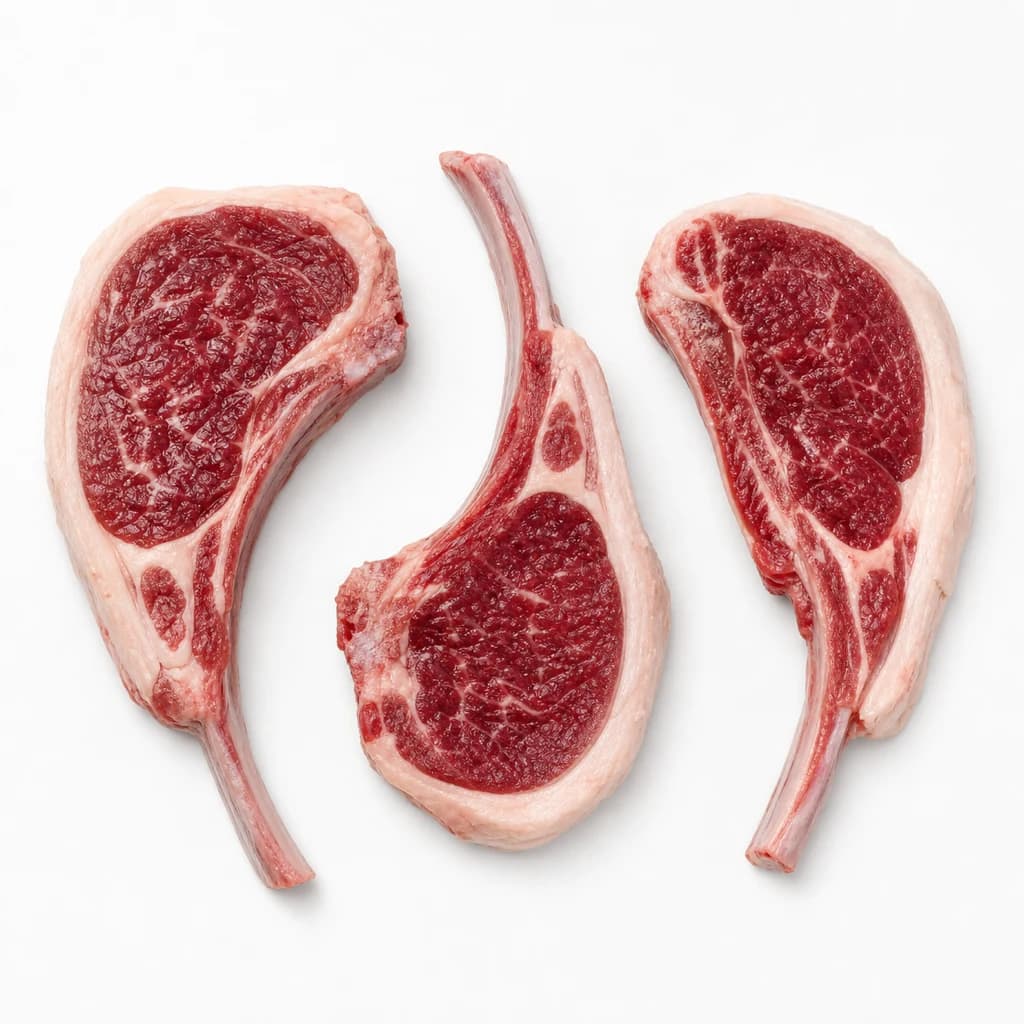
Mini T-bone from the lamb loin with tenderloin and strip on either side of the bone. Tender and lean; pan-sear or grill hot to medium-rare. Quicker and meatier than rib chops.
The lamb loin chop is the smallest-yielding and arguably most refined cut on the animal — just two single chops per side, sliced straight through the rear of the saddle. Its signature is the T-shaped vertebral bone that carries two very different muscles in one neat package: the psoas major (tenderloin) on one side and the longissimus dorsi (the eye of loin, or strip) on the other. That anatomy makes the chop behave like a miniature beef T-bone, with a buttery, almost mousse-like tenderloin sitting next to a firmer, beefier strip. Because the cut has almost no external fat cap and the tenderloin contains virtually no intramuscular fat, the loin chop is famously easy to overcook. Treat it the way you would a beef tenderloin steak: hard, fast heat, a brief rest, and a pull temperature well below what your instinct says is "done." The payoff is a chop that is sweet, mineral, and tender in a way no other part of the lamb can match.
Cost tracks rarity. With only four single chops per carcass, the loin commands lamb's highest per-pound price, and that cost is part of why Frenched, bone-in loin chops became a restaurant signature — the presentation is built into the cut. For home cooks, the double loin chop (two loins left joined along the spine) is often the better buy per ounce and a touch more forgiving in the pan, since the two sides shield each other from direct heat. American, British, and Irish lamb tend toward a mild, sweet profile that pairs with mint, rosemary, and redcurrant; New Zealand and Australian grass-fed lamb carries a more pronounced grassy, sometimes lanolin-forward note that holds up to bolder spice work — cumin, coriander, harissa, pomegranate.
- Measured in
- g
- Storage
- Refrigerate
Find it in
Types & varieties
Bone scraped clean of meat and fat for 1–1.5 inches; the standard restaurant presentation.
Bone left with surrounding meat and fat; more forgiving to cook and the traditional butcher-shop style.
Two single chops left joined along the spine; roasted whole for two or split after cooking. Also called saddle of lamb for two or twin chop.
Usually grain-finished, milder flavor, whiter fat; available spring through fall.
Grass-fed year-round; more pronounced grassy, lanolin note; yellower fat.
Pasture-raised on smaller-framed breeds; strong association with spring (milk-fed) lamb.
Under 8 months old, very pale flesh, mild and delicate; prized in Mediterranean and Middle Eastern kitchens.
Understanding the two muscles
The reason a lamb loin chop behaves so differently from a rib chop is that you are cooking two muscles at once, on a single small bone. The psoas major — the lamb's tenderloin — sits inside the curve of the spine and does almost no work over the animal's life, which is why it reads as soft, almost spreadable, with a fine, velvety grain. It has essentially no intramuscular fat and almost no connective tissue, so it overcooks within seconds of crossing 140°F. The longissimus dorsi on the other side of the bone is the same muscle that becomes the rib eye and strip loin; it has slightly more structure, a touch more beefy flavor, and tolerates a degree or two more heat. In practical terms, the tenderloin is always the part that decides when the chop is done. Cook to the tenderloin's needs and the strip will be perfect; cook to the strip and the tenderloin is paste.
Buying and storage
Look for chops with bright, pale-pink flesh (deeper red signals older mutton) and creamy-white fat. Avoid chops with browned or dried edges, a sign of poor rotation. If the butcher offers to French the bone, accept it for presentation, but ask them to leave a thin ring of fat where the bone meets the tenderloin — that fat protects the most vulnerable muscle from the pan's direct heat. Keep refrigerated at 32–38°F and use within 48 hours for best texture; vacuum-sealed and frozen, the chops hold well for 6–9 months, but wrap tightly because the lean meat has no fat buffer against freezer burn.
Domestic vs imported
Where the lamb was raised changes how you should season it. American lamb is typically grain-finished, producing a mild, sweet, almost neutral flavor and bright white fat — the classic canvas for mint sauce, rosemary, and redcurrant. British and Irish lamb is pasture-raised on smaller-framed traditional breeds, with a delicate, slightly sweet flavor and a strong association with spring (milk-fed) lamb; it rewards gentler seasoning rather than assertive spice. New Zealand and Australian lamb is almost always 100% grass-fed year-round, which gives the fat a yellow cast and a more pronounced grassy, sometimes lanolin-forward note. That bolder profile rewards assertive spice work: cumin, coriander, smoked paprika, harissa, sumac, and pomegranate molasses. Treating grass-fed lamb as if it were domestic is the most common seasoning mistake; treating domestic lamb as if it were grass-fed is the second.
Common uses
Tips & pitfalls
- Bring chops to room temperature for 20–30 minutes before cooking — cold centers force the exterior to overcook before the interior catches up.
- Pat completely dry and salt 40–60 minutes ahead (or just before searing); surface moisture is the enemy of crust.
- Use a screaming-hot pan or grill; the loin has almost no fat cap to baste itself, so the pan has to do the work.
- Finish with a spoon of cold butter, crushed garlic, and a woody herb (rosemary, thyme, or sage) basted over the top in the last 30 seconds — this is where the chop gets most of its flavor.
- Pull at 125°F internal; carryover will coast it to 130–132°F. Past 140°F the tenderloin turns dry and livery.
- Rest 5–7 minutes loosely tented. The tenderloin side overcooks fastest, so don't seal the chop in foil — a loose tent only.
- For chops over 1.5 inches thick, sear hard on both sides and finish in a 400°F oven to avoid a burnt outside and raw center.
- Save the trimmed fat and bones to render for lamb fat (excellent for roasting potatoes) or to fortify a lamb stock.
- Common mistakes: cooking straight from the fridge, overcrowding the pan, overcooking past medium, skipping the rest, and salting only after the sear — salt won't adhere to a wet surface and the crust will be uneven.
Nutrition
Energy
594 kJ · per 100 g
Where the calories come from
Protein
20g
40% DV
Carbs
0g
0% DV
Fat
6.9g
9% DV
Fiber
0g
0% DV
Sugars
0g
of which
Sodium
77mg
3% DV
Source · USDA FoodData Central · Lamb, New Zealand, imported, loin chop, separable lean only, raw
View on FDC →In the shops
Matched grocery products
No matched grocery products for Lamb Loin Chop yet.
Good to know
- Source cut
- Loin (saddle), between the rib and the leg, separated through the rear saddle vertebra.
- Bone
- T-shaped vertebral bone — the same T-bone anatomy as a beef T-bone steak.
- Muscles on the bone
- Psoas major (tenderloin) on one side; longissimus dorsi (eye of loin / strip) on the other.
- Yield per carcass
- Only 2 single chops per side (4 total) — one of the smallest yields on the animal.
- Typical weight (single)
- 3–5 oz (85–140 g) bone-in, with roughly 2 oz (55 g) of edible meat.
- Typical weight (double)
- 8–14 oz (225–400 g), often Frenched and roasted whole for two.
- Recommended internal temperature
- 125–130°F (52–54°C) for medium-rare; pull at 125°F — carryover lifts it 5–8°F.
- Cook time
- 2–4 minutes per side over high direct heat, depending on thickness.
- Fresh storage
- 3–5 days at 32–38°F (0–3°C); best texture within 48 hours.
- Freezer storage
- 6–9 months vacuum-sealed at 0°F (-18°C).
Substitutes
- Lamb rib chop — More widely available and cheaper; single muscle, smaller bone, similar tenderness — cook a touch faster.
- Veal T-bone (veal loin chop) — Closest anatomical match; very tender, very mild — pull back on the garlic and herbs to match the delicate flavor.
- Pork loin chop (bone-in) — Leaner and less flavorful; cook to 140°F to avoid dryness and season more aggressively.
- Beef T-bone steak (small portion) — Same bone structure but much larger; if portioned down, works as a substitute, though beef flavor will dominate.
- Lamb sirloin chop — From the hip end of the loin; slightly firmer texture, similar price — a serviceable fallback when loin is unavailable.
Pairs with
Also called
lamb T-bone · loin lamb chop · lamb chump chop