Appliances & Heat
Earth Oven (Umu / Imu / Pib)
A pit lined with fire-heated stones where wrapped food is buried to steam-roast underground.
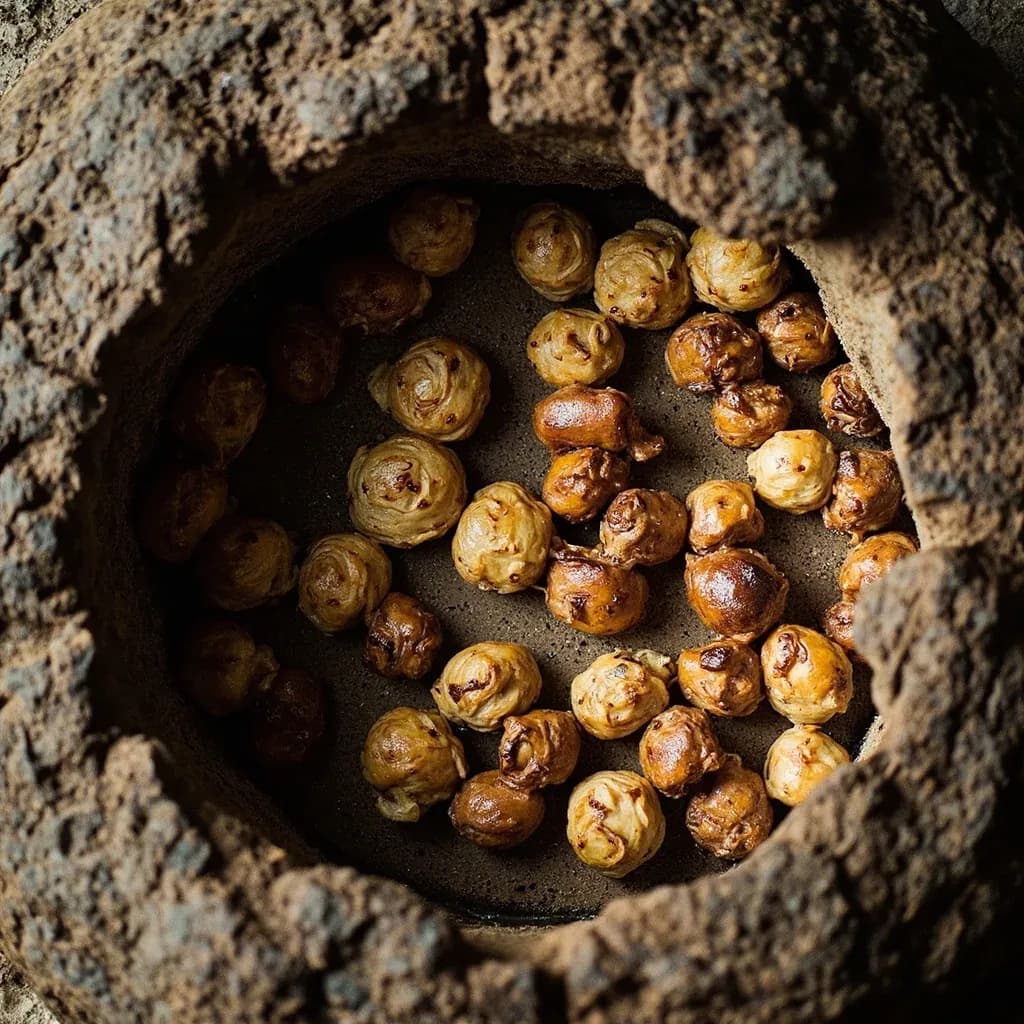
An earth oven is a hole in the ground filled with stones heated by a fire until glowing, on which food is laid, covered with leaves or cloth, and buried for hours of slow, moist cooking. The trapped heat and steam produce deeply tender meats and root vegetables with a smoky, earthy flavor. Pacific and Mesoamerican versions include the umu, imu, motu, and Yucatecan pib.
An earth oven is the oldest continuously used cooking technique on record: a pit in the ground, a fire until the stones inside it glow dull red, then food wrapped in leaves and buried under soil so that the stored heat of the rocks and the trapped steam from the food's own moisture and a wet cap of leaves or burlap do all the work. Nothing touches flame. The food cooks by radiant heat from the stone mass, by conduction through the leaf bundle, and by steam that circulates under the soil cap, which is why a properly buried pig emerges so tender its bones pull clean and so moist it seems to have been poached rather than roasted. The technique is not exotic or primitive; it is one of the most efficient low-tech ways to feed a crowd, and it underlies the etymology of "barbecue" itself.
What distinguishes an earth oven from a smoker, a roast, or a stew is the mass of heat. A grill gives you thin, fast heat from below; an earth oven gives you a deep, slow, all-sided heat reservoir that continues to cook for hours after the fire is out. That thermal inertia is forgiving of long bundles and tough cuts, but unforgiving of mistakes in stone choice, fuel selection, or timing, because once the cap goes on, you cannot adjust until you dig it back up. It is also a single-use structure: each cook rebuilds the pit from scratch.
Practically, an earth oven matters to a modern cook in three ways. It is the only realistic method for cooking 50 to 200 portions of pig, root vegetables, or breadfruit in a single batch with consistent results. It produces a distinctive flavor profile, leaf-steamed and slightly smoky from the buried fire, that is unattainable in any closed metal cooker. And it is a foundational technique worth understanding even if you never dig a pit, because the same radiant-stone-and-trapped-steam principle reappears in the New England clambake, in the above-ground imu boxes now used in Hawaiian restaurants, and in any backyard cook who has buried a pot of beans in a slow-cooling fire pit.
Alternatives
Types & varieties
The generic Polynesian (Samoan, Tahitian, Cook Islands) term for an earth oven, descended from Proto-Polynesian *qumu; the umbrella name for the technique across the Pacific
The Hawaiian pit oven and the canonical luau cooking method, used for kālua puaʻa (pig), laulau (ti-leaf bundles of pork and fish), and breadfruit
Strictly the Hawaiian verb "to cook in an imu," but widely used as a stand-alone term for pit-roasted meat, especially pork
The Māori (Aotearoa/New Zealand) earth oven, distinctive for using flax- or wire-basket trays lowered onto the hot stones so multiple trays cook at once
The Mayan earth oven of the Yucatán, central to festive dishes like pibipollo (banana-leaf-wrapped turkey or chicken) and pibipollo de venado
The Andean (Quechua) pit oven of Peru and Bolivia, traditionally used at harvest for potatoes, oca, mashua, and habas
The earth oven of Chiloé, Chile, layered with shellfish, pork, chicken, potatoes, and milcaos under nalca or rhubarb leaves
The Taino (Caribbean) pit oven, the etymological source of English "barbecue," used for slow-cooking whole animals on a green-wood frame
The Papua New Guinean and broader Melanesian earth oven, central to moka exchanges and ceremonial pig feasts
Among the oldest documented cooking pits, with hearths dated to the Pleistocene (roughly 30,000 years ago); kangaroo, turtle, and yams are typical foods
An Atlantic-coast adaptation using seaweed and seawater-soaked canvas over hot stones, governed by the same radiant-and-steam physics
A metal or wooden box packed with lava rocks that replicates the pit on a patio or in a commercial kitchen when digging is impractical
Choosing and Testing the Stones
The single most consequential decision in an earth oven is the rock. Dense, dry, non-layered igneous stone, basalt, granite, and most volcanic rock, holds enormous heat, releases it slowly, and resists thermal shock. The rocks to refuse are any that hold water in their structure or along bedding planes: limestone, sandstone, slate, shale, and river-rolled limestone are the usual culprits. A wet or porous rock can trap moisture that flashes to steam inside the stone and explodes it mid-cook, which is dangerous and ruins the pit. Practical rules of thumb: select fist-to-head-sized pieces with no visible flaking or chalky texture; if a rock was pulled from a streambed and is still cool and damp to the core, leave it out. Heat the stones until a hand held 15 cm above them feels like a furnace; if you can still comfortably hold the hand there, the rocks are not ready.
- Prefer basalt, granite, or other dense volcanic rock; reject limestone, sandstone, slate, shale, and any visibly damp stone
- Use fist-to-head-sized pieces so they stack with air gaps that the fire can penetrate
- Heat for at least 1–2 hours, until rocks glow faintly or a hand 15 cm above feels furnace-hot
- Move stones with heavy leather gloves and long-handled tongs or poles; burns are the most common injury
Fuel, Smoke, and the Flavor Question
An earth oven is not a smoker, but the buried fire will still influence flavor. Resinous softwoods (pine, spruce, fir, eucalyptus) leave a sharp, bitter, tarlike taint in the food, especially in long cooks, and they should be excluded. The traditional hardwoods in each region, kiawe and ʻōhiʻa in Hawaii, manuka and kanuka in Aotearoa, fruit woods and guava in much of the Pacific, are chosen because they burn hot, clean, and aromatic. The smoke that flavors the food is mostly the smoke trapped in the pre-heated stones and in the charred leaf layer, not the open flame. If you want a clean, leaf-and-steam character, keep green wood, wet leaves, and resinous fuel out of the fire and let the fire burn down to a deep, ashed bed of coals before the food goes in.
- Burn only low-resin hardwoods; avoid pine, spruce, fir, and eucalyptus
- Let the fire burn to a deep coal bed so most smoke is gone before the food is buried
- Keep green leaves and wet wood out of the food layer to prevent taint
- Expect a faint smoke note, but the dominant flavor is leaf-steamed, not smoked
Why the Earth Oven Endures
The earth oven's defining contribution to cookery is the pairing of thermal mass with a sealed steam chamber. That pairing shows up in cookers that look nothing like a pit but obey the same physics. Clay ovens, including the Middle Eastern tannur, and brick pizza ovens retain heat in their masonry. Kamado cookers, Dutch ovens, and thick pizza stones deliver slow, even heat from a hot mass. Covered kettle grills and offset smokers trap heat and smoke in a closed chamber. Modern gas and electric ovens keep the wall-thick, door-sealed logic that lets a chamber coast on residual heat. Understanding the earth oven is, in that sense, understanding why resting meat works and why thick oven walls buy you time: thermal mass and a sealed chamber buy evenness and tenderness that open flame cannot.
- The principle of thermal mass plus a sealed chamber is shared by clay ovens, brick pizza ovens, kamado cookers, Dutch ovens, pizza stones, and covered grills
- Resting meat and coasting on retained heat in a turned-off oven are both expressions of the same physics
- The Taino word "barbacoa" is the widely accepted etymological source of English "barbecue"
Unearthing and Service
Opening an earth oven is the most dangerous moment of the cook. The cap is heavy, the steam under it is scalding, and the stones are still radiating lethal heat. Plan a crew of three or four, mark the position of every bundle with stakes or a clear layout before you cap, and use long-handled tools and heavy gloves. Pull the cap in layers, not in one motion: soil first, then wet leaves and burlap, then dry leaves, then bundles. Bundle interiors will be at full steam; open them at the serving table, not over bare skin. Most earth-oven food holds well for 30 to 60 minutes wrapped once unearthed, longer if you re-bundle in fresh leaves and a clean towel, but it loses character fast once exposed.
- Strip the cap from the edges inward, never lift it whole
- Use long-handled tools and heavy leather gloves; assume everything is hotter than it looks
- Mark every bundle's position before capping so nothing is lost in the dark or in the steam
- Plan to serve within an hour of opening for best texture and moisture
Common uses
Tips & pitfalls
- Use only dense, dry stones such as basalt, granite, or volcanic rock; limestone, sandstone, slate, shale, and any visibly damp rock can shatter or explode when heated, ruining the cook as well as the pit
- Heat the stone mass for at least 1–2 hours, not 30 minutes, and confirm with a hand held 15 cm above; under-heated stones are the most common cause of undercooked centers in thick cuts and whole animals
- Keep resinous woods (pine, spruce, fir, eucalyptus) and green wood out of the fire; the smoke taint is mild in short cooks but turns bitter and tarlike over four-hour-plus roasts
- Wrap food in multiple sealed layers of leaves and wet the outermost layer before capping, so steam condenses and recirculates inside the bundle instead of escaping through a dry cap
- Plan conservative times and check by feel and bone-pull rather than the clock; overcooking is rare because the oven cools steadily, but undercooking a thick joint in the center is the classic failure mode
- Mark the location of every bundle with stakes or a clear grid before the cap goes on, because in the steam and dark of unearthing it is surprisingly easy to lose a tray
- Wear heavy leather gloves and use long-handled tongs or poles when moving stones and lifting the cap; burns during unearthing, not during the fire, are the most common injury
- Restore the site after cooking: refill the pit, scatter cooled ash, and replant or reseed the area if the cook is on cultivated ground; a used earth oven should not be left as a hole in someone's lawn or field
Good to know
- Also known as
- Pit oven, ground oven, Hawaiian imu, Samoan umu, Māori hāngi, Quechua huatia, Mayan pib, Chilean curanto, Taino barbacoa
- Origin
- Among the oldest cooking techniques known; Australian Aboriginal ground ovens date to roughly 30,000 years ago, and comparable pits have been used on every inhabited continent
- Heat source
- Wood fire heats a mass of stones; food cooks from stored radiant and conducted heat plus trapped steam, never from open flame
- Stone temperature
- Roughly 315–540 °C / 600–1000 °F at the moment of covering, depending on fire duration and rock type
- Common cook times
- 1–2 hours for fish bundles and root vegetables; 4–8 hours for a whole pig or large root crops; 6+ hours for traditional multi-course feasts
- Pit depth
- Usually 30–90 cm (1–3 ft); shallower pits suit quick vegetable cooks, deeper pits hold more heat for whole animals
- Lining material
- Volcanic basalt, river-rolled granite, or hard fieldstone; never limestone, sandstone, slate, shale, or any porous or visibly damp rock
- Wrapping
- Food is sealed in ti leaves, banana leaves, taro leaves, corn husks, or palm fronds, then blanketed in more leaves, wet burlap, and a soil cap
- Yield
- A single umu or imu feeds 50–200+ people and is the standard format for luaus, weddings, funerals, and harvest feasts
- Modern commercial form
- Resurfaces in Hawaiian, Chilean, and Māori restaurants and at cultural festivals; above-ground imu boxes replicate the pit for patios and catering
Also called
Umu · Imu · Pib · Stone Earth Oven · Motu · Underground Oven
Related

Stovetop
The everyday burners where most cooking actually happens

Oven
Enclosed dry heat for roasting, baking, and braising

Grill
Live-fire or gas grates for char, smoke, and high heat

Smoker
Low, slow heat and wood smoke for barbecue and brisket

Air Fryer
Countertop convection that crisps with little or no oil

Slow Cooker
Set-and-forget low heat for stews, beans, and braises

Pressure Cooker
Sealed steam pressure that cooks tough food in a fraction of the time

Rice Cooker
Foolproof, perfectly steamed rice every single time