Appliances & Heat
Firewood Cookstove
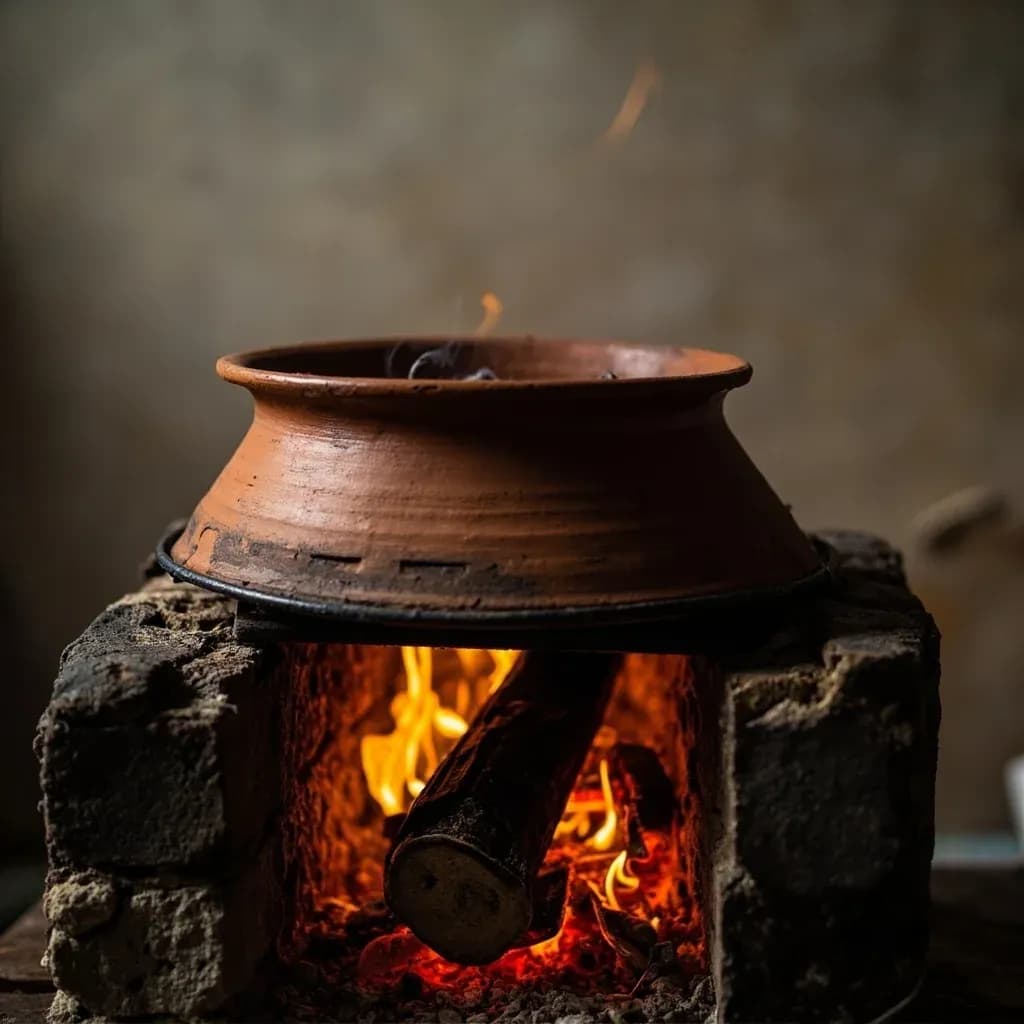
A simple mud or clay stove that channels a wood or dung fire under a single cooking pot.
A firewood cookstove is a basic earthen or clay structure, often homemade, that holds a pot over a contained wood, charcoal, or dung fire. Improved designs add a chimney and insulated combustion chamber to cut smoke and save fuel. Called chulha, chulo, matir chula, unun, or foyer ameliore in different regions, it is the everyday cooking heat source for billions.
A firewood cookstove is less a single appliance than a family of devices that share one idea: burn solid biomass in a contained firebox and channel the flame and hot gases under a pot. The family runs from the most ancient cooking setup humanity has used — three stones supporting a pot over an open fire — through packed-mud chulhas of the Indian subcontinent, ceramic-and-metal jikos of East Africa, and the high-efficiency rocket stoves that anchor the modern improved-cookstove movement. Even at their simplest, these stoves deliver two things a gas or electric burner cannot: a smoky, wood-fired aroma that seeps into beans, stews, and grilled foods, and a long, steady, low output ideal for simmering and slow braising. The trade is precision: heat is regulated by adding or removing sticks, not by turning a knob, so confident sautéing and searing are difficult.
The modern chapter begins with the rocket stove, designed by Larry Winiarski at Aprovecho Research Center in the early 1980s. Its L-shaped, heavily insulated combustion chamber burns fuel so completely that the flame is short, hot, and nearly smokeless, becoming the template for almost every improved cookstove since. Traditional three-stone fires and simple mud stoves convert roughly 5 to 15 percent of the wood's energy into heat in the pot; a well-built rocket or institutional stove pushes that figure to 20 to 40 percent, with proportional savings in fuel gathering and in the smoke that fills kitchens. Solid biomass remains the only practical cooking fuel for around 2.4 billion people, which is why the WHO and IEA treat the clean-cooking transition as a major public-health and equity issue.
For the cook, the practical distinction is between traditional three-stone and mud stoves, prized in heritage cuisines for the dishes they were designed around, and improved stoves, which preserve much of that character while cutting smoke and fuel use. The best advice is old: burn only dry, seasoned hardwood, feed the fire a few sticks at a time, and match the pot to the opening. Whether the goal is a pot of black beans in a highland kitchen, a paella over coals at a festival, or a long, slow braise in a temple kitchen, the firewood cookstove is a tool whose strengths — depth of flavor, slow steady heat, simplicity — remain hard to beat.
Alternatives
Types & varieties
Three stones or bricks supporting a pot over an open fire; the most ancient and lowest-efficiency form, still used by an estimated hundreds of millions of households.
U- or C-shaped enclosure of packed mud or clay with one or two pot openings, found across the Indian subcontinent and neighboring regions.
L-shaped, heavily insulated combustion chamber that creates a strong draft and burns fuel so completely that the flame is short and nearly smokeless; the foundational design for most modern improved stoves.
Built from a mix of loam, rice husks, and sand; developed in highland Guatemala in the late 20th century.
Mexican improved cookstove with a metal combustion chamber, chimney, and optional water-heating jacket, designed through participatory research with rural women.
Central American improved stove with a metal griddle (plancha) on top for simultaneous griddle cooking and pot cooking.
East African ceramic-and-metal charcoal stove, ubiquitous in Kenya, Tanzania, and Uganda; often runs on charcoal rather than firewood.
Large multi-pot or fixed-cauldron biomass stove used in schools, monasteries, temples, hospitals, and community kitchens, often fired with larger logs and agricultural waste.
Heat, flavor, and the rhythm of the fire
A firewood cookstove cooks in two distinct phases. The first is a hot, smoky ignition as the wood catches — an excellent stage for toasting chiles, garlic, and tomatoes directly on the embers or a comal, exactly the smoky aromatics that define moles, sambals, and Central American salsas — but not the stage to cook the main dish on. The second, often twenty minutes to an hour after lighting, is where the cookstove excels: a bed of glowing coals and a small, compact flame that licks the base of the pot, delivering low, even, sustained heat ideal for simmering beans, lentils, rice, stews, and long braises of tough cuts. Holding a precise gentle simmer is difficult because there is no knob to turn; you regulate temperature by how much wood is in the firebox and how recently it was added. Flat-bottomed metal pots in the 20–30 cm range match the firebox opening best; much smaller pots waste heat up the chimney, and much larger ones starve the fire of oxygen. A plancha-top stove closes the gap by adding a metal griddle that behaves like a comal or hot plate, perfect for tortillas, roti, eggs, and vegetables alongside the pot openings for boiling and braising.
Smoke, chimneys, and indoor air
Indoor use of an unvented biomass fire is one of the leading sources of household air pollution worldwide, with a documented burden of respiratory illness and eye irritation falling hardest on women and children who cook and breathe in those kitchens. Improved stoves — rocket, Patsari, Onil, Anagi, and the institutional multi-pot stoves — are designed around this problem, with an insulated combustion chamber that burns fuel so completely that less smoke is produced, plus a chimney that vents what remains.
- A working flue or chimney is essential for any indoor firewood cookstove; an unvented fire is a serious health hazard.
- Inspect and clean chimneys periodically for creosote and soot buildup, which can ignite and cause a chimney fire.
- Burn only untreated, seasoned wood; treated lumber, plywood, particleboard, and painted scraps give off toxic fumes.
- Place the stove on a non-combustible surface with clearance from walls, thatch roofs, and overhanging eaves.
Common uses
Tips & pitfalls
- Burn only well-seasoned wood, ideally under 20 percent moisture content; wood dried 6 to 12 months burns hotter, cleaner, and with far less smoke.
- Prefer dense hardwoods such as oak, hickory, maple, mesquite, or guava for long, steady fires; softwoods like pine and spruce ignite fast but burn quickly and throw sparks.
- Never burn treated, painted, glued, or pressure-impregnated wood, and avoid particleboard or plywood — the fumes are toxic.
- Use the top-down lighting method (largest logs on the bottom, progressively smaller sticks above, with kindling and tinder on top) for a cleaner, longer-burning fire with less smoke.
- Match the pot diameter to the firebox opening; a pot that is too small wastes heat up the chimney, a pot that is too large starves the fire of oxygen.
- Add wood in small amounts as needed rather than smothering the fire with a large load all at once.
- Indoor use requires a functioning flue or chimney; unvented biomass smoke is a major cause of household air pollution and respiratory disease.
- Use flat-bottomed metal pots rather than very deep, narrow pots to maximize contact with the flames and hot gases.
Good to know
- Fuel
- Firewood, charcoal, dung cakes, crop residues, twigs, and other solid biomass
- Primary materials
- Mud, clay, brick, cast iron, steel, ceramic tile, concrete, and combinations of these
- Heat transfer
- Direct flame contact plus hot combustion gases passing under and around the pot
- Thermal efficiency
- Roughly 5–15% for traditional three-stone and simple mud stoves; 20–40% for well-designed improved stoves
- Pot size
- Most household models take a single pot of 20–30 cm diameter; two- and three-pot versions are common, and institutional stoves serve much larger vessels
- Global users
- Around 2.4 billion people still rely primarily on solid biomass for cooking, per WHO and IEA tracking
- Modern anchor design
- The rocket stove, invented by Larry Winiarski at Aprovecho Research Center in the early 1980s, is the reference model for high-efficiency biomass cooking
Also called
Improved Cookstove · Foyer Ameliore · Mud Cookstove · Chulo · Clay Stove · Matir Chula · Chulha · Unun · Chong Kran
Related

Stovetop
The everyday burners where most cooking actually happens

Oven
Enclosed dry heat for roasting, baking, and braising

Grill
Live-fire or gas grates for char, smoke, and high heat

Smoker
Low, slow heat and wood smoke for barbecue and brisket

Air Fryer
Countertop convection that crisps with little or no oil

Slow Cooker
Set-and-forget low heat for stews, beans, and braises

Pressure Cooker
Sealed steam pressure that cooks tough food in a fraction of the time

Rice Cooker
Foolproof, perfectly steamed rice every single time