Appliances & Heat
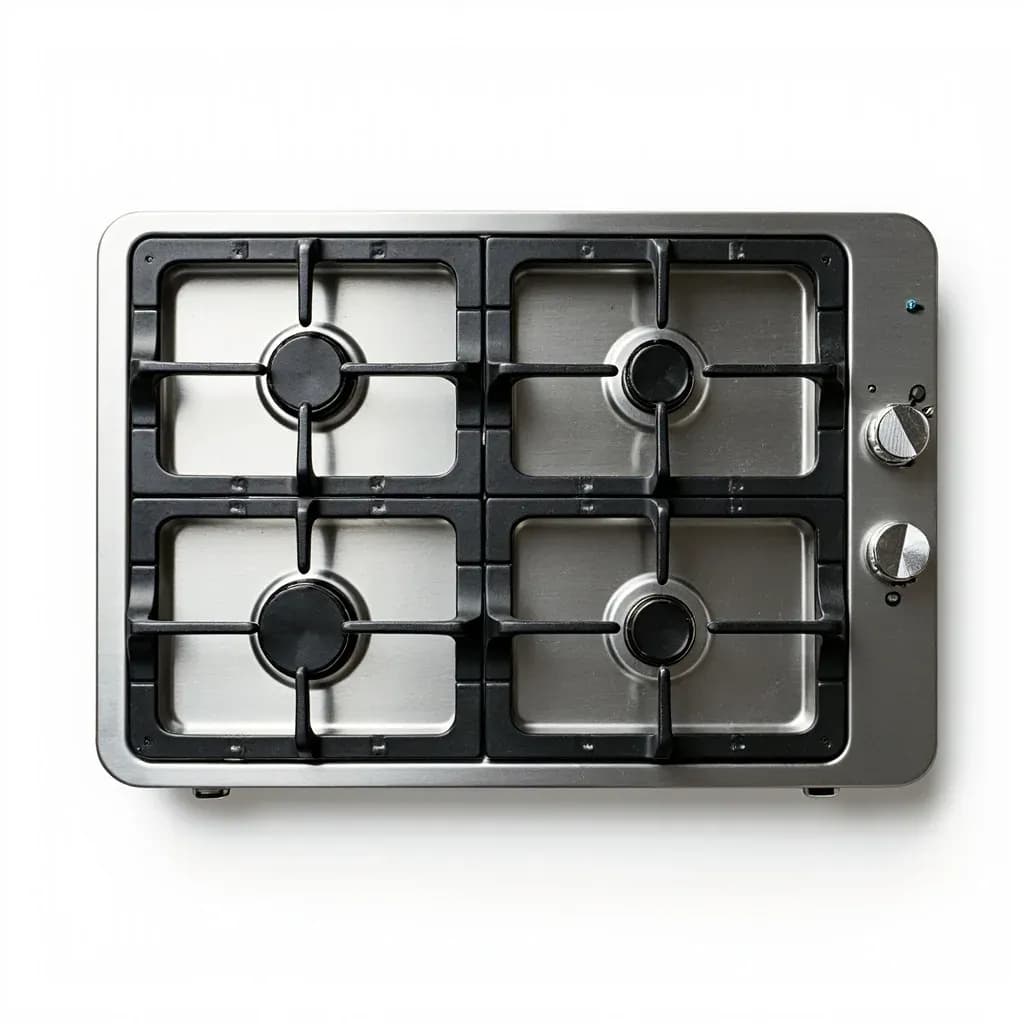
Gas Cooktop
A countertop set of open gas burners that heat pots and pans with a live, instantly adjustable flame.
A gas cooktop is a flat hob with one or more open burners fed by natural gas or bottled LPG. Cooks light a burner and place cookware directly over the flame, prizing the instant, visible heat control for sauteing, searing, simmering, and stir-frying. Compact two-burner cylinder models are common in homes without piped gas.
Gas cooktops remain the workhorse of restaurant lines and the preferred surface of a great many serious home cooks for one reason the alternatives cannot match: the cook can see the heat. The burner produces a live flame that responds the instant the knob turns — full power in a quarter-turn, a bare whisper of blue when the knob is barely cracked, and every gradient in between. That visual feedback, more than any BTU number, is what makes gas feel intuitive after even a single cooking session.
Physically, gas is a partial step backward from induction in efficiency: a flame that has to leap across an air gap to reach the pan loses roughly a third of its energy to the kitchen as combustion byproducts and hot air. What is traded in efficiency is gained in versatility. Any pan material works — cast iron, carbon steel, copper, aluminum, enameled steel — and no electronics package will reject a warped skillet or refuse a flaming flambé. The trade-off requires good ventilation, because the open flame produces carbon monoxide, nitrogen oxides, and fine particulates that a recirculating hood cannot meaningfully remove.
Choosing a cooktop comes down to matching total heat output and burner layout to the way you cook. A 30-inch residential unit typically delivers 30,000–40,000 BTU/h across four burners — adequate for most weeknight cooking. A 36-inch pro-style unit with a 15,000–25,000 BTU/h wok burner can exceed 60,000 BTU/h and gives the muscle for serious stir-frying, searing, and stock-making. The single most underrated feature is a true low-BTU simmer burner (600–1,200 BTU/h); without one, the lowest setting on a standard burner is often still a vigorous simmer, and delicate work like hollandaise or poached fish becomes a fight.
Alternatives
Types & varieties
Burner cap and head are a single sealed unit — spills stay on top of the cooktop rather than dripping into the burner. Easier to clean; the dominant design on most modern residential models.
Burner ports are open to the cooktop and spills drop into a recessed bowl. Favored on many pro-style units for higher heat output and faster boil times, but messier to maintain.
Inner and outer flame rings operate independently, giving a true simmer-to-sear range on a single burner.
A single oversized burner, usually 15,000–25,000 BTU/h, paired with a grate shaped to cradle a round-bottom wok. Found on pro-style ranges from makers such as Wolf, BlueStar, DCS, and Capital.
Heavier cast-iron grates, higher BTU output, stainless finish, available in 30"–60" widths; heavier than standard units and typically require a 120V electrical line for ignition and lighting.
A countertop-mounted unit with its own frame, independent of any wall oven. The standard format for built-in kitchens.
Configurable tops that combine gas burners with a griddle, grill, or French top in interchangeable modules.
Reading the Flame
The flame is the cooktop's instrument panel, and learning to read it changes the way you cook. A properly adjusted gas burner produces a sharp, steady inner cone of pale blue with a softer blue mantle wrapping it. The tips of the inner cones should just touch the bottom of the pan — any flame that licks up the sides of the pot is wasted gas scorching handles and depositing soot on stainless steel. A flame with persistent yellow or orange tips means incomplete combustion: usually the air shutter is closed too far, or the burner ports are clogged and choking off the air supply. A flame that lifts off the burner ports and roars, by contrast, has too much air — the air shutter is open too far. Both problems are corrected with small adjustments to the air shutter (a small lever or screw at the burner base) or, more commonly in the home, with a thorough cleaning of the burner head and ports.
- Inner blue cones should reach the pan bottom, not the pan walls.
- Yellow tips almost always mean clogged ports or an air shutter closed too far — clean with a toothpick or dry stiff brush, never by soaking sealed caps unless the manufacturer approves.
- A lifting, roaring flame usually means the air shutter is open too far; close it in small increments until the flame settles back onto the ports.
- Soot-streaked bottoms on stainless pans are flame creep, not poor cookware quality — trim the flame to the pan and the deposits stop.
Common uses
Tips & pitfalls
- Size the flame to the pan: a flame that licks up the sides of the pot is wasting gas and scorching handles — the tips of the inner blue cones should just reach the pan bottom.
- Light the burner the instant you turn the knob on; if it fails to ignite, turn the knob off and wait a full minute before retrying so unburned gas does not pool.
- Persistent yellow flame tips mean clogged burner ports. Clean with a toothpick or a stiff dry brush — do not soak sealed burner caps unless the manufacturer says it is safe, because water can block the small gas ports and cause uneven ignition.
- For a true bare simmer (hollandaise, custards, poached fish), use the inner ring on a dual-stacked burner, or set a flame-tamer/diffuser over the grate — a low-BTU simmer burner is a feature worth paying extra for.
- A round-bottom wok belongs on a proper wok grate set low, with the burner turned high; on a flat grate over a standard burner it will tip and underperform.
- Let the grates cool fully before washing — thermal shock can crack porcelain enamel. Cast-iron grates benefit from a thin film of oil after drying to resist rust and hold heat more evenly.
- If you smell rotten eggs, that is mercaptan (the odorant added to gas) — shut the knob off, ventilate, and do not operate light switches; call the gas utility from a phone outside the house.
- Install a range hood that vents outside. Recirculating charcoal hoods will not remove carbon monoxide or fine combustion particles.
Good to know
- Also called
- Gas hob (UK/EU), gas range top, gas stove top
- Fuel
- Natural gas or propane (LPG)
- Typical residential burner output
- 5,000–12,000 BTU/h per burner; high-output burners 15,000–20,000+ BTU/h; true simmer burners 600–1,200 BTU/h
- Standard configurations
- 2, 4, 5, or 6 burners; 30" and 36" widths are most common in U.S. homes
- Common surface materials
- Stainless steel, porcelain-enameled steel, black glass-top with sealed burners
- Flame color cue
- Crisp blue cone = complete combustion; persistent yellow or orange tips signal clogged ports or an air–gas mixture that needs adjustment
- Ventilation requirement
- Range hood venting to the outside (or a downdraft system for islands) — combustion produces carbon monoxide and fine particulates that recirculating filters will not remove
- Ignition
- Electronic spark (piezo or battery) on modern units; standing pilot lights are largely obsolete for safety reasons
Also called
Gas Stovetop · Gas Hob · Two-Burner Gas Cooktop · Two-Burner Gas Plate · Gas Cylinder Cooktop · Hob
Related

Stovetop
The everyday burners where most cooking actually happens

Oven
Enclosed dry heat for roasting, baking, and braising

Grill
Live-fire or gas grates for char, smoke, and high heat

Smoker
Low, slow heat and wood smoke for barbecue and brisket

Air Fryer
Countertop convection that crisps with little or no oil

Slow Cooker
Set-and-forget low heat for stews, beans, and braises

Pressure Cooker
Sealed steam pressure that cooks tough food in a fraction of the time

Rice Cooker
Foolproof, perfectly steamed rice every single time