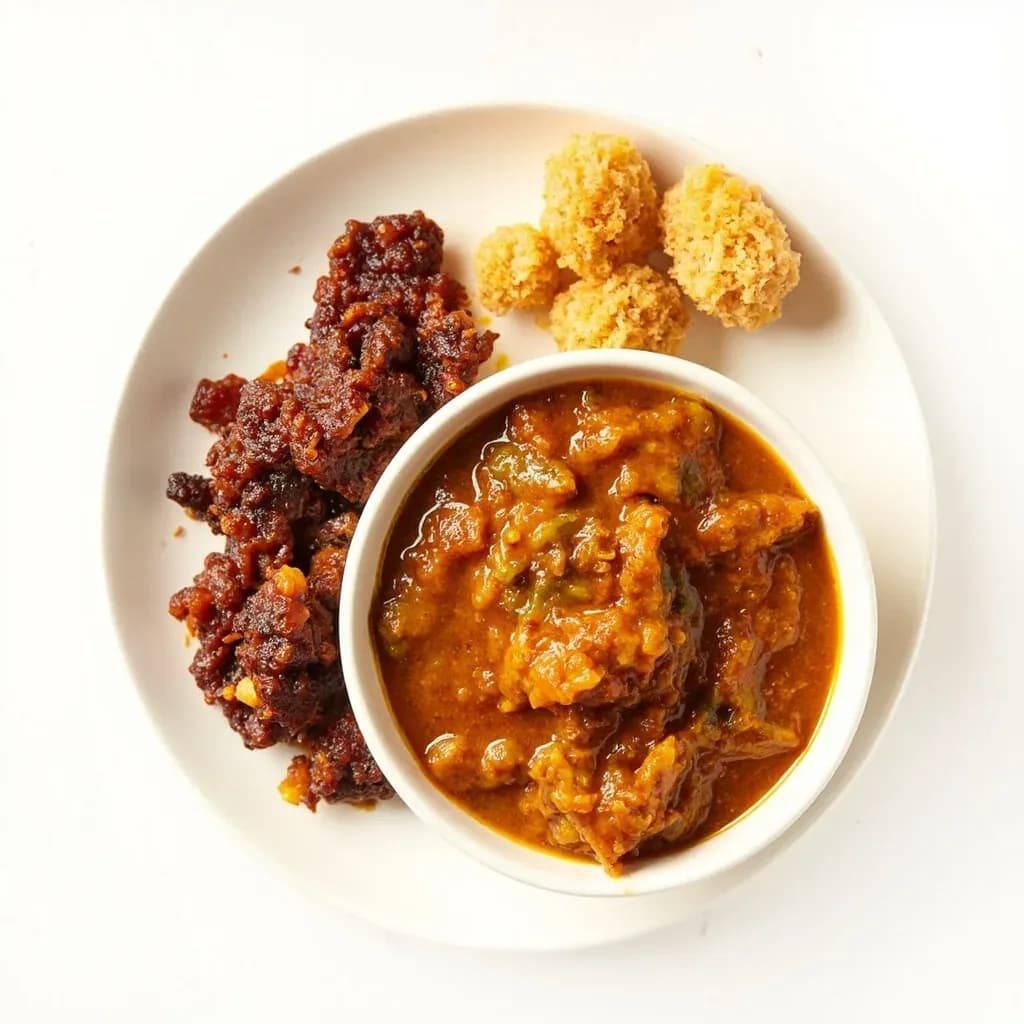
Transform & Preserve
Ambol (Tamarind Sour-Sweet Finish)
Sri Lankan technique of finishing a dish with tamarind for a balanced sour-sweet tang.
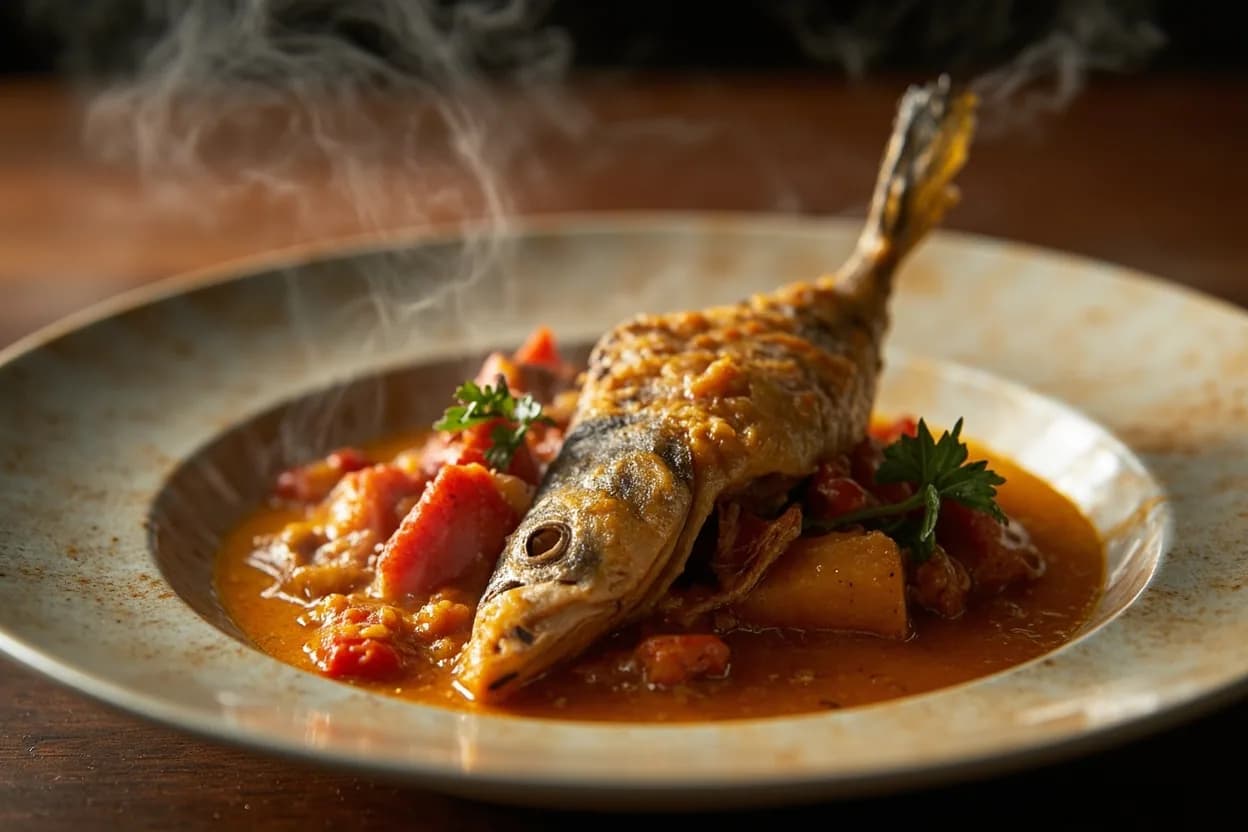
Ambol souring is the Sri Lankan practice of building a sour-sweet finish, typically with tamarind pulp balanced against jaggery or sugar and chili. The acid brightens curries and relishes and balances rich coconut bases, and it is added late so the fresh tang is not cooked away. It defines the flavor profile of dishes like fish ambul thiyal.
Ambol — Sinhalese for 'sour' — is the decisive final move that gives a Sri Lankan curry its bright, rounded finish. Rather than building sourness into a dish from the start, the Sri Lankan cook layers flavor through coconut milk, curry leaves, pandan, and roasted spices, then closes the dish with a measured dose of tamarind tempered by palm jaggery and salt. The result is a sauce that tastes lifted rather than heavy: the gravy thins perceptibly, aromatics re-emerge, and the curry reads as a single coherent note.
What separates ambol from generic souring is its insistence on balance. Tamarind is never added alone; it arrives in dialogue with a sweetener (traditionally kitul jaggery) and a final pinch of salt, and the cook tastes, waits, and re-tastes until the three register as one. Because tamarind's sharper edges mellow on contact with warm coconut milk, the technique is almost always a finishing gesture — added in the last three to five minutes, off the heat or on the barest flame — so the fruit's floral depth survives and the sauce does not split. Treat it as a seasoning rather than an ingredient, and you begin to understand why a good Sri Lankan curry tastes the way it does.
Ambol is conceptually close to the Sindhi 'imbho' sweet-sour finish and to Burmese tamarind souring, but it is distinctively Sri Lankan in its reliance on tamarind-plus-jaggery and in its frequent pairing with coconut-milk curries. It is also frequently confused with thiyal, which is a wholly different dark, dry-roasted sour curry; the two techniques should never be substituted for one another.
- Difficulty
- Easy
Types & varieties
The most common form; made from seedless tamarind block or concentrate soaked in warm water.
Uses dried Garcinia gummi-gutta slices; gives a deeper, more resinous sourness typical of fish curries.
A brighter, fresher finish used when a quick citrus lift is preferred over tamarind's rounded tang.
Unripe mango slices cooked down; more common in northern Sri Lankan vegetable preparations.
A gentler, fragrant version used for delicate seafood or white fish curries.
How to do it
- 1
Soak the tamarind
Place 1 tablespoon of seedless tamarind block (or 1 teaspoon concentrate) in a small bowl and add 4–5 tablespoons of warm water. Let it sit for 5 minutes, pressing with the back of a spoon to release the pulp.
- 2
Strain the pulp
Push the mixture through a fine-mesh strainer into a clean bowl, pressing to extract as much liquid as possible. Discard the fibrous solids. You should have a smooth, dark amber liquid.
- 3
Prepare the sweetener
Grate or shave 1–2 teaspoons of kitul (kithul) jaggery, or use palm sugar or unrefined cane sugar. Dissolve it in a tablespoon of warm water so it disperses quickly in the curry.
- 4
Reduce heat to low
Bring the curry to a gentle simmer — never a rolling boil — as you prepare to finish. Coconut-milk curries should be barely steaming to prevent splitting.
- 5
Add the tamarind
Stir the strained tamarind water into the curry in a slow, steady stream. Fold it through rather than agitating, especially with coconut-based sauces.
- 6
Balance with sweetener and salt
Add the dissolved jaggery, then taste. The aim is a clear, rounded tang where no single element dominates. Adjust salt in small pinches until the sour-sweet-salty trinity reads as one note.
- 7
Rest and re-taste
Remove from heat, cover, and let the curry rest for 1–2 minutes. Taste again — the ambol should be bright but not sharp, present but not heavy. Add a final splash of tamarind water or a few drops of jaggery syrup if needed before serving.
Ambol vs. Thiyal: A Common Confusion
Writers and cooks alike sometimes use these terms interchangeably, but they describe two very different techniques. Ambol is a finishing adjustment — a strained liquid stirred into an already-cooked curry to brighten and balance it. Thiyal, by contrast, is a category of curry in which the souring agent (usually goraka or tamarind) is dry-roasted with spices and coconut, producing a dark, thick, almost dry dish that keeps for days. Substituting one for the other changes the entire character of the meal.
- Ambol = finishing liquid, added at the end, bright and balanced.
- Thiyal = a full curry method with dry-roasted souring agent, dark and long-cooked.
- The two share tamarind or goraka as an ingredient, but never the role they play.
The Sour-Sweet-Salty Trinity
An ambol that tastes only of tamarind is a failed ambol. The technique rests on a three-way balance tasted for at the very end of cooking. The sour opens the palate, the sweet rounds off the acid's sharp edges, and the salt lifts both into the other flavors of the curry. Skip any one of the three and the finish will read as flat, harsh, or cloying.
- Sour: tamarind water, strained smooth, added in small amounts.
- Sweet: dissolved kitul jaggery or palm sugar, added to taste.
- Salt: a final pinch, adjusted only after the sweet and sour have settled.
When Not to Use Ambol
The technique is forgiving but not universal. Heavy slow-braised meats, deeply roasted dhal preparations, and any dish built on dark caramelization rarely need a final sour lift — their flavor is already dense enough. Equally, a curry that has been aggressively boiled after the tamarind goes in will taste harsh and may have split its coconut milk. Reach for ambol when a curry smells right but tastes muted, when the gravy has dulled from reheating, or when a coconut-milk base feels heavy on the tongue.
- Best for: coconut-milk hodi, seafood curries, dhal, reheated leftovers.
- Skip for: thiyal-style dry curries, long-braised dark gravies, anything already dominated by tamarind.
Common uses
Tips & pitfalls
- Add tamarind water only in the final 3–5 minutes; prolonged cooking turns the acidity harsh and can tip the sauce toward bitterness.
- Always pair the acid with a sweetener and a final pinch of salt — ambol without balance is just sour.
- Strain tamarind water through a fine-mesh sieve to remove fibers and any seed fragments that would otherwise muddy the sauce.
- If using tamarind concentrate, dilute roughly 1:4 with warm water before adding — concentrates vary wildly in strength.
- Taste, then wait 30 seconds before re-adjusting; tamarind's sharpness softens as it mingles with the curry.
- For a cleaner finish, add tamarind off the heat and let residual warmth carry it through — useful for coconut-milk curries that split if boiled aggressively.
- If a dish has gone too sour, a small spoonful of jaggery or a splash of coconut milk will rescue it; if too sweet, a few drops of lime will rebalance.
- Do not substitute vinegar — it lacks tamarind's fruity-floral depth and the trace sweetness that defines ambol.
Good to know
- Origin
- Sri Lanka; the Sinhalese term ඇම්බල් (ambul) literally means 'sour'
- Stage of cooking
- Final 3–5 minutes, off-heat or on very low heat
- Primary souring agent
- Tamarind (siyambala) pulp, sometimes goraka (Garcinia gummi-gutta)
- Balancing sweetener
- Palm jaggery (kitul or kithul), kitul treacle, or unrefined cane sugar
- Flavor target
- A bright tang tempered by sweetness and salt — never one-note sharp
- Texture effect
- Thins the gravy slightly and lifts aromatics without thickening
- Equipment needed
- Small bowl, fine-mesh strainer, whisk or spoon
- Time required
- About 5 minutes from pulp to finished finish
Also called
Ambol · Tamarind Souring · Ambol Souring
Dishes that rely on it
Related

Confit
Cook slowly submerged in fat for silky tenderness and keeping

Cure
Draw out moisture with salt and time to preserve and concentrate

Pickle
Steep in acidic brine for bright, tangy, crunchy preservation

Ferment
Let friendly microbes transform food into tangy, complex flavor

Marinate
Soak in a seasoned mix to flavor and tenderize before cooking

Brine
Soak in salt water so meat stays juicy and seasoned throughout

Dehydrate
Slowly dry out moisture to concentrate flavor and extend shelf life

Cold-Smoke
Perfume cured food with smoke without cooking it through