Prep & Assembly
Baguette Shaping
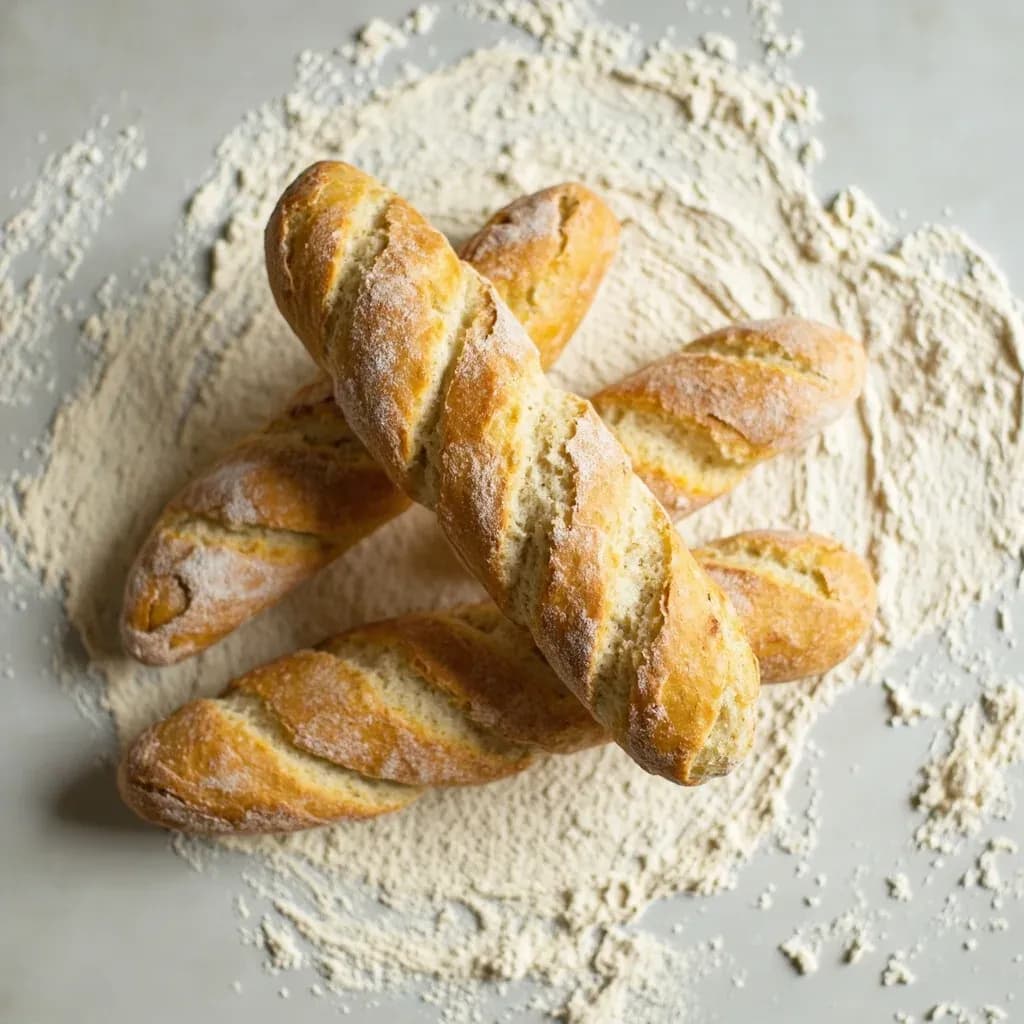
Rolling and tapering pre-shaped dough into a long, even baguette with tight surface tension.
Baguette shaping turns a rested rectangle of dough into a long, slender loaf by folding it over itself and rolling to seal a taut skin, then tapering the ends. The surface tension created during shaping holds the loaf's form and helps it spring and score cleanly in the oven. Even pressure along the length keeps the diameter consistent.
Baguette shaping is the final manipulation of fermented lean bread dough that turns a generic piece of dough into the long, slender, evenly tapered loaf that defines French bread. It happens after bulk fermentation and a pre-shape, and its job is to create a tight, glossy surface 'skin' that holds the loaf's form during final proof and springs vigorously in the oven. Good shaping is what allows the loaf to open cleanly along the grignes (the diagonal slashes) rather than cracking unpredictably, and it preserves the irregular, open crumb that baguette dough spent hours developing.
The technique is more delicate than it appears because two opposing forces are in play. The dough wants to relax back toward a ball once the bench rest is over, while the baker wants to elongate and tighten it into a long cylinder. Handle too gently and the loaf spreads flat in the oven; handle too aggressively and you deflate the gas pockets you've spent the previous eight to twenty-four hours building. The classic motions — a pre-shape, a short bench rest, a letter fold, then rolling from the center outward with cupped palms — exist to thread that needle.
A well-shaped baguette ends thickest at the center and tapering to clean points, with a sealed seam running along the bottom. It rests seam-down in a heavily floured couche or on a perforated baguette pan for final proof, then is scored with a lame and baked in a very hot, steamy oven. The same fundamental motions produce everything from a full-length classique to a thin ficelle, a twisted torsade, or a fanned épi.
- Difficulty
- Hard
Types & varieties
The standard long, evenly tapered loaf with 5–7 diagonal grignes; the everyday French sandwich and breakfast bread.
Half-length version, about 25–30 cm; common for home ovens because a single loaf fits a sheet pan or small stone.
Thinner, longer baguette ('string'); shaped from a smaller piece of dough, more delicate, and dries out faster after baking.
Slightly shorter and thicker than a baguette, often with a squarer cross-section; shaped the same way but rolled less.
Legally defined loaf made on premises from flour, water, salt, and yeast only; no frozen or ready-baked dough permitted.
A baguette cut on a steep angle and fanned sideways on the pan to resemble a stalk of wheat; built from a single shaped baguette.
Two strands of dough twisted together and folded; same shaping steps followed by a twist and pinch at each end.
A baguette baked with one lengthwise split rather than diagonal grignes; made by a single long slash down the center.
How to do it
- 1
Pre-shape into rough logs
Turn fermented dough onto a lightly floured surface. Gently press out the largest gas pockets without deflating the dough, then fold the sides toward the center and roll, seam-side down, into a rough cylinder about 12–15 cm long for a full baguette (8–10 cm for a demi). Do not elongate fully at this stage; just establish an even thickness and mild surface tension.
- 2
Bench rest
Place pre-shaped logs seam-side up on a lightly floured surface or tray, cover loosely with a linen couche or plastic, and rest 15–30 minutes. The dough should relax and spread slightly; if it springs back hard when pressed, give it another 5–10 minutes.
- 3
Flatten and fold
Set one rested log seam-side up. Using your fingertips or the heel of your hand, gently press and stretch it into a rough rectangle about 10–12 cm wide for a full baguette, with a short edge facing you. Fold the top third down toward you, then the bottom third up, like folding a letter. Press the seam closed lightly with the heel of your hand.
- 4
Roll and elongate from the center
Seam-side down, cup the loaf with both hands, palms on the top. Starting at the center, roll forward and back with even pressure while sliding your hands outward. Work in short, repeated passes, never stretching more than the dough will allow without tearing. Continue until the loaf reaches about 35–40 cm for a full baguette, or 20–25 cm for a demi.
- 5
Taper the ends
With each pass, apply slightly more pressure and a longer stroke toward the ends than at the center, so the loaf is thickest in the middle and narrows to clean points. The tips should be roughly half the thickness of the center — not pinched off and not bulging like a sausage.
- 6
Seam and set in a couche
Pinch the seam closed along the bottom, then flip the loaf seam-down into a floured fold of a couche, or onto a perforated baguette pan seam-down. If using a couche, tuck the edges of the linen between adjacent loaves to keep them upright and separate.
- 7
Final proof
Cover and proof at room temperature (or retarded cold for more flavor) until the dough is puffy, holds its shape when gently lifted, and shows a slight dome on top — typically 45–75 minutes at about 24°C / 75°F for dough shaped straight from the bench. The loaf should still feel slightly firm on the surface; if a floured finger leaves a deep dent that does not recover, it is over-proofed.
- 8
Score and bake
Transfer a proofed loaf to a peel, pan, or stone, seam still down. With a lame or sharp razor, make 5–7 quick diagonal slashes along the top at about 20–30°, each stroke overlapping the previous one by roughly one-third. Load immediately into a very hot oven (240–250°C / 465–480°F) with steam for the first 10–15 minutes.
Surface tension: the whole point of shaping
Every motion in baguette shaping — the pre-shape, the letter fold, the rolling, the pinching of the seam — exists to build a smooth, taut skin on the outside of the loaf. That skin is what keeps the baguette from flattening sideways during its final proof and what controls where it splits in the oven. The grignes open because the surface around them is under even, balanced pressure; if one section is loose, the loaf cracks there instead and you get a ragged, ugly top. Tension comes from rolling with cupped palms, sealing the seam firmly, and never letting the dough sit uncovered so a dry skin forms. Cool, rested dough (around 60–65°F / 15–18°C) holds tension far better than warm, sticky dough, which is why many bakers chill the dough briefly between pre-shape and final shape.
- Cupped palms, not flat hands, create the gentle, even pressure that builds skin without tearing.
- The seam on the bottom is the closed side; the smooth, tensioned side goes up.
- A short, gentle slap of the shaped loaf against the floured counter can even out the surface, but only if tension is already good.
- Dry air during final proof produces a leathery skin that cracks unpredictably — cover shaped loaves with a couche flap or plastic.
Reading a well-shaped loaf
Before proofing, a properly shaped baguette should look like a smooth, symmetrical cigar: a fat middle that gradually narrows toward clean, pointed tips; no visible holes, dimples, or tears on top; and a tight seam along the underside. Press the side gently with a floured finger — it should dent slowly and the mark should mostly relax within a second or two. If the loaf feels slack and your finger leaves a deep impression, it is over-proofed and will spread in the oven. If it feels rock-hard and springs back instantly, it needs more time. After baking, the truest test is the ear: the grigne nearest the tip should rise into a thin, crispy flap, which only happens when surface tension and oven spring are both doing their job.
Common uses
Tips & pitfalls
- Pre-shape first and give the dough a 15–30 minute bench rest before final shaping; relaxed dough elongates without snapping back, and skipping the rest produces stubby, tight loaves.
- Keep the work surface and your hands lightly floured, never the dough itself — flour on the dough's surface kills the tension you are trying to build.
- Roll from the center outward with both hands, finishing each pass by walking your fingers toward the ends to draw out a clean taper rather than a thick, rounded bullet shape.
- Apply slightly more pressure at the tips than at the middle on each pass; the loaf should be thickest at center and roughly half that thickness at the points.
- Seal the final seam by pinching gently and place the loaf seam-down in the couche or on the pan — the smooth, tensioned side goes up where the grignes will be cut.
- Common mistake: over-handling the dough, which deflates gas pockets and produces a dense, tight crumb even though the loaf may look tidy on the outside.
- Common mistake: skipping the bench rest, so the gluten stays tight and the loaves shrink back in the oven instead of springing tall.
- Common mistake: leaving shaped loaves uncovered during final proof, which forms a dry skin that cracks unpredictably and ruins the ear.
Good to know
- Technique type
- Final shaping of fermented lean bread dough into a long, thin loaf
- Origin and legal definition
- Standardized in 20th-century France; the 'baguette de tradition française' is defined by the 1993 Décret Pain as made on premises with only flour, water, salt, and yeast
- Traditional weight
- About 250 g (8.8 oz) per full loaf
- Traditional length
- Roughly 50–65 cm (20–26 in); home demi-baguettes run 25–30 cm (10–12 in)
- Hydration range
- Often 65–75% water to flour; higher-hydration doughs need gentler handling
- Slashes (grignes)
- 5–7 quick diagonal cuts with a lame, at 20–30°, made just before loading the oven
- Active time
- 2–5 minutes per loaf once pre-shape and bench rest are done
- Difficulty
- Moderate; shaping improves markedly with repetition and a cool dough
Also called
Shaping Baguettes
Related

Whisk
Beat ingredients smooth and aerated with a looping wire motion

Sift
Pass dry ingredients through mesh to aerate and remove lumps

Strain
Pour through mesh to separate solids from liquid for a smooth result

Filter
Pass liquid through fine material to clarify out the smallest particles

Rice
Press cooked potatoes through small holes for fluffy, lump-free texture

Mash
Crush soft cooked food into a rustic, creamy purée

Grind
Crush food into a coarse to fine texture, from spices to meat

Grate
Shred food into fine bits against a sharp-toothed surface