Prep & Assembly
Bench Rest
Letting pre-shaped dough relax on the bench so it shapes without tearing.
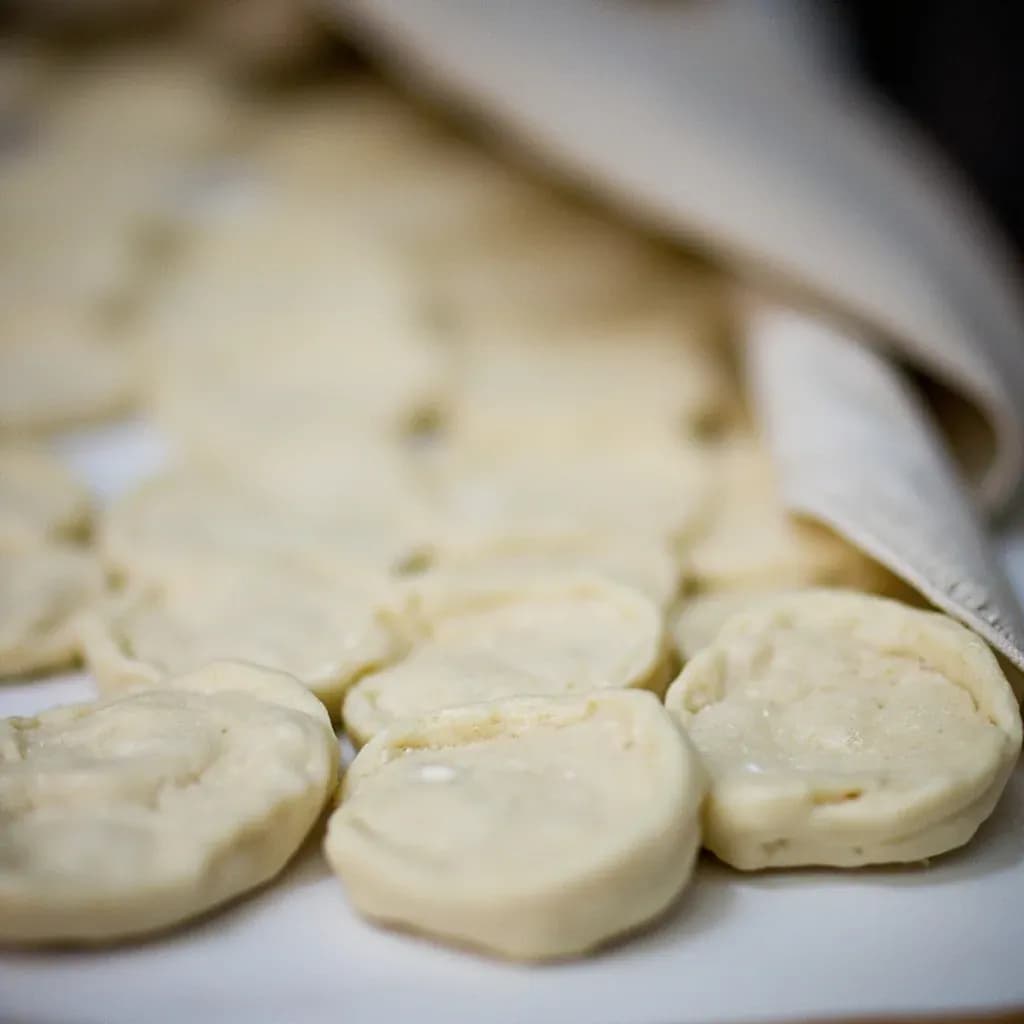
Bench rest is a short pause after dividing and pre-shaping dough, leaving the rounds covered on the work surface for ten to twenty minutes. The rest relaxes the gluten so the dough stretches into its final shape without springing back or tearing. It is a key step between pre-shaping and final shaping in bread making.
A bench rest is the deliberate, passive wait a baker gives dough after it has been divided and shaped but before it goes into the oven (or into its final cold retard). During shaping, the gluten network is pulled tight; if that tension is not allowed to relax, the dough fights back — seams tear when you try to transfer it, rolls slump, and baguettes shrink in length. A few minutes to an hour or more on the bench lets the gluten strands settle into a state where the dough holds its form without resistance.
The rest is doing two distinct jobs depending on how long it runs. A short rest of 5–15 minutes is purely a relaxation step, buying just enough time for gluten to ease so the piece can be handled cleanly. A longer bench rest of 30 minutes to 1.5 hours, often used with cool sourdoughs or when the bulk fermentation was deliberately cut short, doubles as the final proof itself, with the yeast finishing its work at room temperature rather than in the fridge.
Bench rest sits between bulk fermentation and the final proof (or the oven) in the bread timeline, and it is one of the most under-explained steps in home baking. Get it right and you get cleaner seams, better oven spring, and a more open crumb; skip it or rush it and you fight the dough at every subsequent step. The technique also shows up in viennoiserie and pizza work, wherever shaped dough needs to calm down before it is asked to do something delicate.
- Difficulty
- Easy
Types & varieties
5–15 minutes on the bench, just long enough for gluten to ease so seams don't tear on transfer. The most common form in home baking.
30 minutes to 1.5+ hours at room temperature; used when the bulk was slowed (cold bulk or short bulk) and the bench rise finishes the proof. Standard for many artisan loaves.
Shaped loaves held on a couche or parchment in a cool spot, or briefly chilled, to firm up before scoring and to slow yeast so cuts stay open and clean.
Long, slender loaves nestled seam-up in a heavily floured linen couche for 30–60 minutes; the couche wicks surface moisture and physically supports the shape.
Divided dough balls rested 15 minutes to over an hour under plastic or in dough boxes so they relax into an extensible, stretchable state.
How to do it
- 1
Final-shape the dough
Final-shape the divided pieces into loaves, rolls, or balls using the recipe's technique. Handle the dough gently so you do not deflate more air than the recipe intends to keep.
- 2
Set seam-side on the prepared surface
Place each shaped piece seam-side down (or curl-side down for rounds) on a lightly floured bench, parchment, or couche. For baguettes and batards, seam goes up inside the folds of a floured couche.
- 3
Cover to prevent a skin
Drape loosely with plastic wrap, a lightly damp kitchen towel, or close a proofing box lid. The cover should not press into or deform the dough's surface.
- 4
Rest at room temperature
Leave undisturbed for 5–15 minutes for a simple relaxation rest, or 30 minutes to 1.5+ hours if the bench rise is acting as the final proof. Adjust for dough temperature, hydration, yeast activity, and room warmth.
- 5
Check readiness
For a short rest, the dough should feel supple and no longer spring back when lifted. For a full bench proof, use the poke test: a floured finger pressed about half an inch in should leave a dent that slowly and only partially fills back in.
- 6
Transfer, score, and bake
Move the rested dough to a banneton, parchment sling, peel, or sheet as the recipe requires. Score immediately before loading if the loaf calls for it, then bake straight away or move to a cold retard.
Common uses
Tips & pitfalls
- Cover the shaped dough. A dry skin forms in minutes under a fan or in a drafty kitchen, and once it does the surface tears when you try to score or stretch it later.
- Time the rest by feel, not the clock. A soft poke that leaves a slow, partial rebound is the more reliable signal of end-of-proof on the bench, especially for sourdoughs running on their own schedule.
- Do not over-flour the bench. Excess flour gets folded into seams, burns dark in the oven, and leaves pale streaks on the crust. Reach for rice flour or a couche with wet doughs instead.
- For sourdoughs bulk-fermented cool, plan on a longer bench proof — often 45 to 90 minutes. Wild yeast is markedly slower than commercial yeast at room temperature.
- If shaping tension keeps snapping the dough back, give it a longer rest and re-shape rather than forcing it. Tearing at this stage creates rough, gluey seams and a tighter crumb.
- Keep pieces out of drafts and direct sun. Uneven temperature over-proofs one side while the other stays under, leading to lopsided rise and crooked oven spring.
- Score immediately after the bench rest, before the surface dries and the dough relaxes so far that cuts no longer open cleanly in the oven.
- In a hot kitchen, shorten the bench rest or move the dough to a cooler spot. Over-proofed bench loaves collapse on the peel or spread flat in the oven, costing you both height and crumb.
Good to know
- Other names
- Intermediate proof, intermediate rest, shaping rest, short proof
- Position in workflow
- After dividing and pre-shaping/final shaping, before the final proof, cold retard, or oven
- Short-rest duration
- 5–15 minutes for gluten to relax after shaping
- Full bench-proof duration
- 30 minutes to 1.5+ hours at room temperature, depending on dough and yeast activity
- Ideal room temperature
- 20–24°C / 68–75°F; cooler slows it, warmer speeds it up
- Covering
- Loosely with plastic wrap, a lightly damp towel, a couche, or a proofing box lid to prevent a skin
- Surface
- Lightly floured bench, parchment, or a floured linen couche; very wet doughs need a couche rather than a flat surface
- Dough type suitability
- Most enriched and lean yeasted doughs; not used for laminated doughs between single folds, which get a short 30–60 minute chill instead
- Common confusion
- Distinct from bulk fermentation (first rise) and from the cold retard in the fridge
- Difficulty
- Beginner-friendly; timing is the main variable
Also called
Bench Proof · Intermediate Proof
Related

Whisk
Beat ingredients smooth and aerated with a looping wire motion

Sift
Pass dry ingredients through mesh to aerate and remove lumps

Strain
Pour through mesh to separate solids from liquid for a smooth result

Filter
Pass liquid through fine material to clarify out the smallest particles

Rice
Press cooked potatoes through small holes for fluffy, lump-free texture

Mash
Crush soft cooked food into a rustic, creamy purée

Grind
Crush food into a coarse to fine texture, from spices to meat

Grate
Shred food into fine bits against a sharp-toothed surface