
Knife Skills
Batonnet
Cut into tidy sticks, thicker than julienne — think classic fries
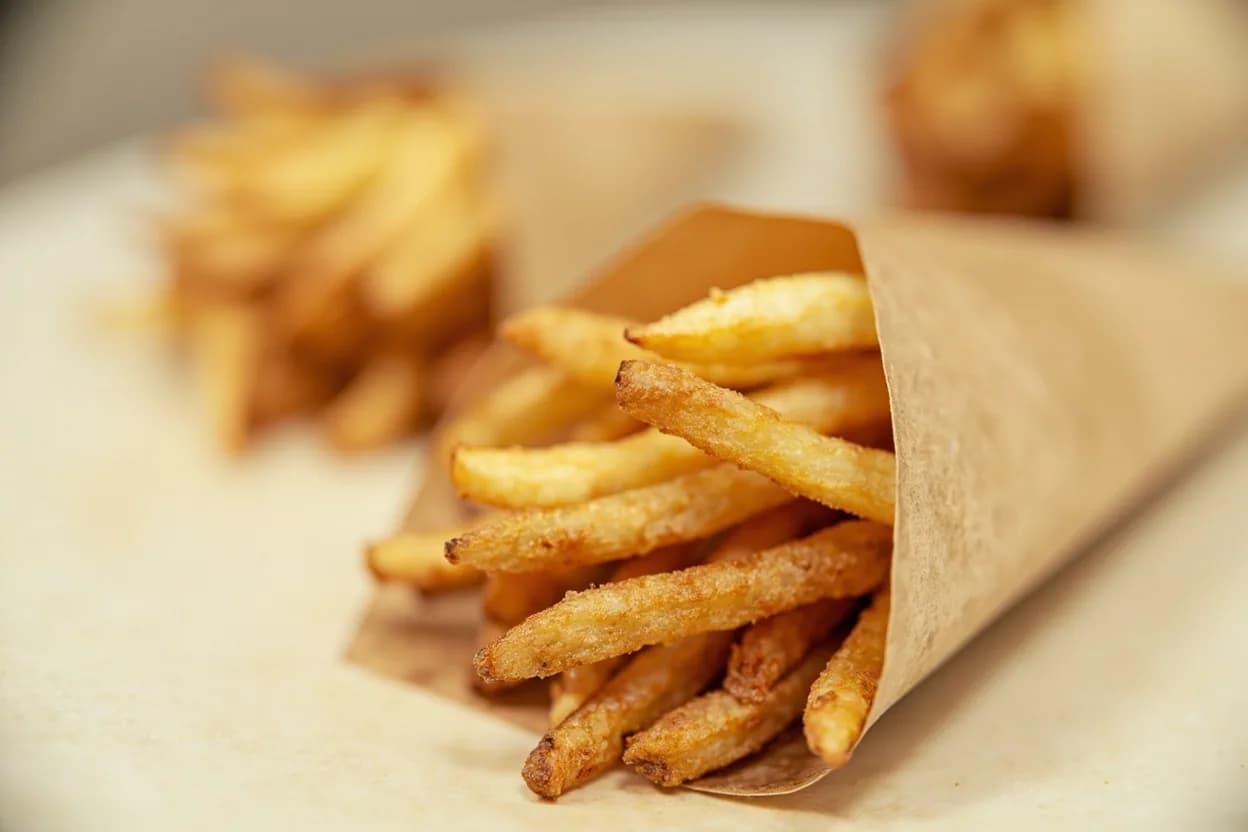
Batonnet cuts food into uniform sticks, larger than julienne, the size of a classic French fry. It's the cut for crudités and pommes frites, and the starting point for a medium dice. Square off the vegetable first so every stick comes out the same length and thickness.
Batonnet is the classical stick cut — uniform sticks larger than a julienne, roughly the size of a thick French fry (traditionally about 6 mm square and 5–6 cm long). It's the cut behind pommes frites and crudités, and the starting point for a medium dice (cut a batonnet crosswise and you get cubes). As with all the classical cuts, the secret is squaring off the vegetable first so every stick comes out the same length and thickness, which means even cooking and a clean, intentional look.
- Difficulty
- Intermediate
Types & varieties
Potato batonnet cut to fry size for classic French fries.
Carrot, celery, and cucumber batonnet for dipping.
Sticks cut crosswise into uniform medium cubes.
How to do it
- 1
Square off the vegetable
Trim the rounded sides into a clean rectangular block so the sticks come out uniform.
- 2
Cut even planks
Slice the block into planks about 6 mm thick — the width of your target stick.
- 3
Stack the planks
Lay the planks flat and stack a few to cut efficiently.
- 4
Slice into sticks
Cut down through the stack at 6 mm intervals to make even sticks.
- 5
Trim to length
Cut the sticks to a consistent length, around 5–6 cm.
- 6
Use or dice further
Cook the sticks as is, or cut them crosswise into a tidy medium dice.
Why square off first
Squaring the vegetable into a clean block before cutting is what makes batonnet (and brunoise and dice) uniform. Round, tapered edges produce uneven, oddly shaped sticks that cook at different rates and look haphazard. Trimming to a block wastes a little (save it for stock), but it's the difference between a precise, even cut and a ragged one. From a clean batonnet, a medium dice is just one more set of crosswise cuts.
Common uses
Tips & pitfalls
- Square off the vegetable for uniform sticks and even cooking.
- Save the trimmings for stock or purée.
- Keep planks and sticks stacked neatly for fast, even cuts.
- Soak potato batonnet in cold water before frying for crisper fries.
- A batonnet is your shortcut to a clean medium dice.
Good to know
- Cut size
- Sticks ~6 mm square, ~5–6 cm long (thicker than julienne)
- Best for
- Fries, crudités, and as the base for a medium dice
- Starts from
- Squared-off planks cut into sticks
- Grip
- Claw grip; square the vegetable first
- Leads to
- A medium dice when cut crosswise
Also called
stick cut · baton
Dishes that rely on it
Related

Chop
Cut into rough, irregular pieces — the everyday workhorse cut

Dice
Cut into uniform cubes for even cooking and a tidy look

Mince
Cut as fine as possible so flavor melts evenly into the dish

Slice
Cut into even, flat pieces for consistent cooking and presentation

Julienne
Cut into thin matchsticks for fast cooking and elegant garnish

Brunoise
Cut into tiny, precise cubes — the finest dice in the kitchen

Chiffonade
Roll and slice leafy greens into delicate ribbons

Tournée
Carve vegetables into seven-sided footballs — a chef's badge of skill