Prep & Assembly
Bowl Assembly
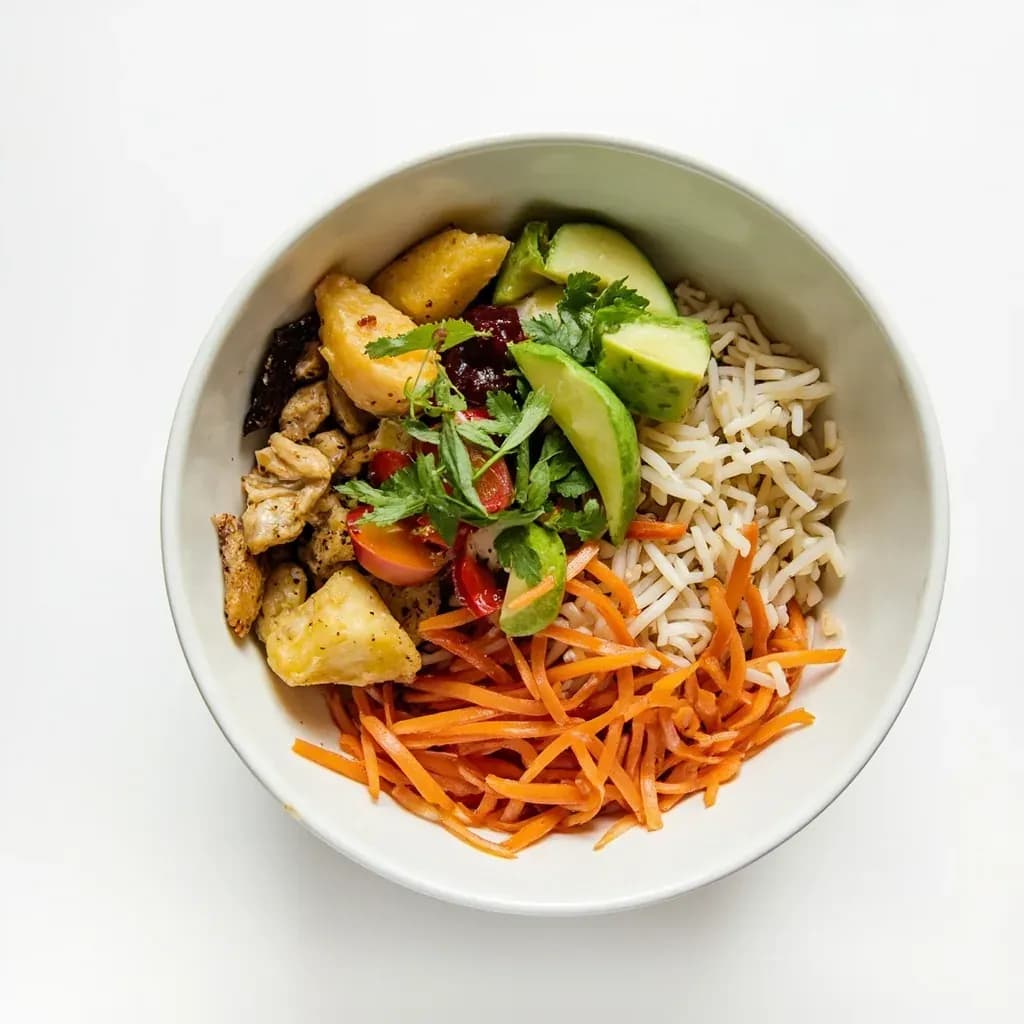
Composing and plating ingredients in a bowl with intention, as in Japanese moritsuke.
Bowl assembly arranges cooked and raw components in a bowl with deliberate placement for both appearance and eating order. The Japanese art of moritsuke treats this plating as a craft, considering height, color, and negative space. Thoughtful assembly keeps textures distinct and guides the diner through the dish. The goal is a composition that looks generous and intentional, not just a pile of food.
Bowl assembly is the practice of composing a meal in a bowl as an arrangement rather than a mixture, with each ingredient placed, not stirred. The technique draws from Japanese moritsuke (盛り付け), the disciplined art of arranging food so that color, season, shape, and negative space all carry meaning. A well-assembled bowl behaves like a small still life: the diner sees distinct sectors of grain, protein, vegetable, and accent before the first bite, and the act of eating becomes a guided tour rather than a scramble.
The reason the technique matters is that it preserves what cooking tends to destroy — texture contrast, temperature contrast, and the integrity of seasoned components. A grain that was seasoned with vinegar, a green that was dressed with acid, and a pickle that carries sweetness all lose their distinct voices the moment they are stirred together. Assembly keeps those voices audible. It also scales with remarkable grace: the same logic governs a five-component weekday grain bowl and a seven-element kaiseki course, differing only in restraint and refinement.
In practice, bowl assembly is one of the few plating disciplines where a home cook with a wide shallow bowl can match restaurant results. The cost is attention, not equipment. The gain is a meal that looks composed, eats with intention, and lets the diner choose how — or whether — to combine the parts.
- Difficulty
- Easy
Types & varieties
Classical Japanese food arrangement where components are placed, never mixed, with attention to color, season, and negative space. The foundation of the technique.
Single-bowl Japanese meal with rice as the base and toppings fanned in sectors — gyudon, kaisendon, oyakodon, tendon.
Scattered sushi bowl where vinegared rice is dressed with arranged sashimi, vegetables, and garnishes rather than rolled into pieces.
Korean rice bowl with seasoned namul and proteins arranged in wedges around the rim; gochujang is added and mixed at the table by the diner.
Hawaiian-origin bowl of seasoned raw fish over rice or greens, with crunchy vegetables, seaweed, and a finishing sauce.
Modern Western template: whole grain, leafy green, roasted vegetable, raw vegetable, protein, fat, and sauce.
Chinese Buddhist vegetarian bowl layering tofu, mushrooms, and seasonal vegetables, often served over rice or noodles.
Frozen blended fruit base topped in sectors with granola, sliced fruit, seeds, and coconut.
High-end Japanese course where small bowls hold individually placed seasonal items; the technical apex of bowl assembly.
How to do it
- 1
Choose the bowl
Select a wide, shallow bowl (15–20 cm) for composed builds where ingredients should remain visible; choose a deeper bowl for brothy or layered dishes such as ramen or bibimbap. Match material to temperature: pre-warmed stoneware for hot bowls, chilled ceramic for cold. A neutral interior lets the food read as the subject.
- 2
Prepare and season each component separately
Cook the grain, dress the greens, season the protein, marinate or pickle the vegetables, and finish any sauces before assembly begins. Each element should be ready to eat on its own — bowl assembly is final arrangement, not cooking. Bland rice or undressed greens will undermine an otherwise beautiful bowl.
- 3
Add the base
Spoon the grain (or greens, or noodles) into the bowl and spread it gently to an even layer. Do not press or compact; leave it loose so toppings sit on top rather than sinking. Season the surface of the base lightly if it will be the first bite — rice especially benefits from a final pinch of salt or a drizzle of seasoned liquid.
- 4
Place the protein
Position the protein off-center or in a defined sector — sliced fish fanned in a half-circle, tofu cut into slabs, meat in a neat row. If the protein is the visual hero (as in sashimi-heavy chirashi), place it first; otherwise let vegetables lead so the protein reads as one element among many.
- 5
Arrange vegetables in sectors
Group vegetables by color and texture into distinct wedges around the bowl rather than mixing them. Aim for three to five vegetable types covering a range of colors. Use varied cuts — julienne, dice, shaved, whole leaf — so the eye reads the sections as different even when colors repeat.
- 6
Add crunchy or textural accents
Sprinkle seeds, nuts, fried shallots, crispy chickpeas, or crumbled chips last so they remain crisp. These should sit on top, never buried. A small amount placed deliberately reads as garnish; a heavy scatter reads as topping.
- 7
Apply herbs, microgreens, and aromatics
Use fresh herbs, citrus zest, sliced scallion, or microgreens to introduce a final color note. Place them where they will be seen first — typically toward the center or front edge of the bowl, opposite the diner's dominant hand if the bowl has a clear orientation.
- 8
Finish with sauce
Drizzle sauce in a controlled line, dot it with a spoon, or serve it in a small side dish. For broths, pour at the table. Never let sauce pool at the bottom of a composed bowl unless the dish is meant to be mixed — pooled sauce bleeds color and softens crisp elements.
- 9
Clean the rim and serve immediately
Wipe the bowl edge with a damp cloth. Serve within a few minutes so textures and temperature hold. A clean rim signals care more reliably than any garnish.
The Classical Principles Behind Bowl Composition
Japanese culinary tradition organizes bowl composition around several interlocking principles, and understanding them lifts a bowl from pleasant to considered. Modern grain bowls rarely name them, but they obey the same logic.
Goshiki — Five Colors
Aim for at least five colors in the finished bowl: red, yellow, green, white, and black or dark.
- Red: tomato, radish, pickled ginger, pomegranate, red cabbage, chili oil
- Yellow: corn, egg yolk, turmeric rice, squash, lemon zest
- Green: herbs, leafy greens, cucumber, scallion, avocado, edamame
- White: daikon, tofu, onion, kohlrabi, yogurt, cauliflower
- Black/dark: nori, sesame seeds, black beans, mushrooms, charred onion
Gomi — Five Flavors
Distribute sweet, sour, salty, bitter, and umami across separate components rather than seasoning at the end.
- Sweet: roasted squash, corn, pickled carrot, teriyaki glaze
- Sour: pickled vegetable, citrus, vinaigrette, yogurt
- Salty: miso, soy, feta, cured fish, olives, capers
- Bitter: radicchio, endive, arugula, bitter melon, charred greens
- Umami: miso, mushrooms, aged cheese, slow-cooked meat, dashi, tomato
Texture — The Unspoken Principle
Texture is the unspoken sixth principle in modern bowls. A composed bowl should offer at least four distinct textures so the mouth stays interested bite after bite.
- Crunchy: seeds, nuts, fried shallots, raw vegetables, crisps
- Tender: slow-cooked meat, braised greens, roasted root vegetables
- Creamy: avocado, yogurt, soft cheese, tahini, soft-cooked egg
- Crisp-fresh: raw herbs, microgreens, shaved radish, fresh sprouts
Common uses
Tips & pitfalls
- Season every component individually — bland rice or undressed greens undermine an otherwise beautiful bowl.
- Mind temperature: place cold toppings on a warm base just before serving, and vice versa, to preserve texture contrast.
- Cut ingredients to varied shapes and sizes (julienne, dice, shaved) so the eye reads distinct sections even when colors repeat.
- Use the rim as a frame — leave a clean edge rather than smearing sauce to the lip, and wipe the rim after assembly.
- Apply wet sauces (dressings, juices) at the last moment, or serve in a small side cup, to prevent sogginess.
- Aim for at least one element of each texture: crunchy, tender, creamy, and crisp-fresh.
- Counter dark greens with bright orange, red, or white; use pickled vegetables to add color and acidity in one move.
- Avoid more than seven components in a single home bowl; five is a strong default and reads more cleanly than seven.
- Common mistake: treating a composed bowl like a casserole — building it hot, saucing it early, and stirring it at the table. Reserve mixing for dishes that are designed to be mixed (bibimbap, ochazuke) and serve everything else as placed.
- Common mistake: overfilling. A bowl should show negative space — the white of the rice or the clean interior of the vessel — so the eye can rest between bites.
Good to know
- Origin
- Draws from Japanese moritsuke, codified in kaiseki alongside classical principles including goho (five cooking methods: raw, simmered, grilled, steamed, fried), goshiki (five colors), gomi (five flavors), and gokan (five senses).
- Category
- Prep & Assembly / Plating technique
- Working temperature
- Compatible with cold (poke, chirashi, açaí), warm (donburi, bibimbap), and hot (ramen, pho, curry) builds.
- Ideal vessel
- Wide, shallow bowls (15–20 cm) show composition best; deep bowls suit brothy or layered meals. Stoneware holds heat; ceramic stays neutral; wood is decorative only.
- Typical service size
- 400–700 mL / 6–8 inches (15–20 cm) diameter is the most versatile home range.
- Time required
- 5–10 minutes per bowl once components are prepped; up to 30 minutes for a kaiseki-style composed bowl.
- Component count
- Japanese tradition favors 3, 5, or 7 elements; modern grain bowls typically use 5–7 distinct components.
- Skill ceiling
- Beginner-friendly in concept; kaiseki-level moritsuke is a multi-decade craft.
Also called
Bowl Assembly (Moritsuke) · Moritsuke
Dishes that rely on it
Related

Whisk
Beat ingredients smooth and aerated with a looping wire motion

Sift
Pass dry ingredients through mesh to aerate and remove lumps

Strain
Pour through mesh to separate solids from liquid for a smooth result

Filter
Pass liquid through fine material to clarify out the smallest particles

Rice
Press cooked potatoes through small holes for fluffy, lump-free texture

Mash
Crush soft cooked food into a rustic, creamy purée

Grind
Crush food into a coarse to fine texture, from spices to meat

Grate
Shred food into fine bits against a sharp-toothed surface