Water & Steam
Caponata Stewing
Sicilian sweet-and-sour stewing of eggplant and vegetables in a vinegar-sugar base.
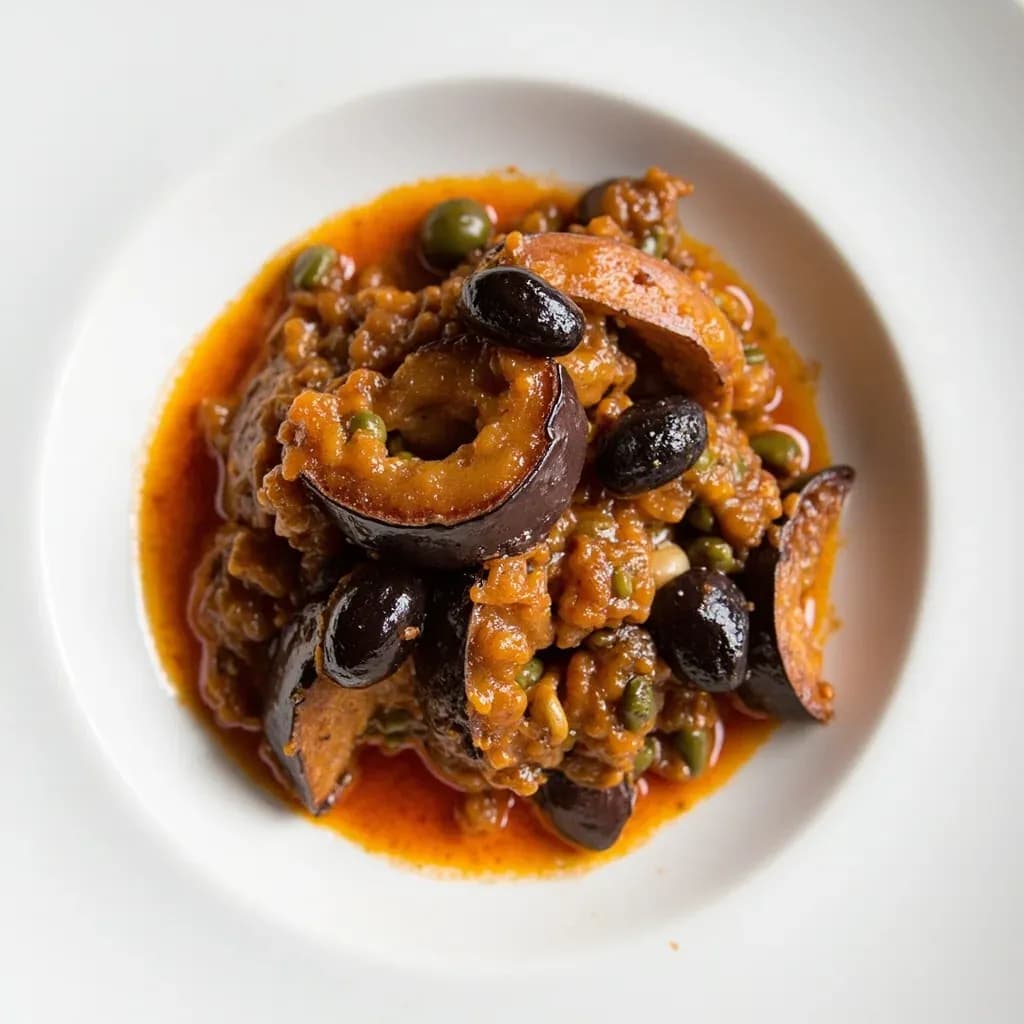
Caponata stewing fries eggplant and aromatics, then simmers them with tomato, celery, capers, olives, vinegar, and sugar to a soft, jammy agrodolce relish. The balance of sweet and sour is the signature, deepened by gentle cooking and resting. It's served at room temperature and improves after a day as the flavors meld.
Caponata is less a single dish than a Sicilian stewing method built around a sweet-and-sour sauce called agrodolce. The technique braises pre-fried eggplant with a gently cooked soffritto of onion and celery, a small measure of concentrated tomato, briny capers and green olives, and a sharply sweet-sour reduction of wine vinegar and sugar added near the end. The result is a glossy, jammy vegetable stew that reads simultaneously savory, sweet, sour, and salty — a balance that comes from layering, not from any single ingredient.
What makes the technique distinctive is how it handles eggplant, which would otherwise dissolve into a greasy sponge if stewed from raw. The cubes are salted, drained, and fried first so the flesh sets up with a golden crust; only then do they meet the acid and the moisture of the braise, where they absorb the agrodolce without collapsing. The vinegar-sugar reduction is built separately and added late, because vinegar cooked too long turns harsh and flat, while sugar added too early loses its sweetening lift. Rest is the final, non-negotiable step: hours in the refrigerator let the briny, sweet, and acidic notes stop shouting and start agreeing.
Although this entry sits under "Water & Steam," caponata is in practice a moist-heat braise finished by an acidic-sweet reduction, with frying as a preparatory step rather than a finishing one. The technique is forgiving but multi-component, and it is designed to be made ahead — the dish on day two is meaningfully better than the dish on day one. Treat the canonical Palermo version as a template; Sicilian cooks vary it freely by town, season, and pantry, and so should you.
- Difficulty
- Medium
Types & varieties
The canonical Palermo version: fried eggplant, celery, onion, tomato, capers, green olives, finished with agrodolce.
Eastern Sicilian variation from Catania, commonly built around potatoes alongside the eggplant.
Western Sicilian version, often enriched with toasted almonds and sometimes raisins.
Household-style add-ins that lend sweetness and texture; widespread in family recipes across the island.
Spring and summer versions that swap or add vegetables depending on the market; artichoke-forward versions are a seasonal specialty in spring.
How to do it
- 1
Prep and drain the eggplant
Cut 1–1.2 kg eggplant into 2 cm cubes. Toss generously with coarse salt and pile into a colander weighted with a plate; let drain 30–60 minutes. Pat the cubes thoroughly dry with a clean towel before frying.
- 2
Prep the soffritto and briny ingredients
Dice 1 large onion. Trim and dice 4–5 celery stalks (reserve the leaves for garnish); if the celery is fibrous, soak in cold water 15 minutes, then drain. Have ready 2 tbsp capers (rinsed if salt-packed) and about 100 g pitted green olives, left whole or roughly chopped.
- 3
Fry the eggplant
Heat about 1 cm of olive oil in a wide pan to roughly 170°C/340°F. Fry the eggplant in batches, turning, until deeply golden on all sides, 3–4 minutes per batch. Drain on paper towels and reserve about 4 tablespoons of the frying oil.
- 4
Sweat the aromatics
In a wide sauté or braising pan, heat the reserved frying oil over medium-low. Cook the onion with a pinch of salt until translucent and sweet, 8–10 minutes. Add the celery and cook another 6–8 minutes until tender and aromatic.
- 5
Bloom the tomato
Stir in 2 tbsp tomato paste and cook 1–2 minutes until it turns brick-red and smells fragrant. If using pine nuts and/or raisins, add 2 tbsp of each with the paste so they soften in the oil.
- 6
Build the agrodolce
In a small saucepan, combine 120 ml red wine vinegar with 1–2 tbsp sugar and a small splash of water. Bring to a simmer, stirring, just until the sugar dissolves. Taste: it should be sharply sweet-sour, more aggressive than the finished dish should be.
- 7
Combine and stew
Add the fried eggplant, capers, and olives to the pan of aromatics. Pour the hot agrodolce over everything and stir gently. Simmer uncovered 15–20 minutes so the eggplant drinks the sauce without going mushy. Season with black pepper; salt only after tasting, since the capers and olives contribute significant salinity.
- 8
Rest and serve
Cool to room temperature, then refrigerate at least 4 hours, ideally overnight. Serve at room temperature, scattered with the reserved celery leaves, with crusty bread or as a contorno to grilled fish.
Understanding the Agrodolce
Agrodolce is the engine of caponata, and the entire method is organized around protecting its brightness. The reduction is built in a separate small pot — vinegar, sugar, and sometimes a splash of water simmered only until the sugar dissolves — and added to the vegetables near the end of cooking. When the reduction is hot, it should taste noticeably sharper and sweeter than you want the finished dish to be; the eggplant, olives, and capers will mellow it considerably. If you add the vinegar early, it boils off and the dish ends up bland; if you cook the sugar too long with the vegetables, it can jam up the sauce and tip the balance toward a relish. White wine vinegar gives a cleaner, sharper profile; red wine vinegar adds color and a rounder acidity. A spoon of honey can stand in for sugar for a more floral sweetness, but granulated or light brown sugar is the traditional choice.
- Build the agrodolce separately — vinegar plus sugar simmered just to dissolve — and taste it before adding.
- Expect the reduction to taste sharper and sweeter than the final dish; the eggplant and briny ingredients will soften it.
- Red wine vinegar gives depth and color; white wine vinegar gives a brighter, more aggressive acid.
- Add the reduction in the last 10–15 minutes of simmering so the vinegar stays lively rather than cooking flat.
Why the Eggplant Is Fried First
Eggplant is roughly a sponge of water and air held together by a delicate cell wall. Stew it raw in an acidic liquid and the wall collapses, the flesh drinks the sauce, and you end up with oily mush. Salting and draining the cubes for 30–60 minutes pulls out bitter liquid and lets the cells firm up slightly; frying in a shallow pool of olive oil at around 170°C/340°F then sets the exterior in a golden crust. That crust is what lets the cubes hold their shape through the final simmer, when they can absorb the agrodolce without disintegrating. The reserved frying oil — not fresh oil — is then used to sweat the soffritto, carrying flavor forward. If you'd rather skip the fry, a hot oven roast on an oiled sheet pan at 230°C/450°F until deeply browned is a serviceable substitute, though it gives a slightly drier, chewier result than the traditional method.
- Salt and drain the cubed eggplant for 30–60 minutes to pull out bitter moisture and reduce oil uptake.
- Fry at about 170°C/340°F in batches until deeply golden, not pale; the crust is what holds the cubes together.
- Reserve 3–4 tablespoons of the frying oil to cook the soffritto — it carries the eggplant's flavor forward.
- A high-heat oven roast is the best non-fried substitute; steaming or stewing the eggplant raw is not recommended.
Common uses
Tips & pitfalls
- Salt the cubed eggplant generously and let it drain 30–60 minutes; this draws out bitterness and meaningfully reduces oil absorption during frying.
- Fry the eggplant separately in olive oil until deeply golden — do not stew it raw, or it will turn spongy and greasy.
- Build the agrodolce in a small pot (vinegar plus sugar, sometimes a splash of water) and taste it before adding; it should be noticeably sharp-sweet, because the vegetables and briny ingredients will mellow it.
- Add the agrodolce near the end of cooking. Vinegar added too early or cooked too long turns harsh and can leave the dish paradoxically flat.
- Use brined or salt-packed capers (rinsed) and brined green olives — their salinity is part of the seasoning; taste before adding extra salt at the end.
- Cool the caponata completely and refrigerate overnight before serving; the sweet-sour-briny balance genuinely rounds out on rest, and the dish is meant to be made ahead.
- Common mistake: drowning the vegetables in tomato. Tomato is a supporting flavor — often just a spoon or two of paste bloomed in oil — not a long-simmered tomato sauce.
- Common mistake: skipping the celery. Its bitter-green herbal note is essential to cut the sweetness and richness of the eggplant; without it, the dish tilts heavy and cloying.
Good to know
- Origin
- Sicily, Italy, with roots in Palermo; the agrodolce profile reflects Arab culinary influence on the island.
- Defining flavor profile
- Agrodolce — a balanced sweet (sugar) and sour (red wine vinegar) sauce, sharpened by brined capers and olives.
- Core ingredients
- Eggplant, celery, onion, tomato (paste or a small amount of fresh), capers, green olives, olive oil, red wine vinegar, sugar.
- Serving temperature
- Traditionally served at room temperature, ideally after resting overnight in the refrigerator.
- Course
- Antipasto, contorno (vegetable side), or condiment; also used as a pasta sauce or bruschetta topping.
- Active time
- Roughly 45–60 minutes of hands-on work, plus 30–60 minutes of eggplant draining and a 15–20 minute final simmer.
- Make-ahead behavior
- Excellent — designed to be made ahead. Flavor deepens noticeably after 12–24 hours of refrigeration.
- Difficulty
- Moderate — multi-component, but forgiving; flavors improve on day two.
Also called
agrodolce stewing
Related

Boil
Cook in vigorously bubbling liquid at full rolling heat

Simmer
Hold liquid at a gentle shimmer for tender, unhurried cooking

Poach
Cook gently in barely-trembling liquid for silky, tender results

Steam
Cook in rising vapor to keep color, nutrients, and shape intact

Blanch
Plunge briefly in boiling water, then shock cold to lock color

Braise
Sear, then cook slow in a little liquid until fall-apart tender

Stew
Simmer bite-sized pieces fully submerged into a rich, unified pot

Sous-Vide
Seal and cook in precise warm water for edge-to-edge doneness