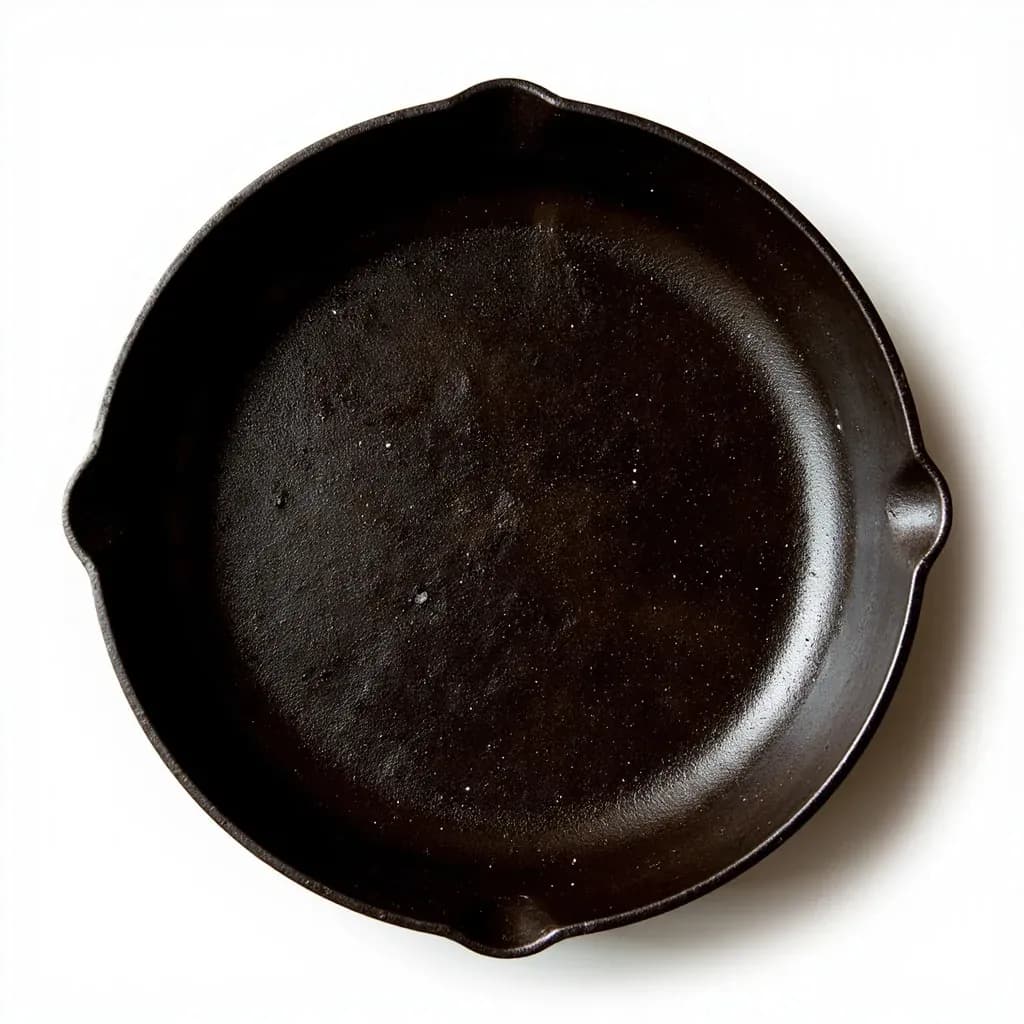
Heat & Fire
Cast-Iron Seasoning
Baking thin layers of oil onto cast iron to build a slick, rust-proof nonstick patina.
Seasoning cast iron coats the pan with a thin film of oil and heats it past the oil's smoke point so it polymerizes into a hard, bonded layer. Repeated rounds build a naturally nonstick, corrosion-resistant patina that protects the bare iron and improves with use. The same process maintains griddles and carbon-steel pans, and a well-seasoned surface should be kept dry and lightly oiled.
Cast-iron seasoning is the thin, dark patina that forms when oil is baked onto bare iron and chemically transforms from a liquid fat into a solid polymer fused to the metal. It is not a coating in the paint sense, nor a layer of burnt-on food — it is a hard, hydrophobic film of cross-linked fat molecules bonded to the iron's surface, a thermoset layer cured in place by dry heat. That polymer film is what gives a well-kept skillet its glassy black finish, its release, and its resistance to rust.
The seasoning matters because bare cast iron is porous and reactive: it rusts in hours when wet, and food glues to it on contact. A built-up patina solves both problems at once, and unlike a synthetic nonstick coating, it can be repaired, deepened, and stripped back to bare metal and rebuilt whenever a cook wants to start over. The film survives scrubbing, high heat, and decades of use; it thickens with every meal, and it seasons further every time you cook something fatty in the pan.
In practice, a properly seasoned pan looks dull and almost dry at every stage of the process — never glossy, never tacky. The single most important habit is applying less oil than you think you need, because any wet oil left on the surface will polymerize into a sticky, uneven residue rather than a slick film.
- Difficulty
- Easy
Types & varieties
Produces a hard, dark, near-lacquered patina; popularized by Sheryl Canter's 2007 'Science of Cast Iron Seasoning' essay. Unrefined flax has a low smoke point (~225°F), so thin coats and careful heat are essential.
Long the default American choice — neutral, easy to spread thinly, and forgiving of small over-applications.
The traditional 19th- and early-20th-century method on Griswold, Wagner, and Lodge pans; builds a soft luster and is still favored by many collectors.
Common modern choice with high smoke points and neutral flavor.
Very high smoke point (~520°F refined); a popular alternative among enthusiasts for fast, even polymerization.
How to do it
- 1
Strip and clean if needed
New factory pans need only a quick rinse and towel dry. Rusted or gummy old pans should be scrubbed with steel wool and hot water, run through a self-cleaning oven cycle, or soaked in a lye bath until seasoning is gone and bare gray iron is exposed.
- 2
Dry the pan completely
Towel dry, then set on a burner over low heat for a minute or two until all moisture has evaporated. Any water left will flash to steam under oil and cause splotchy seasoning.
- 3
Apply a thin coat of oil
Place about a teaspoon of chosen oil (shortening, lard, flaxseed, canola, or avocado) on the warm surface. With a folded paper towel or lint-free cloth, rub a film across the cooking face, walls, handle, and underside.
- 4
Wipe off the excess
With a fresh, dry paper towel, buff the entire pan until it appears almost dry to the eye. The pan should look dull, not glossy. Any visible wet oil will polymerize into a sticky residue.
- 5
Bake upside down
Preheat the oven to 450–500°F (230–260°C). Set the pan upside down on the middle rack with a foil-lined sheet pan on the rack below. Bake for 1 hour.
- 6
Cool in the oven
Turn the oven off and leave the pan inside until fully cooled. Slow cooling helps the polymerized layer cure evenly and reduces flaking risk.
- 7
Repeat three to six times
Re-oil, wipe, bake, and cool 3 to 6 times for a deep base coat. Three coats is functional; five or six gives the glassy black finish prized by collectors.
- 8
Maintain the patina
After each cook, rinse with hot water, scrape clean, dry on the burner, and wipe a barely-there film of oil onto the warm surface. Re-bake the pan if food begins to stick or gray spots appear.
What seasoning actually is
The black film on a well-used cast-iron pan is not carbonized food and not a layer of grease — it is a polymer. When a thin film of drying oil is heated past its smoke point in the presence of iron, the unsaturated fatty acids cross-link with each other and with the metal surface, forming a hard, cross-linked polymer layer that is chemically bonded to the iron rather than merely sitting on top of it. This is why the patina survives scrubbing, soap, and decades of cooking, and why a fully stripped pan is a dull, silvery gray instead of black. The layer is also hydrophobic: water beads on a properly seasoned pan rather than wetting the iron, which is the mechanism behind its rust resistance.
Reading your patina
A healthy seasoning is uniformly dark, smooth, and dull. Several warning signs tell you it needs attention:
- Gray or silvery patches — the iron is showing through; the pan needs another coat or a session of fatty cooking.
- Sticky or tacky surface at room temperature — the last coat was over-oiled; scrub with hot water and a stiff brush, then re-bake a thin coat.
- Flaking or peeling — the polymer layer was too thick or applied over a dirty surface; strip back to bare iron and start over.
- A rainbow or blue-purple sheen on the cooking face — this is a sign of very high heat with a fresh coat of oil; usually cosmetic and will darken with subsequent use.
- Persistent rust spots — surface rust scrubs off with steel wool and the pan is re-seasoned; deep pitting may warrant a full strip and re-build.
Beyond the skillet
The same technique applies to any bare carbon-steel or cast-iron cookware. Carbon-steel woks, crepe pans, and omelette pans benefit from a thinner, faster seasoning schedule (often 2–3 coats is enough) and are typically re-seasoned on the stovetop at high heat. Comals, griddles, and Dutch ovens take the same oven method, though lids and knobs should be seasoned separately to avoid pooling oil in crevices.
Common uses
Tips & pitfalls
- Apply the thinnest possible coat — wipe until the surface looks almost dry, then buff once more with a fresh paper towel. This single step decides success or stickiness.
- Place the pan upside down on the middle oven rack over a foil-lined sheet pan so oil cannot pool in the cooking surface.
- Build seasoning in many thin coats rather than one thick coat; thick oil carbonizes into a tacky, uneven film.
- If a freshly baked coat comes out sticky, rub it down with a barely oiled paper towel and re-bake at 500°F for 30 minutes.
- Avoid soaking; rinse hot, scrub with a chain-mail or stiff-bristle brush, dry immediately on a warm burner, and wipe a micro-thin oil film while still warm.
- Modern dish soap in small doses will not strip a well-polymerized patina — only prolonged soaks or harsh detergents will.
- Cook fatty foods (bacon, sausage, fried chicken) in a new pan to accelerate seasoning through everyday cooking.
- Surface rust is recoverable: scrub with steel wool, rinse, dry, and re-season. Deep rust or pitting may warrant a full strip.
Good to know
- Process type
- Thermal polymerization of oil bonded to bare iron
- Oven temperature
- 450–500°F (230–260°C)
- Baking time per coat
- About 1 hour, followed by oven cooling
- Initial coats recommended
- 3–6 thin layers for a deep base
- Surface effect
- Hydrophobic, semi-nonstick polymer film fused to the iron
- Origin
- Used since the 18th–19th centuries in Europe and America; iron cookware itself dates to Han Dynasty China (c. 5th century)
- Notable manufacturer
- Lodge Manufacturing Company (founded 1896, South Pittsburg, Tennessee)
- Modern factory state
- Most new cast iron ships pre-seasoned with a vegetable-oil bake
Also called
Seasoning Cast Iron · Seasoning the Griddle
Related

Sear
Blast the surface hot for a deep-browned, savory crust

Sauté
Cook quickly in a little fat over lively heat, tossing as you go

Stir-Fry
Toss bite-sized pieces over roaring heat for fast, smoky cooking

Pan-Fry
Crisp food in a shallow layer of hot fat, turning once or twice

Deep-Fry
Submerge in hot oil for an all-over crackling crust

Roast
Cook uncovered in dry oven heat for browned edges and tender centers

Bake
Cook with steady, surrounding oven heat — the soul of bread and pastry

Broil
Hit food from directly above with fierce overhead heat