Heat & Fire
Charring Vegetables (Köz)
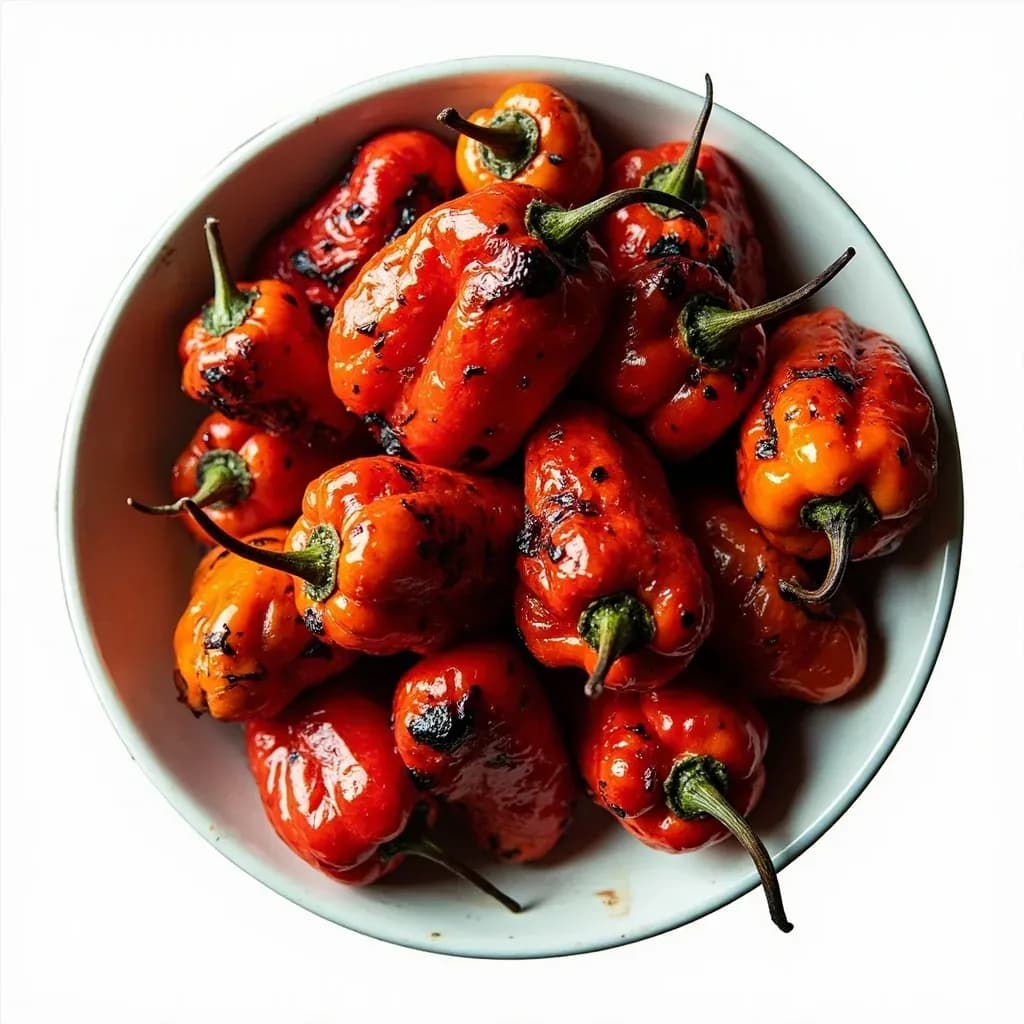
Blackening vegetables over fire or coals for smoky, tender flesh, as in Turkish köz.
Charring vegetables scorches peppers, eggplant, onions, or tomatoes directly over flame, coals, or ashes until the skins blacken and the flesh softens and turns smoky. The Turkish köz style and Catalan calçotada and escalivada all rely on this fire-roasting to build deep flavor before the burnt skins are peeled away. Cooking in embers or hot ashes gives an especially intense, earthy smokiness.
Köz (literally "ember" in Turkish) is the art of blackening vegetables on glowing hardwood coals until the skin crackles into carbon and the flesh beneath collapses into a soft, smoky pulp. It is not grilling over flame — the vegetables sit directly on or just above a bed of uniform, ashen embers at roughly 500–700°F, where radiant heat chars the surface and conducts inward at the same time, cooking the interior to a custardy texture in minutes.
The technique defines a whole family of Turkish and Levantine dishes — babaganoush, muhammara, imam bayıldı, acılı ezme — because it produces something no oven or pan can match: a layer of bitter char wrapped around sweet, smoke-infused flesh, with oils that carry that flavor into whatever the vegetable is dressed with. A gas burner or broiler can imitate the surface blackening but cannot replicate the depth of wood smoke drawn into the flesh through direct contact with embers.
It is also a remarkably forgiving technique. The vegetables that char best — eggplant, peppers, tomatoes, onions, garlic, corn — all have high water and sugar content, which buffers them from burning through while the skin carbonizes. Skill lives mostly in fuel choice, turning frequency, and a brief steam-rest that lets the blackened skin slip away in clean sheets.
- Difficulty
- Easy
Types & varieties
Charred globe or long purple eggplant; the most iconic use, base for babaganoush, imam bayıldı, and patlıcan salatası.
Charred red bell peppers (Turkish kapya); sweet, smoky, foundational to salads and muhammara.
Charred long green Turkish peppers; mildly hot, used in acılı ezme and as a meze.
Charred vine or Roma tomatoes; pulp folds into menemen, shakshuka, and çoban salatası.
Charred whole onions; sweet, jammy layers used in kebab shops and on lahmacun.
Charred whole heads or cloves; turns soft and spreadable, eaten on flatbread or stirred into soups.
Charred corn in the husk; husks shield kernels while smoke seasons them.
How to do it
- 1
Build the ember bed
Light hardwood logs or lump charcoal in a mangal or kettle grill and let it burn down until you have a uniform layer of glowing embers covered in light gray ash, with no active flames licking up. This is the literal köz.
- 2
Prepare the vegetables
Choose firm, unblemished specimens. Leave stems on peppers and tomatoes. For eggplant, pierce the skin 6–8 times with a skewer so steam can vent. Leave onions, garlic heads, and corn in their outer layers for protection.
- 3
Lay vegetables on or over the embers
Set eggplants, peppers, tomatoes, and onions directly on the coals. Place more delicate items — garlic heads, corn in the husk, leeks, mushrooms — on a grate 4–6 inches above the embers to avoid direct ash contact.
- 4
Turn frequently for even char
Rotate each piece every 2–3 minutes with long tongs. Expect eggplants 8–12 minutes total, peppers 6–10, tomatoes 5–8, whole onions 15–25, and whole garlic heads 20–30.
- 5
Judge doneness by feel, not color
The skin should be uniformly blackened and cracked. Press gently: a properly cooked eggplant yields like a ripe avocado; peppers collapse and the skin wrinkles; tomatoes slump and the bottom feels fluid.
- 6
Steam-rest in a covered bowl
Move vegetables to a heatproof bowl, cover tightly with a plate or plastic wrap, and rest 10–15 minutes. The steam condenses under the skin and separates it from the flesh.
- 7
Peel and deseed
Pull the blackened skin away with your fingers or the back of a small knife; do not rinse. Split peppers and tomatoes lengthwise and scrape out seeds if a smoother texture is wanted. Tear eggplant flesh into shreds rather than chopping.
- 8
Season and use immediately
Dress with olive oil, lemon juice or pomegranate molasses, salt, and any herbs or chili the dish calls for. Hold briefly at room temperature — chilling dulls the smoky aroma.
Why embers, not flame
The whole flavor logic of köz depends on what is happening underneath the vegetable, not above it. Glowing embers radiate heat in every direction at once, so the skin blackens while heat conducts directly into the resting surface, cooking the flesh evenly from below. Open flame licks unevenly and tends to scorch one side long before the rest of the vegetable has begun to soften. That is why a properly built mangal is allowed to burn down until only a flat carpet of ashen coals remains — anything less is closer to broiling than to közleme.
- A deep, gray ash layer over the coals signals the right temperature; flames still visible mean the fire is too young.
- Smaller embers with high air flow can run hotter than a packed bed; spread the coals to control the heat.
- Wood choice colors the final dish — grapevine (asma) gives a sharp, almost wine-like smoke; oak is neutral and sweet; olive prunings lend a fruitier, greener note favored in Aegean villages.
- In Turkish kebab shops, the same embers used for vegetables later brew the daily çay — both rely on radiant heat rather than flame.
Common uses
Tips & pitfalls
- Wait for flames to die down to a deep, ashy glow before adding vegetables; open flame scorches the skin before the flesh has begun to cook.
- Prick eggplants a few times with a skewer before placing them on the coals — trapped steam can otherwise split the fruit and lose moisture.
- Transfer the hot vegetables straight into a bowl and seal with plastic wrap or a plate for at least 10 minutes; the trapped steam is what lets the skin slip off in sheets.
- Do not rinse the peeled flesh under water — you wash away the smoky oils. Brush or scrape the char off with a paper towel instead.
- Salt the peeled eggplant liberally and let it drain 15–20 minutes if the dish needs a tighter, less watery texture (imam bayıldı, karnıyarık).
- For an indoor method, char whole peppers and tomatoes directly over a gas burner flame on a fork, or run them under a broiler set to high on the top rack with the door ajar.
- Save the blackened skins and any collected juices; simmer them in water for 20 minutes, strain, and use the liquid as a smoky broth for rice or beans.
- Use ripe, in-season produce whenever possible — high sugar content chars faster, tastes sweeter, and yields more of the smoky oils that define the technique.
Good to know
- Origin
- Anatolia, the Caucasus, and the broader Eastern Mediterranean; the word köz (Turkish for 'ember' or 'live coal') also names the technique.
- Also called
- Közleme, közleme sebze, ember-roasting, char-grilling.
- Fuel
- Hardwood embers or quality lump charcoal; softwoods and briquettes are avoided because they impart resinous or chemical off-flavors.
- Ideal temperature
- Glowing embers around 500–700°F (260–370°C) — hot enough to blister skin within 2–4 minutes per side.
- Doneness cue
- Skin fully blackened and blistered; flesh collapses under gentle thumb pressure and feels custardy at the core.
- Rest time
- 10–15 minutes covered, to loosen skin and finish cooking flesh in trapped steam.
- Yield from eggplant
- 1 medium globe eggplant (~300 g) yields roughly 180–200 g of peeled flesh after charring.
- Storage
- Peeled flesh keeps 3 days refrigerated under a thin film of olive oil; freezes well for 2–3 months.
Also called
Köz · Calçotada Charring · Escalivada · Roasting in Ashes
Dishes that rely on it
Related

Sear
Blast the surface hot for a deep-browned, savory crust

Sauté
Cook quickly in a little fat over lively heat, tossing as you go

Stir-Fry
Toss bite-sized pieces over roaring heat for fast, smoky cooking

Pan-Fry
Crisp food in a shallow layer of hot fat, turning once or twice

Deep-Fry
Submerge in hot oil for an all-over crackling crust

Roast
Cook uncovered in dry oven heat for browned edges and tender centers

Bake
Cook with steady, surrounding oven heat — the soul of bread and pastry

Broil
Hit food from directly above with fierce overhead heat